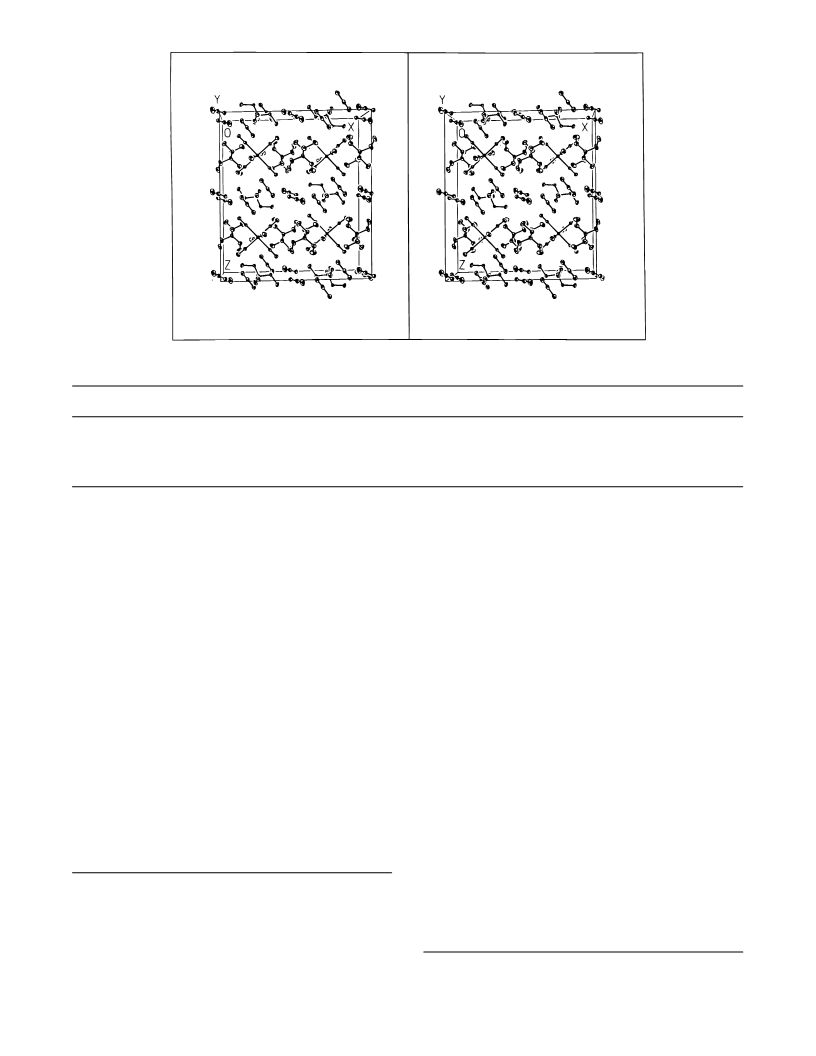
III
Synthesis of [NEt4]3[Ti (CN)6]‚4MeCN
J. Am. Chem. Soc., Vol. 119, No. 27, 1997 6257
the signal at g ) 1.971 broadens slightly (peak-to-peak line
width ) 55 G) but otherwise remains unchanged. In addition,
however, two smaller resonances grow in: one near g ) 1.897
becomes apparent at temperatures below 250 K, and a second
near g ) 1.779 becomes apparent at temperatures below 100
K. At 3.2 K, these two resonances appear at g ) 1.901 (line
width ) 70 G) and 1.778 (line width ) 140 G). These
resonances are tentatively ascribed to an axially-distorted
standard procedure of washing the solid with diethyl ether dissolves
the crude product.14 The infrared spectrum of the recrystallized triflate
salt contains a noticeable OH stretch; this is most likely due to the
presence of traces of water or triflic acid in the recrystallized product.
III
4 3 6
Tetraethylammonium Hexacyanotitanate(III) [NEt ] [Ti (CN) ]
III
(
1). To a purple solution of Ti (O
in acetonitrile (22 mL) was added a clear solution of NEt
.1 mmol) in acetonitrile (40 mL). A dark brown-black precipitate
3
SCF
3
)
3
(MeCN)
3
(0.70 g, 1.1 mmol)
4
CN (1.42 g,
9
formed immediately. The reaction mixture was warmed to 45 °C for
ca. 10 min (higher temperatures result in decomposition of the product);
at this point the solution was cloudy and orange. The solution was
filtered, concentrated to ca. 50 mL, layered with toluene (2 mL), and
stored at -20 °C. After 24 h, a large crop of clear orange crystals
was isolated. If crystallization does not occur within 24 h, additional
toluene should be layered on top of the clear orange solution and cooling
should be continued. The clear orange crystals were dried in vacuum,
3-
[Ti(CN)6 ] ion. For comparison, Rb3[TiCl6] also gives an axial
EPR spectrum, and the effects of the Jahn-Teller distortion on
4
3
the electronic structure of this ion have been analyzed.
Concluding Remarks. Numerous investigators have sought
to prepare cyanotitanate(III) complexes, but the results until now
have been doubtful, inconclusive, or contradictory. By treating
titanium(III) triflate with tetraethylammonium cyanide in ac-
at which point they desolvated and turned into a yellow powder.
etonitrile, we have obtained the first authentic hexacyanotitanate-
III
Powdered samples of [NEt
4
]
3
[Ti (CN)
6
] (1) are extremely air sensitive
III
(
III) complex [NEt4]3[Ti (CN)6]. The magnetic and spectro-
and rigorous precautions must be taken to avoid exposing the sample
to the atmosphere. Yield: 0.50 g (74%). Mp: 250 °C dec. Anal.
Calcd for C H N Ti: C, 60.6; H, 10.17; N, 21.2; Ti, 8.05. Found:
scopic data clearly are consistent with the presence of a
hexacyanotitanate(III) anion in this salt. Single-crystal X-ray
diffraction studies unequivocally establish the presence of an
30
60
9
-
1
C, 60.2; H, 10.32; N, 20.4; Ti, 7.88. IR (cm ): 2200 (m), 2103 (w),
2093 (w), 2071 (vs), 1400 (vs), 1306 (s), 1272 (m), 1186 (vs), 1175
III
3-
almost undistorted octahedral structure for the [Ti (CN)6
]
(vs), 1080 (m), 1033 (s), 1006 (vs), 792 (vs), 669 (w), 639 (w), 606
anion in the solid state. Our attempts to use this hexacyanoti-
tanate(III) salt as a building block for the construction of
molecular magnets will be reported in due course.
(
m).
Crystallographic Studies.70 Single crystals of [NEt
]
3
[Ti (CN)
III
]‚
4
6
4
MeCN grown from acetonitrile were mounted while still wet with
the mother liquors on glass fibers with Paratone-N oil (Exxon) and
immediately cooled to -75 °C in a cold nitrogen gas stream on the
diffractometer. Standard peak search and indexing procedures gave
rough cell dimensions, and inspection of the diffraction pattern
confirmed the crystal symmetry. Least-squares refinement of 25
reflections yielded the cell dimensions given in Table 1.
Data were collected in one quadrant of reciprocal space ((h, -k,
-l) by using the measurement parameters listed in Table 1. Systematic
absences for hkl (h + k + l * 2n) and h0l (h, l * 2n) were consistent
with space groups Ia and I2/a. The average values of the normalized
structure factors suggested the centric choice I2/a, which was confirmed
by successful refinement of the proposed model. The measured
intensities were reduced to structure factor amplitudes and their esd’s
by correction for background, scan speed, and Lorentz and polarization
effects. While corrections for crystal decay were unnecessary, absorp-
tion corrections were applied, the maximum and minimum transmission
factors being 0.945 and 0.907. Systematically absent reflections were
deleted and symmetry equivalent reflections were averaged to yield
the set of unique data.
Experimental Section
All operations were carried out in vacuum or under argon. Aceto-
nitrile and toluene were was distilled under N
respectively, before use. Distilled water was sparged with argon prior
to use. HO SCF (Lancaster) was distilled in vacuum (bp 20 °C at 1
Torr) to remove colored impurities before use. (NEt )CN was prepared
2 2
from CaH and Na,
3
3
4
69
according to the method of Andreades and Zahnow. Anhydrous TiCl
Cerac) was used as received.
Microanalyses were performed by the University of Illinois Mi-
3
(
croanalytical Laboratory. The IR spectra were recorded as Nujol mulls
between KBr plates on a Perkin-Elmer 1750 FTIR instrument. Far-IR
spectra were recorded as Nujol mulls between CsI plates on a Nicolet
7
50 Magna-IR Spectrometer employing a Solid Substrate beamsplitter
and a DGTS polyethylene detector. Reflectance spectra were recorded
on a Hitachi U-3300 spectrophotometer equipped with an integrating
sphere. Magnetic measurements were carried out with a low-field (1
T) Quantum Design MPMS SQUID magnetometer. The diamagnetic
4 3 6
correction for [NEt ] [Ti(CN) ] was estimated by using Pascal’s
2
6
4,65
-6
3
-1
constants:
were recorded on a Bruker ESP 300 spectrometer.
Tris(acetonitrile)titanium(III) Trifluoromethanesulfonate Ti -
SCF (MeCN) . To TiCl (1.0 g, 6.5 mmol) at -78 °C was added
ø
dia ) -410 × 10 cm mol . The X-band EPR spectra
The structure was solved by using direct methods (SHELXS-86)
and weighted difference Fourier methods. The correct positions for
the Ti atom and the non-hydrogen atoms of one of the tetraethylam-
monium cations were deduced from an E-map. Subsequent least-
squares refinement and difference Fourier calculations revealed the
positions of the remaining non-hydrogen atoms including two inde-
III
(O
3
3
)
3
3
3
trifluoromethanesulfonic acid (2.2 mL, 25 mmol). The dark-purple
reaction mixture was slowly warmed to room temperature and then
heated to 30 °C for 48 h (heating to higher temperatures causes
decomposition). The resulting light blue-white precipitate was
contaminated with a significant amount of unreacted dark-purple TiCl
An additional aliquot of trifluoromethanesulfonic acid (2.0 mL, 23
3
-
pendent solvate molecules. The [Ti(CN)
6
] anion resides on an
+
inversion center, and one of the [NEt
4
] cations (N6A-C68A) is
3
.
disordered about a 2-fold axis. The N-C and C-C distances of the
+
disordered [NEt
4
] cation were restrained to 1.52 and 1.54 Å,
mmol) was added, and the mixture was heated to 30 °C for an additional
respectively, and chemically equivalent 1,3 C‚‚‚C distances were
restrained to be equal with an effective standard deviation of 0.01 Å.
Methyl hydrogen atom positions were optimized by rotation about the
C-C bond with idealized C-H, C‚‚‚H, and H‚‚‚H distances. The
remaining hydrogen atoms were included as fixed idealized contributors
with C-H ) 0.99 Å. Non-hydrogen atoms were refined anisotropi-
cally, while the displacement parameters for hydrogen atoms were set
to 1.2 times Ueq for the adjacent non-hydrogen atom. The relative site
occupancy factor for the disordered acetonitrile positions (C81A-N8A)
converged at 0.819(8). The quantity minimized by the least-squares
2
4 h. The solvent was removed by vacuum distillation at 25 °C, and
the resulting turquoise solid was extracted into acetonitrile (40 mL).
The purple extract was filtered, and the filtrate was concentrated to ca.
7
mL and stored at -20 °C for 12 h to give a sticky dark-purple solid.
This solid was recrystallized from acetonitrile to give analytically pure
material. Yield: 2.43 g (60%). Anal. Calcd for C
Ti: C,
7.48; H, 1.47; N, 6.80; Ti, 7.75. Found: C, 17.42; H, 1.45; N, 7.16;
9
9 3 9 9
H N F O
1
-
1
Ti, 7.68. IR (cm ): 3235 (s), 2322 (vs), 2293 (vs), 1653 (m), 1356
(
(
vs), 1239 (vs), 1200 (vs), 1156 (vs), 972 (vs), 813 (w), 769 (m), 634
vs), 605 (vs), 570 (w), 534 (m), 506 (s). The excess triflic acid must
2
2
2
2
2
2
program was Σw(F
o
- F
c
) , where w ) 1/[σ (F
o
) + (0.1429P) +
2
2
be removed from the crude pale-blue product in vacuum since the
0.8085P] with P ) (F
o
+ 2F
c
)/3. The analytical approximations to
the scattering factors were used, and all structure factors were corrected
(68) McGarvey, B. R. In Transition Metal Chemistry; Carlin, R. L., Ed.;
Marcel Decker: New York, 1966; Vol. 3, pp 89-201.
69) Andreades, S.; Zahnow, E. W. J. Am. Chem. Soc. 1969, 91, 4181-
190.
(70) For a description of the crystallographic procedures and programs
employed, see: Jensen, J. A.; Wilson, S. R.; Girolami, G. S. J. Am. Chem.
Soc. 1988, 110, 4977-4982.
(
4

 Entley, William R.