INVESTIGATION OF LEAD THIOSULFATE PHOTOLYSIS IN AQUEOUS SOLUTIONS
41
Table 2. Bond lengths (
tures, which change during photolysis, as calculated by the
semiempirical PM3 method
d) of the suggested PbS O strucꢀ ing a strong bond between the lead and sulfur atoms
2 3
after the dissociation of the S–S bond in the thiosulꢀ
fate group, since the conditions for the formation of
the strong Pb–S bond are less favorable in the solid
state because of the rigidity of the crystal lattice. The
presence of negatively charged oxygen and sulfur ions
d
, Å
d
, Å
d, Å
Bond
in structure I in structure II in structure III
in crystalline PbS O3 creates a field that prevents the
lead and sulfur atoms from approaching one another,
thereby ultimately resulting in enhancement of the
2
Pb–S
2.839
2.098
1.619
1.484
1.465
2.146
2.304
2.862
1.495
1.464
1.482
–
2.243
5.897
1.415
1.431
1.432
–
Pb–O
Pb–O bond and the rupture of the Pb–S bond to give
S–O (1)
S–O (2)
S–O (3)
S–S
0
PbSO3 and
S
, the experimentally proved products [1].
REFERENCES
1
. Egorov, N.B., Eremin, L.P., and Usov, V.F., Izv. Vyssh.
Uchebn. Zaved., Fiz., 2002, no. 11, p. 90.
2
. Egorov, N.B., Eremin, L.P., Usov, V.F., and Lariꢀ
onov, A.M., High Energy Chem., 2007, vol. 41, no. 4,
p. 251.
imply the detachment of the hydrated SO3 group from
the lead atom to give PbS and H SO4.
Thus, proceeding from the general concepts of the
photolysis mechanism, we can assume that the priꢀ
2
3
. Lukashin, A.V., Eliseev, A.A., Zhuravleva, N.G., Verteꢀ
gel, A.A., Tretyakov, Y.D., Lebedev, O.I., and Tendeꢀ
loo, G., Mendeleev Commun., 2004, vol. 14, p. 174.
mary stage of the photolysis of PbS O aqueous soluꢀ
2
3
4. Ichimura, M., Narita, T., and Masui, K., Mater. Sci.
Eng., vol. 96, p. 296.
tions is the excitation and dissociation of the S–S
bond in the thiosulfate group resulting in the formaꢀ
tion of an activated complex, which is hydrolyzed to
5
. Freedman, A.N. and Straughan, B.P., Spectrochim.
Acta, 1971, vol. 27A, p. 1455.
give PbS and H SO4:
2
6. Yatsimirskii, K.B., Zh. Fiz. Khim., 1951, vol. 25, no. 4,
p. 475.
*
PbS O + h
3
ν
PbS O ,
(1)
(2)
2
2
3
7
. Egorov, N.B., Russ. J. Inorg. Chem., 2010, vol. 55,
no. 2, p. 179.
*
PbS O3 + H O
PbS + H SO .
2 4
2
2
8. Maurice, M.J., Anal. Chim. Acta, 1957, vol. 16, p. 574.
The results obtained by the computational methꢀ
ods explain only the formation of the primary photolꢀ
ysis products PbS and H SO . It is obvious that the
9
. Christensen, A.N., Hazell, R.G., Hewat, A.W., and
O’Reilly, K.P.J., Acta Chem. Scand., 1991, vol. 45,
p. 469.
2
4
0
presence of PbSO , PbSO3, and
S in the photolysis
4
10. Lur’e, Yu.Yu., Spravochnik po analiticheskoi khimii
Analytical Chemistry Handbook), Moscow: Khimiya,
1979.
products is due to secondary reactions.
(
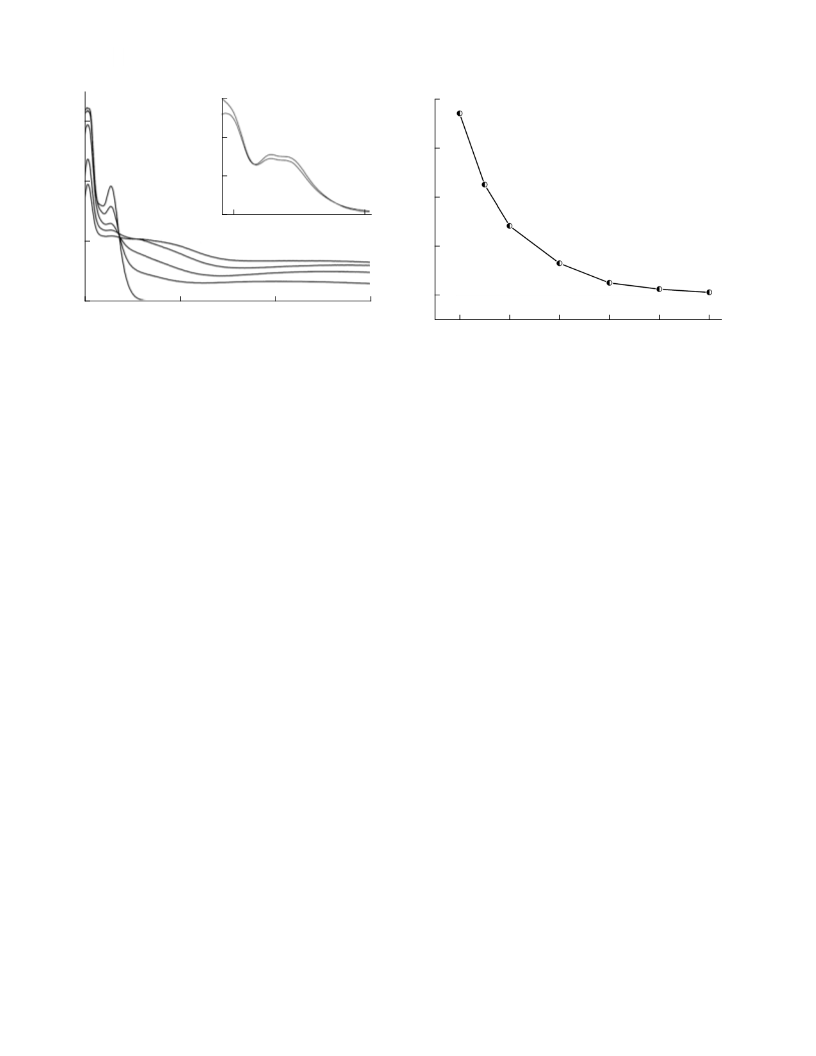
It is known that acidification of Na S O solutions
2
2
3
results in their decomposition with the formation of 11. Kharitonov, Yu.Ya., Knyazeva, N.A., and Goeva, L.V.,
thiosulfuric acid H S O , which is very unstable and
Opt. Spektrosk., 1968, vol. 24, no. 4, p. 639.
12. Lisensky, G.C. and Levy, H.A., Acta Crystallogr. B,
2
2
3
0
can decompose to give
S
and H SO [20].
2
3
+
1978, vol. 34, p. 1975.
With allowanced for the buildup of
H
during the
photolysis in our case (Fig. 2), the following reactions 13. Elerman, Y., Uraz, A.A., and Armagan, N., Acta Crysꢀ
are possible:
tallogr. B, 1978, vol. 34, p. 3330.
1
4. Baggio, S., Pardo, M.I., Baggio, R., and Gonzalez, O.,
PbS O + H SO
2
PbSO + H S O ,
2
(3)
(4)
(5)
3
2
4
4
2
3
Acta Crystallogr. C, 1997, vol. 53, p. 1521.
H S O
2
S + H SO ,
2 3
2
3
15. Aka, Y., Armagan, N., and Uraz, A.A., Z. Kristallogr.
980, vol. 151, p. 61.
,
1
PbS O + H SO
2
PbSO + H S O ,
2
2
3
3
3
2
3
16. Cavalca, L., Mangia, A., Palmieri, C., and Pelizzi, G.,
H SO
2
4
Inorg. Chim. Acta, 1970, vol. 4, p. 299.
7. Ruben, H., Zalkin, A., Faltens, M.O., and Templeꢀ
PbS O
2
PbSO + S,
3
(6)
(7)
3
1
PbS + H SO
2
PbSO + H S.
4 2
4
ton, D.H., Inorg. Chem., 1974, vol. 13, no. 8, p. 1836.
Since the photolysis was run in the presence of air 18. Andersson, J.E. and Bosson, B., Acta Crystallogr. C
oxygen, H2S could be oxidized according the followꢀ
,
1
976, vol. 32, p. 2225.
ing reaction:
19. Christensen, A.N. and Hazell, R.G., Acta Chem.
Scand., 1990, vol. 44, p. 1077.
0
H S + 1/2O
2
S + H O.
2
(8)
2
2
0. Volynskii, N.P., Tiosernaya kislota. Politionaty.
Reaktsiya Vakenrodera (Thiosulfuric Acid. Polythionꢀ
ates. Wackenroder’s Reaction), Moscow: Nauka, 1971.
It is likely that the difference in the photolysis
products between crystalline PbS O and PbS O3
2
3
2
aqueous solutions is due to the impossibility of formꢀ
Translated by L. Brovko
HIGH ENERGY CHEMISTRY
Vol. 48
No. 1
2014

 Egorov