22
I. Oh et al. / Journal of Catalysis 213 (2003) 17–22
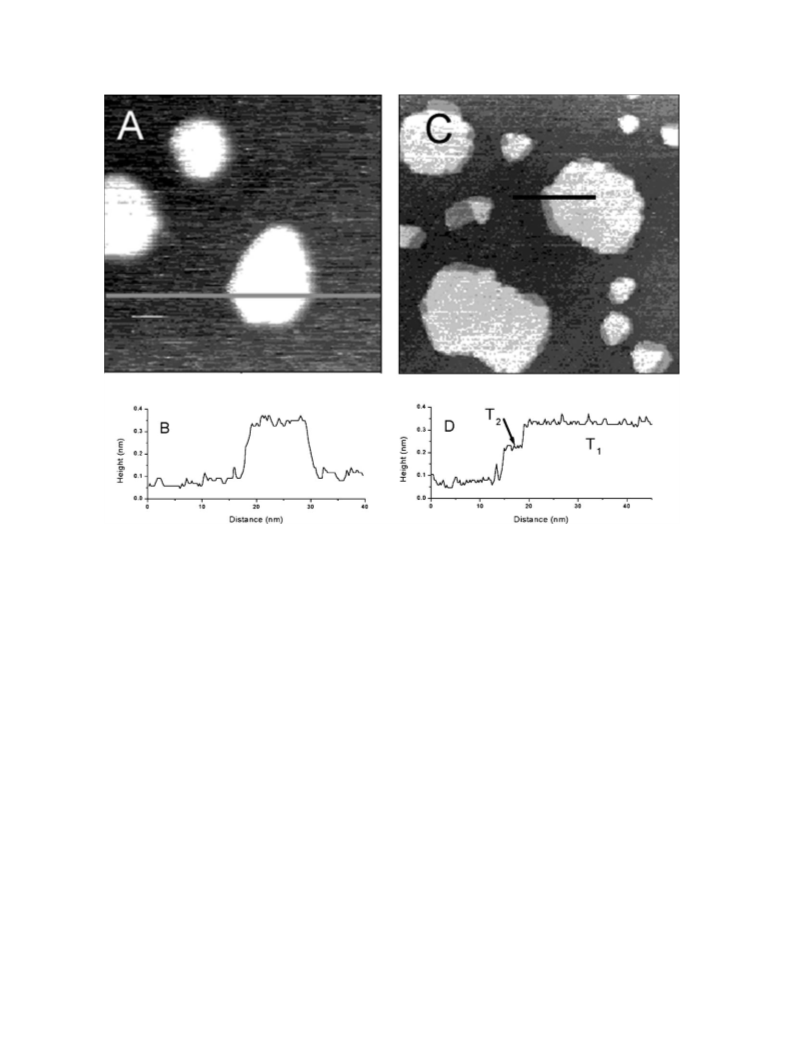
tinct. At very positive potentials, the whole surface becomes
covered with a number of vacancy islands. This observation
indicates that EtSH binds not only at the Pb island edges but
to the whole surface at this positive potential [27].
[2] T.D. Jarvi, E.M. Stuve, in: J. Lipkowski, P.N. Ross (Eds.), Electro-
catalysis, Wiley–VCH, New York, 1998, p. 75.
[3] R. Adzic, in: J. Lipkowski, P.N. Ross (Eds.), Electrocatalysis, Wiley–
VCH, New York, 1998, p. 197.
[4] M.R. Tarasevich, A. Sadkowski, E. Yeager, in: B.E. Conway, J.O.M.
Bockris, E. Yeager, S.U.M. Kahn, R.E. White (Eds.), Oxygen Electro-
chemistry, Plenum, New York, 1983, p. 301.
[5] D.M. Kolb, in: H. Gerischer, C.W. Tobias (Eds.), Advances in
Electrochemistry and Electrochemical Engineering, Wiley, New York,
1978, p. 125.
4. Conclusion
We performed electrochemical and STM measurements
in order to establish a structure–reactivity correlation for
electrocatalytic H2O2 and O2 reduction by Pb upd on
Au(111) in the acid electrochemical environment. At the
potential of maximal catalytic activity, a Pb island structure
is found. Introduction of EtSH at this potential leads to
significant but incomplete inhibition of electroreduction
activity. STM images show that EtSH adsorbs exclusively
on Au at the edge sites of the Pb island at potentials at
which EtSH is expected to reductively desorb from the
Au(111) terrace. These results suggest that the Au atoms
near the Pb islands are positively polarized by the adjacent
Pb atoms and this heterobimetallic assemblage at the edge
site of the Pb island is probably the catalytic site of peroxide
electroreduction activity.
[6] S.M. Sayed, K. Juttner, Electrochim. Acta 28 (1983) 1635.
[7] C.-H. Chen, A.A. Gewirth, J. Am. Chem. Soc. 114 (1992) 5439.
[8] I. Oh, A.A. Gewirth, J. Kwak, Langmuir 17 (2001) 3704.
[9] R.R. Adzic, J.X. Wang, J. Phys. Chem. B 104 (2000) 869.
[10] C.-H. Chen, N. Washburn, A.A. Gewirth, J. Phys. Chem. 97 (1993)
9754.
[11] B.K. Niece, A.A. Gewirth, J. Phys. Chem. B 102 (1998) 818.
[12] M.P. Green, K.J. Hanson, D.A. Scherson, X. Xing, M. Richter, P.N.
Ross, R. Carr, I. Lindau, J. Phys. Chem. 93 (1989) 2181.
[13] M.P. Green, K.J. Hanson, R. Carr, I. Lindau, J. Electrochem. Soc. 137
(1990) 3493.
[14] M.P. Green, K.J. Hanson, Surf. Sci. Lett. 259 (1991) L743.
[15] S.-J. Hsieh, A.A. Gewirth, Surf. Sci. 498 (2002) 147.
[16] H. Angerstein-Kozlowska, B.E. Conway, A. Hamelin, L. Stoicoviciu,
J. Electroanal. Chem. 228 (1987) 429.
[17] T. Will, M. Dietterle, D.M. Kolb, in: A.A. Gewirth, H. Siegenthaler
(Eds.), Nanoscale Probes of the Solid–Liquid Interface, Vol. 228,
Kluwer Academic, Dordrecht, 1995, p. 137.
[18] I. Oh, M.E. Biggin, A.A. Gewirth, Langmuir 16 (2000) 1397.
[19] R.R. Adzic, J.X. Wang, B.M. Ocko, Electrochim. Acta 40 (1995) 83.
[20] K. Kinoshita, in: Electrochemical Oxygen Technology, Wiley–
Interscience, New York, 1992, p. 8.
[21] S. Nakanishi, Y. Mukouyama, K. Karasumi, A. Imanishi, N. Furuya,
Y. Nakato, J. Phys. Chem. B 104 (2000) 4181.
[22] N.J. Tao, J. Pan, Y. Li, P.I. Oden, J.A. DeRose, S.M. Linday, Surf. Sci.
Lett. 271 (1992) L338.
[23] H. Hagenstrom, M.A. Schneeweiss, D.M. Kolb, Langmuir 15 (1999)
2435.
Acknowledgments
This work was supported in part by the Korea Science
and Engineering Foundation through the MICROS center at
KAIST and by the Ministry of Information and Communica-
tion (Grant IMT 2000-B3-2). A.A.G. acknowledges the NSF
(CHE-9820828) for partial support of this research.
[24] G.E. Poirier, E.D. Pylant, Science 272 (1996) 1145.
[25] M. Valden, S. Pak, X. Lai, D.W. Goodman, Catal. Lett. 56 (1998) 7.
[26] G.K. Bethke, H.H. Kung, Appl. Catal. A Gen. 194 (2000) 43.
[27] G.E. Poirier, Chem. Rev. 97 (1997) 1117.
References
[1] S.-G. Sun, in: J. Lipkowski, P.N. Ross (Eds.), Electrocatalysis, Wiley–
VCH, New York, 1998.
[28] K. Tamura, B.M. Ocko, J.X. Wang, R.R. Adzic, J. Phys. Chem. B 106
(2002) 3896.

 Oh, Ilwhan