Reverse Cation-Exchange Route to Hollow PbSeNanospheres
J. Phys. Chem. B, Vol. 110, No. 20, 2006 9789
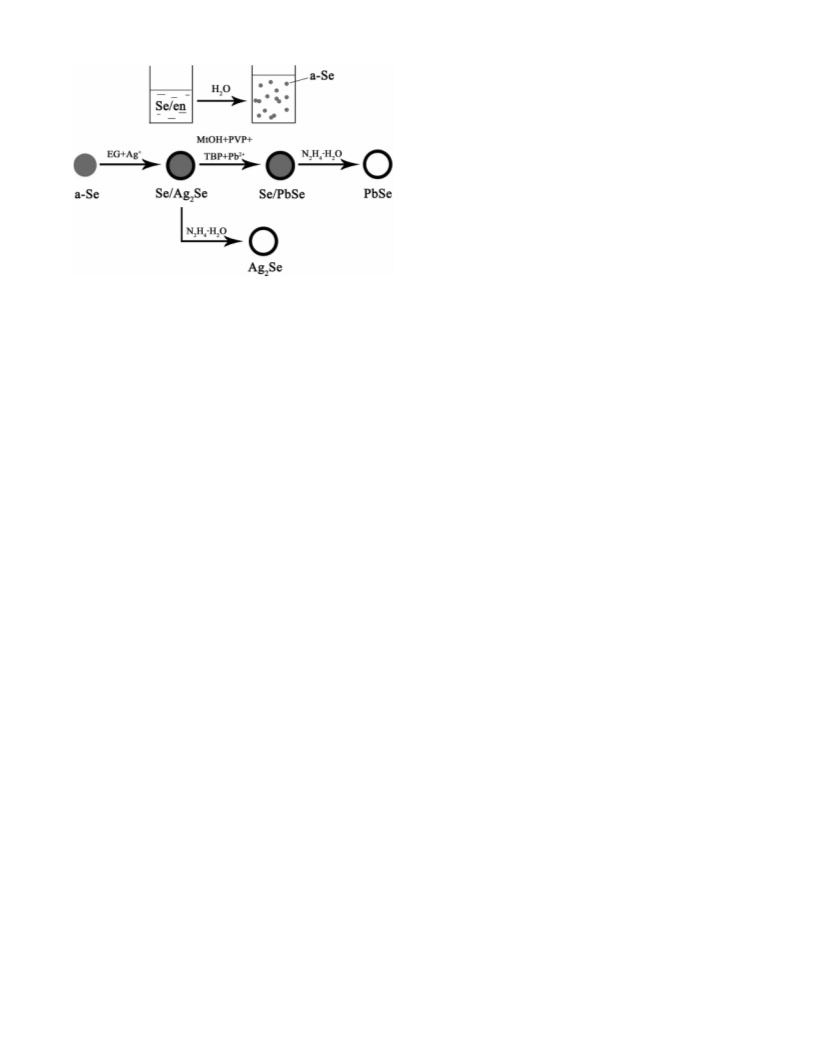
process about the hollow PbSe nanospheres is schematically
illustrated in Figure 6. And it’s worth noting that, to facilitate
the entire conversion from Ag2Se to PbSe, large excess amounts
of Pb2+ is necessary. When the mole ratio of Pb2+ to Ag+ is
adjusted to 10, even after 30 h of reaction, Ag2Se peaks are
also detected in the XRD pattern besides PbSe.
Conclusion
In summary, we have prepared pure hollow PbSe nanospheres
with a cubic structure through a reverse cation-exchange
approach, in which Se/Ag2Se core/shell colloids are used as the
in-situ template. The dimensions of the as-obtained PbSe
spheres, including diameter and thickness, are similar to those
of the initial Ag2Se layer in the template. In view of the
extensive applications of PbSe such as IR and photography, this
conformation is anticipated to enhance the efficiency or
introduce novel functionality. Furthermore, the current work
demonstrates the availability of the reverse cation-exchange
approach in the field of duplicating nanostructures, especially
for some particular morphologies. This strategy is also suggested
to be practicable to other functional selenides or tellurides.
Figure 6. Schematic illustration of the whole evolution process about
the hollow PbSe nanospheres.
materials are indicative of size quantization effects that lead to
a series of discrete states in the conduction and valence
bands.25-27
Within the stepwise evolution process, a-Se colloids are
prepared as the starting template via the chelation of ethylene-
diamine to bulk gray Se. Ethylenediamine could dissolve the
gray Se powder to produce a homogeneous solution based on
the formation of complex polyanions.28-30 However, the high
metastability of the complex ions makes the system labile and
extraordinary sensitive to the environment in the solution. When
the solution is mixed with deionized water, the equilibrium is
destroyed and a large quantity of Se molecules forms. Spherical
a-Se colloids are of preference resulting from the rapid ag-
gregation of the molecules. And the average diameter of the
colloids is determined by the amount of the as-prepared Se
molecules that depends on the initial concentration of Se in the
ethylenediamine solution, as the other experimental parameters
are kept unchanged. Subsequently, these colloids are converted
into the Se/Ag2Se core/shell structures by storing the EG
suspension of a-Se and insufficient Ag+ for the desired time.
EG is a solvent possessing reducibility.31,32 In the dispersion,
the Ag+ cations are reduced by EG to Ag atoms that further
react with a-Se to generate spherical colloids consisting of a-Se
cores and Ag2Se shells as seen in eq 2:
Acknowledgment. Financial support from Chinese Academy
of Sciences and Shanghai Institute of Ceramics under the
program for Recruiting Outstanding Overseas Chinese (Hundred
Talents Program) is gratefully acknowledged.
References and Notes
(1) Matijevic, E. Langmuir 1994, 10, 8.
(2) Jeong, U.; Wang, Y.; Ibisate, M.; Xia, Y. AdV. Funct. Mater. 2005,
15, 1907.
(3) Xia, Y.; Yang, P.; Sun, Y.; Wu, Y.; Mayers, B.; Gates, B.; Yin,
Y.; Kim, F.; Yan, H. AdV. Mater. 2003, 15, 353.
(4) Dhas, N. A.; Suslick, K. S. J. Am. Chem. Soc. 2005, 127, 2368.
(5) Bergbreiter, D. E. Angew. Chem., Int., Ed. 1999, 38, 2870.
(6) Marinakos, S. M.; Anderson, M. F.; Ryan, J. A.; Martin, L. D.;
Feldheim, D. L. J. Phys. Chem. B 2001, 105, 8872.
(7) Oldenburg, S. J.; Averitt, R. D.; Westcott, S. L.; Halas, N. J. Chem.
Phys. Lett. 1998, 288, 243.
(8) Vasquez, Y.; Sra, A. K.; Schaak, R. E. J. Am. Chem. Soc. 2005,
127, 12504.
(9) Jeong, U.; Herricks, T.; Shahar, E.; Xia, Y. J. Am. Chem. Soc. 2005,
127, 1098.
(10) Mulik, R. N.; Rotti, C. B.; More, B. M.; Sutrave, D. S.; Shahane,
G. S.; Garadkar, K. M.; Deshmukh, L. P.; Hankare, P. P. Indian J. Pure
Appl. Phys. 1996, 34, 903.
(11) Zhu, J.; Wang, H.; Xu, S.; Chen, H. Langmuir 2002, 18, 3306.
(12) Murray, C. B.; Sun, S. H.; Gaschler, W.; et al.; IBM J. Res. DeV.
2001, 45, 47.
Ag+ EG8 Ag
9
Se8 Ag2Se
(2)
(13) Wehrenberg, B. L.; Wang, C. Sionnest, P. G. J. Phys. Chem. B
2002, 106, 10634.
(14) Hull, K. L.; Grebinski, J. W.; Kosel, T. H.; Kuno, M. Chem. Mater.
2005, 17, 4416.
(15) Dloczik, L.; Ko¨nenkamp, R. Nano Lett. 2003, 3, 651.
(16) Son, D. H.; Hughes, S. M.; Yin, Y.; Alivisatos, A. P. Science 2004,
306, 1009.
(17) Jeong, U.; Kim, J.; Xia, Y.; Li, Z. Nano Lett. 2005, 5, 937.
(18) Song, J. H.; Messer, B.; Wu, Y.; Kind, H.; Yang, P. J. Am. Chem.
Soc. 2001, 123, 9714.
(19) Gates, B.; Yin, Y.; Xia, Y. J. Am. Chem. Soc. 2000, 122, 12582.
(20) Watillon, A.; Dauchot, J. J. Colloid Interface Sci. 1967, 27, 507.
(21) Zingaro, R. A.; Cooper, W. C. Selenium 1974, Van Nostrand
Reinhold: New York.
(22) Luca, V.; Djajanti, S.; Howe, R. F. J. Phys. Chem. B 1998, 102,
10650.
(23) Dalven, R.; Gill, R. Phys. ReV. 1967, 159, 645.
(24) Streltov, E. A.; Osipovich, N. P.; Ivashkevich, L. S.; Lyakhov, A.
S.; Sviridov, V. V. Electrochim. Acta 1998, 43, 869.
(25) Pejova, B.; Najdoski, M.; Grozdanov, I.; Dey, S. K. Mater. Lett.
2000, 43, 269.
(26) Gorer, S.; Hodes, G. J. Phys. Chem. 1994, 98, 5338.
(27) Gorer, S.; Yaron, A. A.; Hodes, G. J. Phys. Chem. 1995, 99, 16442.
Low environmental temperature (herein, 3 °C) is favorable for
slowering the reaction so as to ensure Ag2Se layer with relatively
uniform thickness. In the following step, the core/shell colloids
serve as the in-situ template to synthesize hollow PbSe spheres.
The reservation of Se cores is expected to preserve the shell
structure during the conversion from Ag2Se to PbSe. TBP is a
necessary coupling agent in the reverse cation-exchange process.
In the methanolic solution, TBP can bind to Ag+ on the surface
of Ag2Se shells to produce stable complexes in the form of
TBPnAg+ (n ) 2, 3, 4)33,34 that are nearly immune to the Se2-
anions backbone. Once these TBP capped Ag+ cations form,
Pb2+ cations are able to associate with Se2- to generate PbSe
NCs. This reaction will stop until Ag2Se NCs are consumed
up. As a result, the composition of the shell is transformed from
Ag2Se to PbSe. Then, when the sample is immersed into
hydrazine, the hydrazine penetrates the polycrystalline PbSe
shell and dissolves the residual Se core, leading to the
achievement of hollow PbSe nanospheres. The whole evolution

 Zhu, Wei