Welcome to LookChem.com Sign In|Join Free
  • or

Encyclopedia

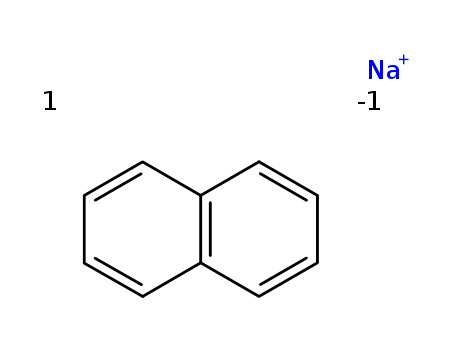
Sodium naphthalenide

Base Information
  • Chemical Name:Sodium naphthalenide
  • CAS No.:3481-12-7
  • Molecular Formula:C10H8*Na
  • Molecular Weight:151.163
  • Hs Code.:
  • European Community (EC) Number:222-460-3
  • DSSTox Substance ID:DTXSID50188347
  • Wikipedia:Sodium_naphthalene
  • Mol file:3481-12-7.mol
Sodium naphthalenide

Synonyms:SODIUM NAPHTHALENIDE;Sodium naphthalide;3481-12-7;sodium;1H-naphthalen-1-ide;EINECS 222-460-3;DTXSID50188347;AKOS006278787

Suppliers and Price of Sodium naphthalenide
Supply Marketing:
Business phase:
The product has achieved commercial mass production*data from LookChem market partment
Manufacturers and distributors:
  • Manufacture/Brand
  • Chemicals and raw materials
  • Packaging
  • price
  • American Custom Chemicals Corporation
  • SODIUM NAPHTHALIDE 95.00%
  • 5MG
  • $ 498.31
Total 14 raw suppliers
Chemical Property of Sodium naphthalenide
Chemical Property:
  • PSA:0.00000 
  • LogP:2.42090 
  • Hydrogen Bond Donor Count:0
  • Hydrogen Bond Acceptor Count:1
  • Rotatable Bond Count:0
  • Exact Mass:150.04454451
  • Heavy Atom Count:11
  • Complexity:170
Purity/Quality:

40% in THF *data from raw suppliers

SODIUM NAPHTHALIDE 95.00% *data from reagent suppliers

Safty Information:
  • Pictogram(s):  
  • Hazard Codes: 
MSDS Files:

SDS file from LookChem

Total 1 MSDS from other Authors

Useful:
  • Canonical SMILES:C1=CC=C2[C-]=CC=CC2=C1.[Na+]
  • General Description Sodium naphthalide (or sodium naphthalenide) is a strong reducing agent with a high reduction potential, commonly used in organic synthesis for cleaving carbon-halogen bonds and removing protecting groups such as O-tosylates from nucleosides. It efficiently deprotects sugar moieties in purine nucleosides by regenerating alcohols from p-toluenesulfonate esters and removes halogen substituents from heterocycles. Additionally, it serves as a single-electron transfer (SET) reagent, selectively reacting with electron-deficient indoles to form indole derivatives, while electron-rich indoles remain unreactive. Its utility extends to nanoparticle synthesis, where it acts as a reductant in stabilizing gold nanoparticles with phosphinine ligands. Overall, sodium naphthalide is a versatile reagent in deprotection, reduction, and electron-transfer reactions.
Technology Process of Sodium naphthalenide

There total 3 articles about Sodium naphthalenide which guide to synthetic route it. The literature collected by LookChem mainly comes from the sharing of users and the free literature resources found by Internet computing technology. We keep the original model of the professional version of literature to make it easier and faster for users to retrieve and use. At the same time, we analyze and calculate the most feasible synthesis route with the highest yield for your reference as below:

synthetic route:
Guidance literature:
With sodium; In tetrahydrofuran; for 24h;
DOI:10.1021/jo00150a003
Guidance literature:
In tetrahydrofuran; Inert atmosphere; Schlenk technique;
DOI:10.1021/ic301675t
Guidance literature:
In tetrahydrofuran; for 3h; Ambient temperature;
upstream raw materials:

naphthalene

sodium

Downstream raw materials:

sodium formate

naphthalene

Isobutane

2,2-dimethyl-propanol-1

Refernces

Efficient removal of sugar O-tosyl groups and heterocycle halogens from purine nucleosides with sodium naphthalenide

10.1016/S0040-4020(97)00313-X

The research study on the efficient removal of sugar O-Tosyl groups and heterocyclic halogens from purine nucleosides using sodium naphthalenide. The purpose of this research was to develop an improved strategy for the synthesis of specific nucleosides by leveraging the high reduction potential of sodium naphthalenide, which is known for its ability to cleave carbon-halogen bonds and regenerate alcohols and amines from p-toluenesulfonate esters and p-toluenesulfonamides. The study concluded that sodium naphthalenide could effectively remove 2'-, 3'-, and 5'-O-tosyl groups from the sugar moiety of nucleosides, making p-toluenesulfonyl a viable protecting group. Additionally, it demonstrated the reductive cleavage of bromo or chloro groups from the 2-, 6-, or 8-position of purine nucleosides. Key chemicals used in the process included sodium naphthalenide, p-toluenesulfonate esters, p-toluenesulfonamides, and various purine nucleosides such as adenosine and its derivatives.

Solid-state 31P NMR characterisation of phosphinine-stabilised gold nanoparticles and a phosphinine-gold complex

10.1039/c000695e

The research aimed to investigate the binding modes of phosphinine ligands on gold nanoparticles using solid-state 31P NMR spectroscopy. The study found that phosphinine ligands, which are used to stabilize gold nanoparticles during synthesis, react partially and form a mixture of intact phosphinine units and other surface-bound species. The intact phosphinines prefer h1(P)-coordination to a single gold atom, and the ligands are not mobile, as evidenced by the coupling with 197Au nuclei. The fraction of intact phosphinines decreases with less steric protection, but the product distribution does not simply correlate with substituent patterns. The key chemicals used in the research include phosphinine ligands (1, 2, and 3 with different substituent patterns), gold salts such as [(thp)AuCl] (thp = tetrahydrothiophene), and sodium naphthalenide for the reduction process. The findings suggest that the superior stabilization of nanoparticles by phosphinines without bulky a-substituents is due to tighter binding and higher yields of strongly donating phosphine-type products.

Effect of sodium naphthalenide, a key set reagent, on 3-substituted indoles

10.3987/COM-04-10142

The research investigates the effects of sodium naphthalenide, a single electron transfer (SET) reagent, on 3-substituted indoles to explore the synthesis of indole derivatives through SET reactions. The study found that indoles with electron-donating substituents do not react with sodium naphthalenide, while those with electron-withdrawing substituents readily undergo reactions, yielding various products depending on the specific substituent. For instance, 3-trifluoroacetylindole, 3-acetylindole, and 3-benzoylindole each produced a single product, whereas 3-formylindole generated four products. The reactions involving electron-withdrawing groups were highly selective and efficient, with high yields of the desired products. The study concludes that SET reactions with sodium naphthalenide are an effective method for constructing indole derivatives when electron-withdrawing substituents are present on the indole ring, as these groups lower the LUMO energy of the indole ring, facilitating electron transfer from the reagent to the substrate.


Post a RFQ

Enter 15 to 2000 letters.Word count: 0 letters

Attach files(File Format: Jpeg, Jpg, Gif, Png, PDF, PPT, Zip, Rar,Word or Excel Maximum File Size: 3MB)

1 Customer Service

What can I do for you?
Get Best Price

Get Best Price for 3481-12-7