Welcome to LookChem.com Sign In|Join Free
  • or

Encyclopedia

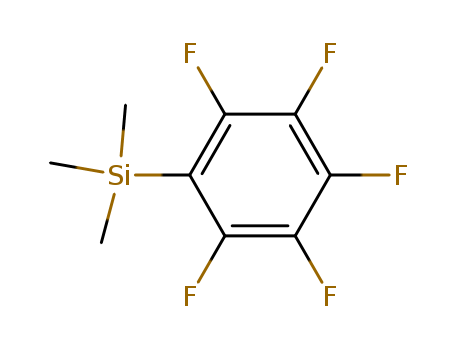
Trimethyl(pentafluorophenyl)silane

Base Information
  • Chemical Name:Trimethyl(pentafluorophenyl)silane
  • CAS No.:1206-46-8
  • Molecular Formula:C9H9F5Si
  • Molecular Weight:240.248
  • Hs Code.:29319090
  • European Community (EC) Number:621-600-4
  • NSC Number:168735
  • DSSTox Substance ID:DTXSID20304996
  • Nikkaji Number:J47.296D
  • Wikidata:Q63393030
  • Mol file:1206-46-8.mol
Trimethyl(pentafluorophenyl)silane

Synonyms:1206-46-8;Trimethyl(pentafluorophenyl)silane;Trimethyl(perfluorophenyl)silane;trimethyl-(2,3,4,5,6-pentafluorophenyl)silane;PENTAFLUOROPHENYLTRIMETHYLSILANE;TRIMETHYL(2,3,4,5,6-PENTAFLUOROPHENYL)SILANE;Perfluorophenyl(trimethyl)silane;NSC168735;Silane, trimethyl(pentafluorophenyl)-;C9H9F5Si;Trimethylsilylpentafluorobenzene;pentafluorophenyl-trimethylsilane;SCHEMBL1053840;(Pentafluorophenyl)trimethylsilane;DTXSID20304996;MFCD00092630;AKOS015853224;NSC-168735;BS-44140;FT-0633486;T3012;T71635;Q63393030

Suppliers and Price of Trimethyl(pentafluorophenyl)silane
Supply Marketing:
Business phase:
The product has achieved commercial mass production*data from LookChem market partment
Manufacturers and distributors:
  • Manufacture/Brand
  • Chemicals and raw materials
  • Packaging
  • price
  • TRC
  • Trimethyl(pentafluorophenyl)silane
  • 2.5g
  • $ 150.00
  • TCI Chemical
  • Trimethyl(pentafluorophenyl)silane >98.0%(GC)
  • 5g
  • $ 297.00
  • TCI Chemical
  • Trimethyl(pentafluorophenyl)silane >98.0%(GC)
  • 1g
  • $ 90.00
  • SynQuest Laboratories
  • Trimethyl(pentafluorophenyl)silane
  • 5 g
  • $ 64.00
  • SynQuest Laboratories
  • Trimethyl(pentafluorophenyl)silane
  • 1 g
  • $ 30.00
  • SynQuest Laboratories
  • Trimethyl(pentafluorophenyl)silane
  • 25 g
  • $ 275.00
  • Crysdot
  • Trimethyl(perfluorophenyl)silane 95+%
  • 25g
  • $ 519.00
  • Chemenu
  • trimethyl(perfluorophenyl)silane 95%
  • 25g
  • $ 490.00
  • Alichem
  • Trimethyl(perfluorophenyl)silane
  • 25g
  • $ 513.52
  • AK Scientific
  • Trimethyl(pentafluorophenyl)silane
  • 1g
  • $ 174.00
Total 38 raw suppliers
Chemical Property of Trimethyl(pentafluorophenyl)silane
Chemical Property:
  • Appearance/Colour:Clear colorless liquid 
  • Vapor Pressure:12.4mmHg at 25°C 
  • Melting Point:-50℃ 
  • Refractive Index:n20/D 1.433(lit.)  
  • Boiling Point:129.5 °C at 760 mmHg 
  • Flash Point:32.1 °C 
  • PSA:0.00000 
  • Density:1.2 g/cm3 
  • LogP:2.92730 
  • Storage Temp.:Flammables area 
  • Hydrogen Bond Donor Count:0
  • Hydrogen Bond Acceptor Count:5
  • Rotatable Bond Count:1
  • Exact Mass:240.03936763
  • Heavy Atom Count:15
  • Complexity:213
Purity/Quality:

99%, *data from raw suppliers

Trimethyl(pentafluorophenyl)silane *data from reagent suppliers

Safty Information:
  • Pictogram(s): IrritantXi 
  • Hazard Codes:Xi 
  • Statements: 10-36/37/38 
  • Safety Statements: 16-36/37/39-15/16 
MSDS Files:

SDS file from LookChem

Total 1 MSDS from other Authors

Useful:
  • Canonical SMILES:C[Si](C)(C)C1=C(C(=C(C(=C1F)F)F)F)F
  • General Description Trimethyl(pentafluorophenyl)silane, also known as (pentafluorophenyl)trimethylsilane or trimethylsilylpentafluorobenzene, is a reagent used in organofluorine chemistry, particularly for pentafluorophenylation reactions. It serves as a source of the pentafluorophenyl group in the presence of catalysts such as copper–bisphosphine complexes, enabling the functionalization of aldehydes and ketones under mild conditions. Trimethyl(pentafluorophenyl)silane is valuable in synthesizing fluorinated organic molecules with applications in pharmaceuticals, agrochemicals, and advanced materials. Additionally, it participates in nucleophilic reactions, as demonstrated in its interaction with perfluoroolefins to form fluorinated indane derivatives.
Technology Process of Trimethyl(pentafluorophenyl)silane

There total 21 articles about Trimethyl(pentafluorophenyl)silane which guide to synthetic route it. The literature collected by LookChem mainly comes from the sharing of users and the free literature resources found by Internet computing technology. We keep the original model of the professional version of literature to make it easier and faster for users to retrieve and use. At the same time, we analyze and calculate the most feasible synthesis route with the highest yield for your reference as below:

synthetic route:
Guidance literature:
In tetrahydrofuran; reaction at 20°C, 19 hours;;
DOI:10.1016/0022-328X(68)80092-0
Refernces

FORMATION OF PERFLUORO-1,1,3-TRIMETHYLINDANE IN THE REACTION OF TRIMETHYLSILYLPENTAFLUOROBENZENE WITH PERFLUORO-4-METHYL-2-PENTENE

10.1007/BF00953645

The study investigates the intramolecular cyclization of pentafluorobenzene derivatives, focusing on the reaction of trimethylsilylpentafluorobenzene (I) with perfluoro-4-methyl-2-pentene (II) in the presence of cesium fluoride (CsF). This reaction unexpectedly yields approximately equal amounts of perfluoro-1,1,3-trimethylindane (IV) and perfluoro-4-methyl-2-phenyl-2-pentene (III). The authors propose a mechanism where the initial step involves nucleophilic pentafluorophenylation of olefin (II) by a complex of arylsilane (I) and CsF, leading to a perfluorinated carbanion (V). This carbanion can either lose a fluoride ion to form perfluorinated arylolefin (III) or undergo further reactions to form fluorinated indane (IV). The study also includes experimental details on the synthesis and characterization of these compounds, highlighting the unique formation of perfluoroindane derivatives through intramolecular nucleophilic cyclization.

Copper-bisphosphine-initiated pentafluorophenylation of aldehydes and ketones

10.1055/s-0029-1219159

The research investigates a method for incorporating pentafluorophenyl groups into aldehydes and ketones using pentafluorophenyltrimethylsilane (TMSC6F5) in the presence of a copper–bisphosphine complex. The purpose of this study is to develop milder conditions for pentafluorophenylation, which is important for the synthesis of organofluorine compounds with applications in pharmaceuticals, agrochemicals, and functional materials. The study concludes that aromatic aldehydes are the best substrates for this reaction, yielding good results, while heteroaromatic and aliphatic aldehydes, as well as more electrophilic ketones, provide less optimal outcomes. The exact role of the copper–bisphosphine complex is not fully understood, but it is hypothesized to initiate an autocatalytic process. The research highlights the potential for further development of improved protocols for incorporating pentafluorophenyl and other fluorine-containing groups into organic molecules.

Post a RFQ

Enter 15 to 2000 letters.Word count: 0 letters

Attach files(File Format: Jpeg, Jpg, Gif, Png, PDF, PPT, Zip, Rar,Word or Excel Maximum File Size: 3MB)

1 Customer Service

What can I do for you?
Get Best Price

Get Best Price for 1206-46-8