Welcome to LookChem.com Sign In|Join Free
  • or

Encyclopedia

ALPHA-CYANOCINNAMIC ACID

Base Information
  • Chemical Name:ALPHA-CYANOCINNAMIC ACID
  • CAS No.:1011-92-3
  • Molecular Formula:C10H7 N O2
  • Molecular Weight:173.171
  • Hs Code.:2926909090
  • European Community (EC) Number:213-788-8
  • NSC Number:298
  • Nikkaji Number:J1.871.193A
  • Mol file:1011-92-3.mol
ALPHA-CYANOCINNAMIC ACID

Synonyms:Cinnamicacid, a-cyano- (6CI,7CI,8CI);2-Cyano-3-phenyl-2-propenoic acid; 2-Cyano-3-phenylacrylic acid;2-Cyanocinnamic acid; 3-Phenyl-2-cyano-2-propenoic acid; NSC 298; a-Cyano-b-phenylacrylic acid; a-Cyanocinnamic acid

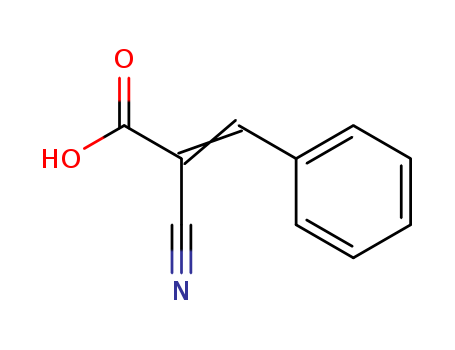
Suppliers and Price of ALPHA-CYANOCINNAMIC ACID
Supply Marketing:
Business phase:
The product has achieved commercial mass production*data from LookChem market partment
Manufacturers and distributors:
  • Manufacture/Brand
  • Chemicals and raw materials
  • Packaging
  • price
  • TRC
  • 2-Cyano-3-phenylprop-2-enoicAcid
  • 25g
  • $ 175.00
  • TCI Chemical
  • alpha-Cyanocinnamic Acid >98.0%(HPLC)(T)
  • 25g
  • $ 182.00
  • Biosynth Carbosynth
  • a-Cyanocinnamic acid
  • 100 g
  • $ 240.00
  • Biosynth Carbosynth
  • a-Cyanocinnamic acid
  • 250 g
  • $ 500.00
  • Biosynth Carbosynth
  • a-Cyanocinnamic acid
  • 50 g
  • $ 150.00
  • Biosynth Carbosynth
  • a-Cyanocinnamic acid
  • 25 g
  • $ 100.00
  • Biosynth Carbosynth
  • a-Cyanocinnamic acid
  • 10 g
  • $ 50.00
  • Apolloscientific
  • Alpha-cyanocinnamic acid
  • 5g
  • $ 156.00
  • Apolloscientific
  • Alpha-cyanocinnamic acid
  • 25g
  • $ 392.00
  • American Custom Chemicals Corporation
  • 2-CYANO-3-PHENYL-ACRYLIC ACID 95.00%
  • 25G
  • $ 1222.52
Total 25 raw suppliers
Chemical Property of ALPHA-CYANOCINNAMIC ACID
Chemical Property:
  • Vapor Pressure:3.98E-05mmHg at 25°C 
  • Melting Point:181°C 
  • Boiling Point:337.9°Cat760mmHg 
  • PKA:0.60±0.10(Predicted) 
  • Flash Point:158.1°C 
  • PSA:61.09000 
  • Density:1.285g/cm3 
  • LogP:1.67818 
  • Storage Temp.:Sealed in dry,Room Temperature 
  • Solubility.:soluble in Methanol 
  • XLogP3:2.2
  • Hydrogen Bond Donor Count:1
  • Hydrogen Bond Acceptor Count:3
  • Rotatable Bond Count:2
  • Exact Mass:173.047678466
  • Heavy Atom Count:13
  • Complexity:266
Purity/Quality:

97% *data from raw suppliers

2-Cyano-3-phenylprop-2-enoicAcid *data from reagent suppliers

Safty Information:
  • Pictogram(s): R36/37/38:Irritating to eyes, respiratory system and skin.; 
  • Hazard Codes:R36/37/38:Irritating to eyes, respiratory system and skin.; 
  • Statements: 20/21/22-36/37/38 
  • Safety Statements: 26-36/37/39 
MSDS Files:

SDS file from LookChem

Useful:
  • Canonical SMILES:C1=CC=C(C=C1)C=C(C#N)C(=O)O
  • Isomeric SMILES:C1=CC=C(C=C1)/C=C(/C#N)\C(=O)O
Technology Process of ALPHA-CYANOCINNAMIC ACID

There total 22 articles about ALPHA-CYANOCINNAMIC ACID which guide to synthetic route it. The literature collected by LookChem mainly comes from the sharing of users and the free literature resources found by Internet computing technology. We keep the original model of the professional version of literature to make it easier and faster for users to retrieve and use. At the same time, we analyze and calculate the most feasible synthesis route with the highest yield for your reference as below:

synthetic route:
Guidance literature:
With tris(2-hydroxyethyl)ammonium acetate; at 80 ℃; for 0.75h;
DOI:10.1039/b818540a
Guidance literature:
With amine-functionalized mesoporous zirconia; at 20 ℃; Neat (no solvent);
DOI:10.1016/j.apcata.2010.04.008
Refernces

Synthesis of hydroxyquinoline derivatives, amino-hydroxychromene, aminocoumarin and their anti-bacterial activities

10.3987/com-04-10089

The research focuses on the synthesis and antimicrobial activity evaluation of various heterocyclic compounds. The study involves the creation of new diaminochromenes, aminohydroxychromene, aminocoumarin, and hydroxyquinoline derivatives through Michael addition reactions using different substituted aminonaphthol, aminophenol, resorcinol derivatives, chloronaphthol, and 4-hydroxycoumarin with α-cyanocinnamonitriles and ethyl α-cyanocinnamates. Specific chemicals like triethyl orthoformate and hydrazine hydrate are also used in the synthesis process to achieve desired products. The newly synthesized compounds are characterized by spectroscopic data (IR, 1H NMR, 13C NMR, and EMS) and tested for their antimicrobial activities against various bacterial strains, with some showing activity against Staphylococcus aureus.

Post a RFQ

Enter 15 to 2000 letters.Word count: 0 letters

Attach files(File Format: Jpeg, Jpg, Gif, Png, PDF, PPT, Zip, Rar,Word or Excel Maximum File Size: 3MB)

1 Customer Service

What can I do for you?
Get Best Price

Get Best Price for 1011-92-3