Welcome to LookChem.com Sign In|Join Free
  • or

Encyclopedia

Hypodiphosphorous tetraiodide

Base Information
  • Chemical Name:Hypodiphosphorous tetraiodide
  • CAS No.:13455-00-0
  • Molecular Formula:I4P2
  • Molecular Weight:569.566
  • Hs Code.:
  • European Community (EC) Number:236-646-7
  • DSSTox Substance ID:DTXSID6065474
  • Nikkaji Number:J166.100K
  • Wikipedia:Diphosphorus tetraiodide
  • Wikidata:Q412973
  • Mol file:13455-00-0.mol
Hypodiphosphorous tetraiodide

Synonyms:Diphosphorus tetraiodide;13455-00-0;Hypodiphosphorous tetraiodide;diiodophosphanyl(diiodo)phosphane;Diphosphorous tetraiodide;Phosphorus iodide;Diphosphorus tetraiodide, 95%;EINECS 236-646-7;tetraiododiphosphane;periododiphosphine;Tetraiododiphosphine;Diphosphine, tetraiodo-;I4P2;P2I4;DTXSID6065474;I4-P2;MFCD00011526;AKOS015916035;Q412973;J-006558

Suppliers and Price of Hypodiphosphorous tetraiodide
Supply Marketing:
Business phase:
The product has achieved commercial mass production*data from LookChem market partment
Manufacturers and distributors:
  • Manufacture/Brand
  • Chemicals and raw materials
  • Packaging
  • price
  • TRC
  • Tetraiododiphosphine
  • 250mg
  • $ 45.00
  • Sigma-Aldrich
  • Diphosphorus tetraiodide 95%
  • 25g
  • $ 247.00
  • Sigma-Aldrich
  • Diphosphorus tetraiodide 95%
  • 5g
  • $ 72.50
  • Labseeker
  • Diphosphorus tetraiodide 95
  • 50g
  • $ 1766.00
Total 36 raw suppliers
Chemical Property of Hypodiphosphorous tetraiodide
Chemical Property:
  • Appearance/Colour:orange to red powder 
  • Melting Point:124-127 °C(lit.) 
  • PSA:27.18000 
  • LogP:5.26520 
  • Storage Temp.:2-8°C 
  • XLogP3:3.2
  • Hydrogen Bond Donor Count:0
  • Hydrogen Bond Acceptor Count:0
  • Rotatable Bond Count:0
  • Exact Mass:569.5654
  • Heavy Atom Count:6
  • Complexity:26.5
Purity/Quality:

98%,99%, *data from raw suppliers

Tetraiododiphosphine *data from reagent suppliers

Safty Information:
  • Pictogram(s): Corrosive
  • Hazard Codes:
  • Statements: 34-37 
  • Safety Statements: 26-36/37/39-45 
MSDS Files:

SDS file from LookChem

Useful:
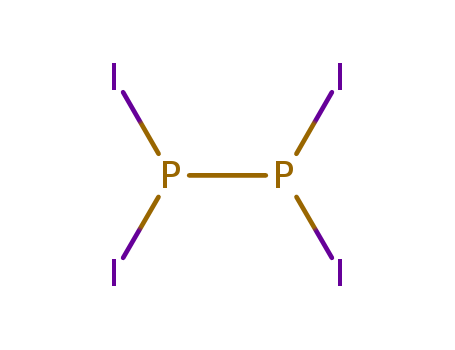
  • Canonical SMILES:P(P(I)I)(I)I
  • General Description Diphosphorus tetraiodide (P2I4), also known as phosphorus iodide, diphosphorus tetraiodide, phosphorous diiodide, or tetraiododiphosphine, is a mild condensing agent used in organic synthesis, particularly for converting oximes of α-diketones into oxadiazoles and nitriles. It facilitates dehydration and rearrangement reactions, enabling the formation of 1,2,5-oxadiazoles and 1,2,4-oxadiazoles, as well as nitriles, under mild conditions. The reagent is effective in chlorinated solvents like dichloromethane, making it a useful tool for synthesizing heterocyclic compounds with potential bioactivity.
Technology Process of Hypodiphosphorous tetraiodide

There total 44 articles about Hypodiphosphorous tetraiodide which guide to synthetic route it. The literature collected by LookChem mainly comes from the sharing of users and the free literature resources found by Internet computing technology. We keep the original model of the professional version of literature to make it easier and faster for users to retrieve and use. At the same time, we analyze and calculate the most feasible synthesis route with the highest yield for your reference as below:

synthetic route:
Guidance literature:
In neat (no solvent); heating mixture of 1 Mol I2 and 0.75 Mol red P and stirring for 1 h at 180°C after reaction took place;; dissolving in boiling chlorobenzene, filtering off, washing crystals with hot CHCl3 and drying in vacuum;;
Guidance literature:
In acetic acid; react. with iodine in glacial acetic acid; formation of P2I4 or PI3 depending on ratio of educts;;
DOI:10.1021/ja01401a001
Guidance literature:
In neat (no solvent); heating I2 with dry PH3 in excess; formation of P2I4 and HI;;
Refernces

Reaction of oximes of-diketones with diphosphorous tetraiodide for preparation of oxadiazoles and nitriles

10.1080/00397911.2011.595035

The study primarily investigates the use of diphosphorus tetraiodide (P2I4) as a novel and mild condensing agent for the synthesis of oxadiazoles and nitriles from the oximes of α-diketones. The research explores the dehydration of oximes to form 1,2,5-oxadiazoles and the rearrangement of oximes to produce the normal Beckmann product, 1,2,4-oxadiazole. Key chemicals used in the study include dioximes derived from α-diketones, such as benzildioxime, and various substituted 1,2-dioximes, which serve as substrates for the synthesis of oxadiazoles. The study also examines the effects of different solvents on the reaction, with chlorinated solvents, particularly dichloromethane, proving to be the most effective. The purpose of these chemicals is to facilitate the synthesis of oxadiazoles, which are an important class of heterocycles used in a variety of bioactive molecules, and nitriles, through a simple and efficient method.

Post a RFQ

Enter 15 to 2000 letters.Word count: 0 letters

Attach files(File Format: Jpeg, Jpg, Gif, Png, PDF, PPT, Zip, Rar,Word or Excel Maximum File Size: 3MB)

1 Customer Service

What can I do for you?
Get Best Price

Get Best Price for 13455-00-0