Welcome to LookChem.com Sign In|Join Free
  • or

Encyclopedia

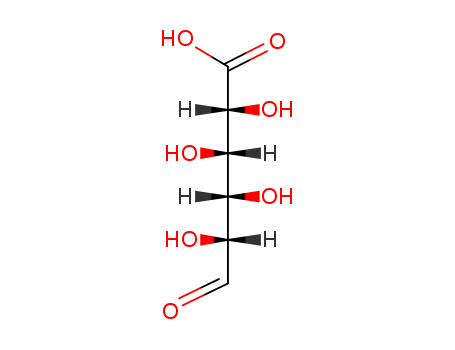
D-Guluronic Acid

Base Information
  • Chemical Name:D-Guluronic Acid
  • CAS No.:15769-56-9
  • Molecular Formula:C6H10O7
  • Molecular Weight:194.141
  • Hs Code.:
  • European Community (EC) Number:239-860-9
  • Metabolomics Workbench ID:155982
  • Wikipedia:Guluronic_acid
  • Mol file:15769-56-9.mol
D-Guluronic Acid

Synonyms:alpha-L-guluronic acid;G2013;G2013 compound;guluronic acid;guluronic acid, (alpha-L)-isomer;guluronic acid, (L)-isomer;guluronic acid, sodium salt, (L)-isomer

Suppliers and Price of D-Guluronic Acid
Supply Marketing:
Business phase:
The product has achieved commercial mass production*data from LookChem market partment
Manufacturers and distributors:
  • Manufacture/Brand
  • Chemicals and raw materials
  • Packaging
  • price
Total 22 raw suppliers
Chemical Property of D-Guluronic Acid
Chemical Property:
  • Vapor Pressure:1.49E-14mmHg at 25°C 
  • Boiling Point:553.4°Cat760mmHg 
  • Flash Point:302.6°C 
  • PSA:0.00000 
  • Density:1.748g/cm3 
  • LogP:0.00000 
  • XLogP3:-2.3
  • Hydrogen Bond Donor Count:5
  • Hydrogen Bond Acceptor Count:7
  • Rotatable Bond Count:1
  • Exact Mass:194.04265265
  • Heavy Atom Count:13
  • Complexity:205
Purity/Quality:

97% *data from raw suppliers

Safty Information:
  • Pictogram(s):  
  • Hazard Codes: 
MSDS Files:
Useful:
  • Canonical SMILES:C1(C(C(OC(C1O)O)C(=O)O)O)O
  • Isomeric SMILES:[C@H]1([C@H]([C@H](OC([C@@H]1O)O)C(=O)O)O)O
  • Description Glucuronic acid is a sugar acid derived from glucose, with its sixth carbon atom oxidized to a carboxylic acid. In living beings, this primary oxidation occurs with UDP-α-D-glucose (UDPG), not with the free sugar. Glucuronic acid, like its precursor glucose, can exist as a linear (carboxo-)aldohexose (<1%), or as a cyclic hemiacetal (furanose or pyranose). Aldohexoses such as D-glucose are capable of forming two furanose forms (α and β) and two pyranose forms (α and β). By the Fischer convention, glucuronic acid has two stereoisomers (enantiomers), D- and L-glucuronic acid, depending on its configuration at C-5. Most physiological sugars are of the D-configuration. Due to ring closure, cyclic sugars have another asymmetric carbon atom (C-1), resulting in two more stereoisomers, named anomers. Depending on the configuration at C-1, there are two anomers of glucuronic acid, α- and β-form. In β-D-glucuronic acid the C-1 hydroxy group is on the same side of the pyranose ring as the carboxyl group. In the free sugar acid, the β-form is prevalent (~64%), whereas in the organism, the α-form UDP-α-D-glucuronic acid (UDPGA) predominates.
Technology Process of D-Guluronic Acid

There total 18 articles about D-Guluronic Acid which guide to synthetic route it. The literature collected by LookChem mainly comes from the sharing of users and the free literature resources found by Internet computing technology. We keep the original model of the professional version of literature to make it easier and faster for users to retrieve and use. At the same time, we analyze and calculate the most feasible synthesis route with the highest yield for your reference as below:

synthetic route:
Post a RFQ

Enter 15 to 2000 letters.Word count: 0 letters

Attach files(File Format: Jpeg, Jpg, Gif, Png, PDF, PPT, Zip, Rar,Word or Excel Maximum File Size: 3MB)

1 Customer Service

What can I do for you?
Get Best Price

Get Best Price for 15769-56-9