Welcome to LookChem.com Sign In|Join Free
  • or

Encyclopedia

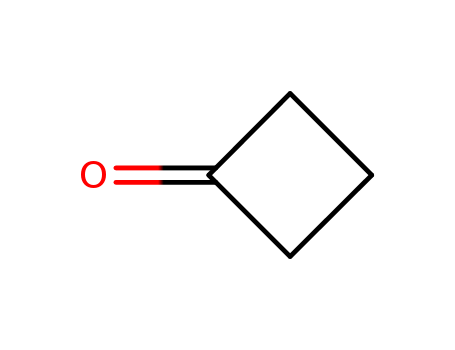
Cyclobutanone

Base Information
  • Chemical Name:Cyclobutanone
  • CAS No.:1191-95-3
  • Deprecated CAS:2010999-65-0
  • Molecular Formula:C4H6O
  • Molecular Weight:70.091
  • Hs Code.:29142900
  • European Community (EC) Number:214-745-6
  • NSC Number:87632
  • UNII:6PF2SH405U
  • DSSTox Substance ID:DTXSID9061592
  • Nikkaji Number:J80.072D
  • Wikipedia:Cyclobutanone
  • Wikidata:Q1147434
  • Mol file:1191-95-3.mol
Cyclobutanone

Synonyms:CYCLOBUTANONE;1191-95-3;UNII-6PF2SH405U;6PF2SH405U;EINECS 214-745-6;NSC 87632;NSC-87632;Cyclobutanone, 98+%;AI3-37787;cyclobutyloxy;cyclobutanon;cylcobutanone;cylobutanone;3-cyclobutanone;MFCD00001332;Cyclobutanone, 99%;DTXSID9061592;BCP26050;NSC87632;STR06460;BBL102042;STL555841;AKOS005259133;CS-W001200;PS-9376;SB40655;4-(2,4-DINITROPHENYLAZO)-PHENOL;AM20070575;C1913;FT-0600042;EN300-25701;A804218;Q1147434;W-108526;F0001-0313

Suppliers and Price of Cyclobutanone
Supply Marketing:
Business phase:
The product has achieved commercial mass production*data from LookChem market partment
Manufacturers and distributors:
  • Manufacture/Brand
  • Chemicals and raw materials
  • Packaging
  • price
  • TRC
  • Cyclobutanone
  • 2.5g
  • $ 110.00
  • TCI Chemical
  • Cyclobutanone (stabilized with Na2CO3) >97.0%(GC)
  • 1g
  • $ 51.00
  • TCI Chemical
  • Cyclobutanone (stabilized with Na2CO3) >97.0%(GC)
  • 5g
  • $ 169.00
  • SynQuest Laboratories
  • Cyclobutanone 98.0%
  • 100 g
  • $ 200.00
  • SynQuest Laboratories
  • Cyclobutanone 98.0%
  • 5 g
  • $ 29.00
  • SynQuest Laboratories
  • Cyclobutanone 98.0%
  • 25 g
  • $ 93.00
  • Sigma-Aldrich
  • Cyclobutanone 99%
  • 1g
  • $ 71.70
  • Sigma-Aldrich
  • Cyclobutanone 99%
  • 5g
  • $ 194.00
  • Oakwood
  • Cyclobutanone
  • 500g
  • $ 943.00
  • Oakwood
  • Cyclobutanone
  • 100g
  • $ 223.00
Total 139 raw suppliers
Chemical Property of Cyclobutanone
Chemical Property:
  • Appearance/Colour:Clear colourless to slightly yellow liquid 
  • Vapor Pressure:43.4mmHg at 25°C 
  • Melting Point:-50.9 °C 
  • Refractive Index:n20/D 1.421(lit.)  
  • Boiling Point:96.5 °C at 760 mmHg 
  • Flash Point:10 °C 
  • PSA:17.07000 
  • Density:1.038 g/cm3 
  • LogP:0.73940 
  • Storage Temp.:0-6°C 
  • Water Solubility.:INSOLUBLE 
  • XLogP3:0
  • Hydrogen Bond Donor Count:0
  • Hydrogen Bond Acceptor Count:1
  • Rotatable Bond Count:0
  • Exact Mass:70.041864811
  • Heavy Atom Count:5
  • Complexity:50.7
Purity/Quality:

99% *data from raw suppliers

Cyclobutanone *data from reagent suppliers

Safty Information:
  • Pictogram(s): HighlyF+ 
  • Hazard Codes:F,F+ 
  • Statements: 10-11 
  • Safety Statements: 23-24/25-9-33-29-16-7/9 
MSDS Files:

SDS file from LookChem

Useful:
  • Chemical Classes:Solvents -> Ketones (
  • Canonical SMILES:C1CC(=O)C1
  • Description Cyclobutanone is an organic compound with a four-membered cyclic ketone. It is used in preparation of cyclobutane derivatives, as a starting material for aminocyclobutanecarboxylic acid through sulfonyloxiranes, to prepare dihydro-furan-2-one in presence of polystyrene-bound phenylselenic acid as catalyst. It is also involved in the photochemical synthesis of nucleoside analogues such as bicyclic nucleosides and isonucleosides. Furthermore, it is used to synthesis fatty acid, 2-oxo-cyclobutane undecanoic acid, which is used in the development of an enzyme-linked immunosorbent assy for the detection of irradiated foods.
  • Uses Cyclobutanone is used in preparation of cyclobutane derivatives. It is used as a starting material for aminocyclobutanecarboxylic acid through sulfonyloxiranes. It is also used to prepare dihydro-furan-2-one in presence of polystyrene-bound phenylselenic acid as catalyst. Further, it is involved in the photochemical synthesis of nucleoside analogues such as bicyclic nucleosides and isonucleosides.
Technology Process of Cyclobutanone

There total 89 articles about Cyclobutanone which guide to synthetic route it. The literature collected by LookChem mainly comes from the sharing of users and the free literature resources found by Internet computing technology. We keep the original model of the professional version of literature to make it easier and faster for users to retrieve and use. At the same time, we analyze and calculate the most feasible synthesis route with the highest yield for your reference as below:

synthetic route:
Guidance literature:
With iodosylbenzene; 4 A molecular sieve; sodium ruthenate(VI); In dichloromethane; at 20 ℃; for 3h;
DOI:10.1016/S0040-4039(00)00531-1
Refernces

Ir-Catalyzed Asymmetric Hydrogenation of α-Alkylidene β-Lactams and Cyclobutanones

10.1002/cjoc.201800088

The research aims to develop a highly efficient and stereoselective method for constructing chiral four-membered ring compounds, specifically β-lactams and cyclobutanones, which are important in pharmaceuticals and natural products. The study employs an iridium (Ir) catalyst complexed with an axially-unfixed biphenyl phosphine-oxazoline ligand (BiphPHOX) to achieve asymmetric hydrogenation under mild conditions (1.0 - 2.5 bar H? for 1.0 - 10 hours). The reaction conditions were optimized to achieve excellent yields (up to 99%) and enantioselectivities (up to 98%). The study concludes that this method is highly efficient, with a wide substrate scope and potential for further transformations, making it a valuable protocol for the synthesis of chiral four-membered ring compounds.

Charge-transfer effect on chiral phosphoric acid catalyzed asymmetric Baeyer-Villiger oxidation of 3-substituted cyclobutanones using 30% aqueous H2O2 as the oxidant

10.1002/cjoc.201090292

The study investigates the charge-transfer effect on chiral phosphoric acid-catalyzed asymmetric Baeyer-Villiger oxidation of 3-substituted cyclobutanones using 30% aqueous H2O2 as the oxidant. The primary chemicals used include BINOL-derived chiral phosphoric acids as catalysts, 3-aryl cyclobutanones as substrates, and various electron acceptor additives (A1-A7) to modulate enantioselectivity. The purpose of these chemicals is to explore how the intermolecular charge-transfer interaction between the catalyst and electron-deficient additives can fine-tune the enantioselectivity of the asymmetric catalysis, leading to an enhancement of the enantiomeric excess (ee) values in the reaction products.

1-METHOXY-1-(PHENYLTHIO)CYCLOPROPANES FROM OLEFINS VIA THE PUMMERER REARRANGEMENT

10.1016/S0040-4039(00)96628-0

The research focuses on the synthesis of 1-methoxy-1-(phenylthio)cyclopropanes from olefins via the Pummerer rearrangement. The purpose of this study was to develop a versatile and mild method for the preparation of cyclobutanones, which are valuable precursors in the synthesis of higher ring systems, acyclic fragments, and natural products. The researchers successfully modified the Pummerer reaction to achieve high yields of the title compounds through a series of steps involving carbene addition, oxidation, and methylation. Key chemicals used in the process include olefins, phenylthiocarbene, m-chloroperbenzoic acid, trimethyloxonium fluoroborate, and sodium methoxide in methanol. The study concluded that the Pummerer rearrangement of methoxysulfonium salts involving cyclopropanes is a highly stereoselective method for preparing fused bicyclic cyclopropanes, which are useful precursors of fused cyclobutanones.

Directing-Group-Based Strategy Enabling Intermolecular Heck-Type Reaction of Cycloketone Oxime Esters and Unactivated Alkenes

10.1021/acs.orglett.0c00963

This research presents a novel directing-group-based strategy that enables the intermolecular Heck-type reaction of cycloketone oxime esters with unactivated alkenes, marking the first achievement in coupling nonstabilized alkyl radicals with unactivated olefins. The study's purpose was to develop a method for constructing Csp2?Csp3 bonds, which are significant in organic synthesis. Key chemicals used in the process include copper salts as catalysts, DMSO as an initial solvent, and 2-butanol, which was found to be the most effective solvent for controlling both regio- and diastereoselectivities. The reaction's compatibility with various unactivated alkenes and oxime esters derived from cyclobutanone, cyclopentanone, and cyclohexanone was demonstrated, showcasing the potential application of this methodology in organic synthesis.

Post a RFQ

Enter 15 to 2000 letters.Word count: 0 letters

Attach files(File Format: Jpeg, Jpg, Gif, Png, PDF, PPT, Zip, Rar,Word or Excel Maximum File Size: 3MB)

1 Customer Service

What can I do for you?
Get Best Price

Get Best Price for 1191-95-3
  • ©2008 LookChem.com,License:ICP NO.:Zhejiang16009103 complaints:service@lookchem.com
  • [Hangzhou]86-0571-87562588,87562578,87562573 Our Legal adviser: Lawyer
