Welcome to LookChem.com Sign In|Join Free
  • or

Encyclopedia

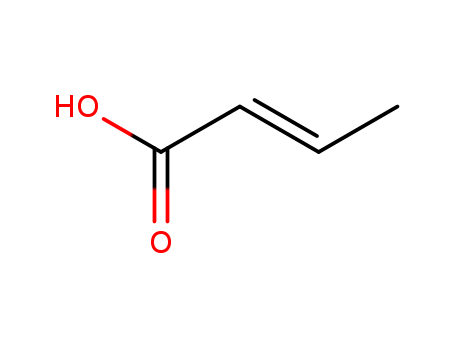
Crotonic acid

Base Information
  • Chemical Name:Crotonic acid
  • CAS No.:107-93-7
  • Deprecated CAS:15105-17-6
  • Molecular Formula:C4H6O2
  • Molecular Weight:86.0904
  • Hs Code.:29161940
  • European Community (EC) Number:203-533-9,223-077-4
  • ICSC Number:0423
  • NSC Number:8751
  • UN Number:2823
  • UNII:YW5WZZ4O5Q
  • DSSTox Substance ID:DTXSID30880973
  • Nikkaji Number:J367K,J109.464E
  • Wikipedia:Crotonic acid
  • Wikidata:Q414207
  • Metabolomics Workbench ID:617
  • ChEMBL ID:CHEMBL1213528
  • Mol file:107-93-7.mol
Crotonic acid

Synonyms:3-methylacrylic acid;crotonic acid;trans-2-butenoic acid
Suppliers and Price of Crotonic acid
Supply Marketing:
Business phase:
The product has achieved commercial mass production*data from LookChem market partment
Manufacturers and distributors:
  • Manufacture/Brand
  • Chemicals and raw materials
  • Packaging
  • price
  • Usbiological
  • Crotonic acid 99+%
  • 25g
  • $ 156.00
  • TRC
  • Crotonic acid
  • 25 g
  • $ 60.00
  • Tocris
  • Crotonic acid ≥99%(HPLC)
  • 100
  • $ 61.00
  • TCI Chemical
  • Crotonic Acid >98.0%(GC)(T)
  • 25g
  • $ 54.00
  • TCI Chemical
  • Crotonic Acid >98.0%(GC)(T)
  • 100g
  • $ 118.00
  • TCI Chemical
  • Crotonic Acid >98.0%(GC)(T)
  • 500g
  • $ 150.00
  • Sigma-Aldrich
  • Crotonic acid 98%
  • 3kg
  • $ 138.00
  • Sigma-Aldrich
  • Crotonic acid 98%
  • 500g
  • $ 38.50
  • Oakwood
  • Crotonic acid 98%
  • 100g
  • $ 24.00
  • Medical Isotopes, Inc.
  • Crotonic acid
  • 25 g
  • $ 625.00
Total 151 raw suppliers
Chemical Property of Crotonic acid
Chemical Property:
  • Appearance/Colour:White to light yellow crystalline flakes 
  • Vapor Pressure:0.19 mm Hg ( 20 °C) 
  • Melting Point:72 °C 
  • Refractive Index:1.4228 
  • Boiling Point:177 °C at 760 mmHg 
  • PKA:4.69(at 25℃) 
  • Flash Point:81.6 °C 
  • PSA:37.30000 
  • Density:1.027 g/cm3 
  • LogP:0.64710 
  • Storage Temp.:Store below +30°C. 
  • Solubility.:H2O: soluble 
  • Water Solubility.:94 g/L (25 ºC) 
  • XLogP3:0.7
  • Hydrogen Bond Donor Count:1
  • Hydrogen Bond Acceptor Count:2
  • Rotatable Bond Count:1
  • Exact Mass:86.036779430
  • Heavy Atom Count:6
  • Complexity:73.6
  • Transport DOT Label:Corrosive
Purity/Quality:

99.0% min *data from raw suppliers

Crotonic acid 99+% *data from reagent suppliers

Safty Information:
  • Pictogram(s): CorrosiveC,DangerousN,IrritantXi 
  • Hazard Codes:C,N,Xi 
  • Statements: 21/22-34-50/53-36/37/38 
  • Safety Statements: 26-36/37/39-45-61-37/39 
MSDS Files:

SDS file from LookChem

Total 1 MSDS from other Authors

Useful:
  • Chemical Classes:Other Classes -> Organic Acids
  • Canonical SMILES:CC=CC(=O)O
  • Isomeric SMILES:C/C=C/C(=O)O
  • Inhalation Risk:A harmful concentration of airborne particles can be reached quickly when dispersed, especially if powdered.
  • Effects of Short Term Exposure:The substance is corrosive to the eyes. The substance may be irritating to the respiratory tract.
  • Uses trans-Crotonic acid is used in the copolymerization of crotonic acid hydrogel systems by using gamma-rays. The crosslinked copolymeric crotonic acid hydrogels release fertilizers and drugs that help to prevent environmental pollution.
Technology Process of Crotonic acid

There total 110 articles about Crotonic acid which guide to synthetic route it. The literature collected by LookChem mainly comes from the sharing of users and the free literature resources found by Internet computing technology. We keep the original model of the professional version of literature to make it easier and faster for users to retrieve and use. At the same time, we analyze and calculate the most feasible synthesis route with the highest yield for your reference as below:

synthetic route:
Guidance literature:
With palladium diacetate; 1,4-di(diphenylphosphino)-butane; In tetrahydrofuran; at 110 ℃; for 18h; under 37503.8 Torr; Solvent; Glovebox; Autoclave;
DOI:10.1021/acs.organomet.0c00117
Guidance literature:
With cyclohexene; In gas; at 350.1 ℃; Kinetics; Mechanism; Product distribution; ΔE(exct.);
DOI:10.1002/poc.610080302
Refernces

Vitamin A analogues. V. Synthesis of 9-, 13-, and 9,13- desmethyl homologues of vitamin A.

10.1016/0040-4020(66)80130-8

The research aimed to investigate the relationship between the chemical structure and biological activity of vitamin A by synthesizing 9-, 13-, and 9,13-desmethyl homologues of vitamin A acetate. The study concluded that the presence of both methyl groups on the sidechain of the all-trans system is essential for growth-promoting properties, as the all-trans-13- and all-trans-9,13-desmethyl vitamin A acetates showed no activity, while the all-trans-9-desmethyl vitamin A acetate exhibited only about 4% of the activity compared to all-trans-vitamin A acetate. The synthesis involved chemicals such as truns-ionylidene acetaldehyde, truns-(2’,6’,6’-trimethylcyclohexen-1’-yl-1’)-pentadiene 2,4- dial, phosphonates of the appropriate crotonic acid esters, and reagents like lithium aluminum hydride (LAH) or diisobutylaluminum hydride (DIBAH) for reduction steps. Biological investigations were conducted to assess the growth-promoting properties of these synthesized compounds.

Post a RFQ

Enter 15 to 2000 letters.Word count: 0 letters

Attach files(File Format: Jpeg, Jpg, Gif, Png, PDF, PPT, Zip, Rar,Word or Excel Maximum File Size: 3MB)

1 Customer Service

What can I do for you?
Get Best Price

Get Best Price for 107-93-7
