Welcome to LookChem.com Sign In|Join Free
  • or

Encyclopedia

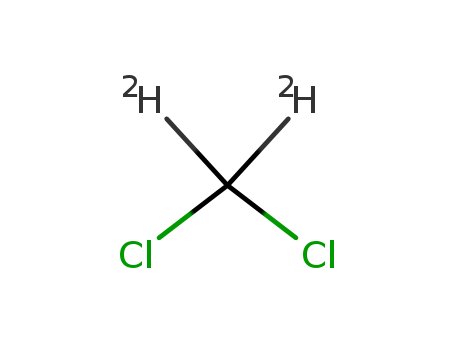
Dichloromethane-d2

Base Information
  • Chemical Name:Dichloromethane-d2
  • CAS No.:1665-00-5
  • Molecular Formula:CCl2D2
  • Molecular Weight:86.917
  • Hs Code.:28459000
  • European Community (EC) Number:216-776-0
  • DSSTox Substance ID:DTXSID80937204
  • Nikkaji Number:J150.032E
  • Wikipedia:Deuterated_dichloromethane
  • Wikidata:Q1101325
  • Mol file:1665-00-5.mol
Dichloromethane-d2

Synonyms:Dichloromethane-d2;1665-00-5;Methylene chloride-D2;dichloro(dideuterio)methane;Dichloro(2H2)methane;Dideuteromethylenechloride;Methane-d2, dichloro- (6CI,7CI,8CI,9CI);Methane-d2, dichloro-;CD2Cl2;Dichloromethane, deuterated;EINECS 216-776-0;Dideuteromethylene Chloride;MFCD00000882;Dichloromethane-d2, 99.9 atom % D;Dichloromethane-d2, "100%", 99.96 atom % D;Deuterated dichloromethane;Dichloromethane D2;Dichlorodideuteriomethane;CCl2D2;Methane-D2-, dichloro-;C-Cl2-D2;CD2C12;DTXSID80937204;CHEBI:193042;Methylene Chloride D2 >99.6%;AKOS015904236;Dichloromethane-d2, 99.5 atom % D;CS-T-33750;Dichloromethane-d2, 100.0 atom % D;AS-75499;D3529;D3569;Methane-d2, dichloro-(6CI,7CI,8CI,9CI);Dichloromethane D2 100 microg/mL in Methanol;D90197;Methylene chloride-D2 (D, 99.8%) reagent grade;J-010289;Q1101325;Dichloromethane-d2, 99.5 atom % D, contains 1 % (v/v) TMS;Dichloromethane-d2, 99.5 atom % D, contains 0.1 % (v/v) TMS;Dichloromethane-d2, 99.9 atom % D, contains 0.1 % (v/v) TMS;Dichloromethane-d2, >=99.5 atom % D, contains 0.03 % (v/v) TMS

Suppliers and Price of Dichloromethane-d2
Supply Marketing:
Business phase:
The product has achieved commercial mass production*data from LookChem market partment
Manufacturers and distributors:
  • Manufacture/Brand
  • Chemicals and raw materials
  • Packaging
  • price
  • Usbiological
  • Methylene Chloride-d2
  • 100mg
  • $ 446.00
  • TRC
  • MethyleneChloride-d2
  • 1g
  • $ 1355.00
  • TRC
  • MethyleneChloride-d2
  • 100mg
  • $ 175.00
  • TCI Chemical
  • Dichloromethane-d2 99.9atom%D
  • 10mL
  • $ 166.00
  • Sigma-Aldrich
  • Dichloromethane-d2 99.9 atom % D, contains 0.1 % (v/v) TMS
  • 25g
  • $ 434.00
  • Sigma-Aldrich
  • Dichloromethane-d2 ≥99.5 atom % D, contains 0.03 % (v/v) TMS
  • 25g
  • $ 401.00
  • Sigma-Aldrich
  • Dichloromethane-d2 99.9 atom % D
  • 25g
  • $ 353.00
  • Sigma-Aldrich
  • Dichloromethane-d2 99.5 atom % D
  • 25g
  • $ 351.00
  • Sigma-Aldrich
  • Dichloromethane-D2
  • 1042000005
  • $ 318.00
  • Sigma-Aldrich
  • Dichloromethane-D2
  • 1042000010
  • $ 457.00
Total 49 raw suppliers
Chemical Property of Dichloromethane-d2
Chemical Property:
  • Appearance/Colour:clear colorless liquid 
  • Vapor Pressure:25.72 psi ( 55 °C) 
  • Melting Point:97 °C 
  • Refractive Index:n20/D 1.4217(lit.)  
  • Boiling Point:39.6 °C at 760 mmHg 
  • PSA:0.00000 
  • Density:1.282 g/cm3 
  • LogP:1.42150 
  • Storage Temp.:Store below +30°C. 
  • Sensitive.:Moisture Sensitive 
  • Solubility.:Miscible with alcohol, ether and dimethyl formamide. 
  • Water Solubility.:Insoluble in water. Soluble in acetone, chloroform, tetrachloromethane, dimethylfomrarnide. 
  • XLogP3:1.5
  • Hydrogen Bond Donor Count:0
  • Hydrogen Bond Acceptor Count:0
  • Rotatable Bond Count:0
  • Exact Mass:85.9659089
  • Heavy Atom Count:3
  • Complexity:2.8
Purity/Quality:

99%, *data from raw suppliers

Methylene Chloride-d2 *data from reagent suppliers

Safty Information:
  • Pictogram(s): HarmfulXn 
  • Hazard Codes:Xn 
  • Statements: 40-67-36/37/38 
  • Safety Statements: 23-24/25-36/37-26 
MSDS Files:

SDS file from LookChem

Useful:
  • Chemical Classes:Solvents -> Chlorinated Aliphatics
  • Canonical SMILES:C(Cl)Cl
  • Isomeric SMILES:[2H]C([2H])(Cl)Cl
  • Uses DICHLOROMETHANE-D2 is a labelled Methylene Chloride used in organic chemical reactions as a general solvent. NMR solvent Dichloromethane-d2 may be used to analyze the three-dimensional structure of (9S,11S)-11-amino-9-deoxo-11,12-deoxy-9,12-epoxyerythromycin by proton NMR derived constrained molecular mechanics.
Technology Process of Dichloromethane-d2

There total 1 articles about Dichloromethane-d2 which guide to synthetic route it. The literature collected by LookChem mainly comes from the sharing of users and the free literature resources found by Internet computing technology. We keep the original model of the professional version of literature to make it easier and faster for users to retrieve and use. At the same time, we analyze and calculate the most feasible synthesis route with the highest yield for your reference as below:

synthetic route:
Guidance literature:
With 1,8-diazabicyclo[5.4.0]undec-7-ene; copper(l) chloride; In acetonitrile; at 60 ℃; for 14h; Inert atmosphere;
DOI:10.1002/adsc.201000691
Guidance literature:
With titanium tetrachloride; magnesium; In tetrahydrofuran; 1,2-dichloro-ethane; at 0 - 25 ℃; for 10h;
DOI:10.1021/ol060438p
Refernces

Synthesis and protonation studies of Cp*Os(dppe)H: Kinetic versus thermodynamic control

10.1021/om8000235

The research investigates the synthesis and protonation behavior of the osmium complex Cp*Os(dppe)H. The study aims to understand how the nature of the metal center and the electronic and steric properties of the ligands influence protonation sites and the resulting isomers. The key chemicals used include Cp*Os(dppe)H, HBF4·Et2O, and various precursors like K2OsX6 salts and H2OsBr6. The researchers synthesized Cp*Os(dppe)H and studied its protonation by HBF4·Et2O in CD2Cl2 at low temperatures. They found that protonation at 193 K exclusively produced the cis isomer [Cp*Os(dppe)(H)2]+BF4-, which irreversibly transformed into the trans isomer above 230 K. The study concludes that the protonation process is influenced by steric hindrance, with the Cp* system favoring the formation of cis-dihydride structures over dihydrogen complexes, unlike its Cp analogues. This research provides valuable insights into the kinetic and thermodynamic control in protonation processes of transition metal hydrides.

Stereoelectronic effects determine oxacarbenium vs β-sulfonium ion mediated glycosylations

10.1021/ol1027267

The study focuses on the stereoelectronic effects that determine whether glycosylations proceed through oxacarbenium or α-sulfonium ion intermediates. The researchers investigated the influence of protecting groups and the constitution of the C-2 chiral auxiliary on the glycosylation pathway and the resulting anomeric outcome. They found that electron-withdrawing protecting groups, such as acetyl esters, favor the formation of α-sulfonium ions, leading to R-glycosides through an SN2-like displacement. In contrast, electron-donating protecting groups, like benzyl ethers, result in a mixture of anomers due to an equilibrium between sulfonium and oxacarbenium ions. The study also highlighted the importance of the chiral auxiliary's constitution, showing that certain substituents can enhance the stability of the sulfonium ion and promote selective glycosylation. These findings provide guidance for selecting glycosyl donors that can achieve exclusive 1,2-cis stereoselectivity in the synthesis of complex oligosaccharides.

Post a RFQ

Enter 15 to 2000 letters.Word count: 0 letters

Attach files(File Format: Jpeg, Jpg, Gif, Png, PDF, PPT, Zip, Rar,Word or Excel Maximum File Size: 3MB)

1 Customer Service

What can I do for you?
Get Best Price

Get Best Price for 1665-00-5