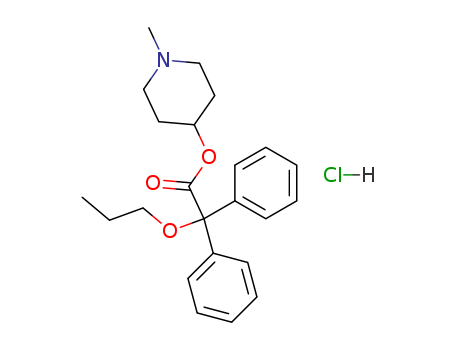
Chemical Property of Propiverine hydrochloride
Chemical Property:
- Appearance/Colour:Off-white solid
- Vapor Pressure:3.61E-10mmHg at 25°C
- Melting Point:224-226 °C
- Boiling Point:484.2 °C at 760 mmHg
- Flash Point:246.6 °C
- PSA:38.77000
- LogP:4.73410
- Storage Temp.:-20°C Freezer
- Solubility.:H2O: soluble5mg/mL, clear (warmed)
- Hydrogen Bond Donor Count:1
- Hydrogen Bond Acceptor Count:4
- Rotatable Bond Count:8
- Exact Mass:403.1914215
- Heavy Atom Count:28
- Complexity:429
- Purity/Quality:
-
99%, *data from raw suppliers
Propiverine hydrochloride *data from reagent suppliers
Safty Information:
- Pictogram(s):
Xi
- Hazard Codes:Xi
- Statements:
37/38-41
- Safety Statements:
26-39
- MSDS Files:
-
SDS file from LookChem
Useful:
- Canonical SMILES:CCCOC(C1=CC=CC=C1)(C2=CC=CC=C2)C(=O)OC3CCN(CC3)C.Cl
- Recent ClinicalTrials:Effect of Interferential Electrical Stimulation on Pain Perception and Disability Level on Interstitial Cystitis
- Recent EU Clinical Trials:Efficacy of propiverine hydrochloride extended release (ER) 45 mg in patients with neurogenic detrusor overactivity – an active-controlled single center crossover trial
- Recent NIPH Clinical Trials:Efficacy of propiverine hydrochloride for urinary incontinence afterlaparoscopic radical prostatectomy
-
Description
Propiverine hydrochloride is a new urological agent developed for pollakuria and
aconuresis. It appears to exhibit anticholinergic properties and in animal experiments
inhibited KCl induced contractions in the bladder and ileum.
-
Uses
Propiverine is used in treatment of urinary incontinence. Propiverine is an anticholinergic.
-
Clinical Use
Treatment of urinary frequency, urgency and
incontinence
Neurogenic bladder instability
-
Drug interactions
Potentially hazardous interactions with other drugs
Anti-arrhythmics: increased risk of antimuscarinic
side effects with disopyramide.