Welcome to LookChem.com Sign In|Join Free
  • or

Encyclopedia

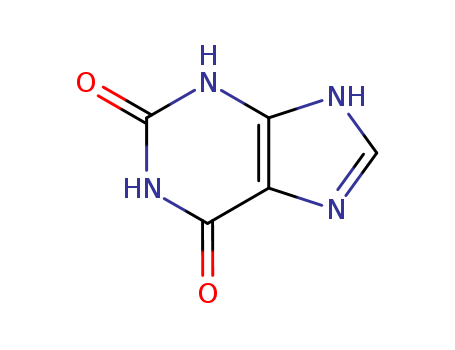
Xanthine

Base Information
  • Chemical Name:Xanthine
  • CAS No.:69-89-6
  • Deprecated CAS:16819-86-6,28522-58-9,33669-67-9,42911-15-9,6050-36-8,6053-41-4,51953-26-5,28522-58-9,33669-67-9,42911-15-9,51953-26-5,6050-36-8,6053-41-4
  • Molecular Formula:C5H4N4O2
  • Molecular Weight:152.112
  • Hs Code.:29335990
  • European Community (EC) Number:200-718-6
  • NSC Number:14664
  • UNII:1AVZ07U9S7
  • DSSTox Substance ID:DTXSID4035120
  • Nikkaji Number:J2.371J
  • Wikipedia:Xanthine
  • Wikidata:Q50980
  • Metabolomics Workbench ID:37186
  • ChEMBL ID:CHEMBL1424
  • Mol file:69-89-6.mol
Xanthine

Synonyms:Xanthine

Suppliers and Price of Xanthine
Supply Marketing:
Business phase:
The product has achieved commercial mass production*data from LookChem market partment
Manufacturers and distributors:
  • Manufacture/Brand
  • Chemicals and raw materials
  • Packaging
  • price
  • Usbiological
  • Xanthine
  • 2.5g
  • $ 418.00
  • Usbiological
  • Xanthine 99+%
  • 5g
  • $ 156.00
  • TRC
  • Xanthine
  • 25g
  • $ 340.00
  • TRC
  • Xanthine
  • 10g
  • $ 145.00
  • TCI Chemical
  • Xanthine >98.0%(HPLC)
  • 25g
  • $ 57.00
  • Sigma-Aldrich
  • Xanthine
  • 5gm
  • $ 77.20
  • Sigma-Aldrich
  • Xanthine ≥99.5% (HPLC), purified by recrystallization
  • 5g
  • $ 75.60
  • Sigma-Aldrich
  • Xanthine BioUltra, ≥99%
  • 1g
  • $ 65.30
  • Sigma-Aldrich
  • Xanthine ≥99%
  • 10g
  • $ 58.60
  • Sigma-Aldrich
  • Xanthine BioUltra, ≥99%
  • 5g
  • $ 145.00
Total 190 raw suppliers
Chemical Property of Xanthine
Chemical Property:
  • Appearance/Colour:White to off-white crystalline powder 
  • Melting Point:300 °C 
  • Refractive Index:1.989 
  • Boiling Point:834.9 °C at 760 mmHg 
  • PKA:pKa 9.95 (Uncertain) 
  • Flash Point:458.7 °C 
  • PSA:94.40000 
  • Density:1.94 g/cm3  
  • LogP:-1.06050 
  • Storage Temp.:Store at RT. 
  • Solubility.:NH4OH: freely soluble 
  • Water Solubility.:Soluble in water(0.067g/L). 
  • XLogP3:-0.7
  • Hydrogen Bond Donor Count:3
  • Hydrogen Bond Acceptor Count:3
  • Rotatable Bond Count:0
  • Exact Mass:152.03342538
  • Heavy Atom Count:11
  • Complexity:217
Purity/Quality:

99% *data from raw suppliers

Xanthine *data from reagent suppliers

Safty Information:
  • Pictogram(s): IrritantXi 
  • Hazard Codes:Xi 
  • Statements: 36-43-36/37/38 
  • Safety Statements: 36/37-37/39-26 
MSDS Files:

SDS file from LookChem

Total 1 MSDS from other Authors

Useful:
  • Chemical Classes:Nitrogen Compounds -> Purines
  • Canonical SMILES:C1=NC2=C(N1)C(=O)NC(=O)N2
  • Recent ClinicalTrials:Effects of Xanthohumol on Metabolic Syndrome Progression
  • Uses 2,6-Dihydroxypurine was fund in animal organs, yeast, patatoes, coffee beans, tea. 2,6-Dihydroxypurine can be used to relax and widen certain breathing passages of the lungs. It is also found that a large number of derivatives have adenoside receptor antagonist properties. Xanthine and xanthine oxidase system can be used to produce superoxide radicals.
Technology Process of Xanthine

There total 114 articles about Xanthine which guide to synthetic route it. The literature collected by LookChem mainly comes from the sharing of users and the free literature resources found by Internet computing technology. We keep the original model of the professional version of literature to make it easier and faster for users to retrieve and use. At the same time, we analyze and calculate the most feasible synthesis route with the highest yield for your reference as below:

synthetic route:
Guidance literature:
With perchloric acid; at 110 - 130 ℃; for 0.25h;
DOI:10.1002/ejoc.200700271
Refernces

Synthesis of some 7-substituted-2,4,8(1H,3H,7H)pyrimido[5,4-d]pyrimidinetriones

10.1002/jhet.5570230531

The study, titled "Synthesis of Some 7-Substituted-2,4,8(1H,3H,7H)pyrimido[5,4-d]pyrimidinetriones," focused on synthesizing 7-substituted pyrimido[5,4-d]pyrimidinetriones under mild conditions, using ethyl 5-ethoxymethyleneamino-orotate as a key starting material. This compound was derived from ethyl 5-aminoorotate, which was obtained by reducing ethyl 5-nitroorotate with sodium dithionite. The ethyl 5-ethoxymethyleneamino-orotate was then cyclized with various primary amines to introduce a range of substituents into the 7-position of the pyrimido[5,4-d]pyrimidinetrione ring system. The synthesized compounds were characterized by their structures, reaction yields, and analytical data, including elemental analysis and NMR spectroscopy. The study also described the methylation of the 7-benzyl derivative to produce 1,3-dimethyl and 1,3,7-trimethyl derivatives using trimethyl phosphate. The synthesized compounds are of interest as deaza-analogs of naturally occurring antibiotics, as "homopurines" related to xanthine and uric acid, and as intermediates in the synthesis of folate analogs.

Mannich-type C-nucleosidations in the 5,8-diaza-7,9-dicarba-purine family

10.1021/ol048649m

The study investigates the Mannich-type C-nucleosidation reactions of 2,6-(oxo or amino)-disubstituted 5,8-diaza-7,9-dicarba-purines, a family of nucleobase analogues that are isomeric to natural purine nucleobases like adenine and guanine. The researchers synthesized various purinoids (1-4) and their adenine analogue using different chemical methods. For instance, the guanine analogue (2) was synthesized from N-formyl-glycyl-guanidine and trichloroacetonitrile through a series of reactions including hydrolysis and cyclization. The isoguanine analogue (3) and xanthine analogue (4) were prepared from 5-aminoimidazole using different reagents and reaction conditions. The study found that all these purinoids can undergo Mannich-type C-nucleosidation reactions with cyclic iminium salts, such as pyrroline derivatives (12 and 15), under mild conditions to form C-nucleosides. These C-nucleosides are isosteric with conventional N-nucleosides of natural purines. The reactivity of the purinoids in these C-nucleosidation reactions varies, with the 2,6-diamino derivative (1) being the most reactive and the 2-deamino derivative (adenine analogue) being the least reactive. The study also explored the stability and configuration of the resulting nucleosides, as well as the potential tautomerism in the isoguanine analogue (3). The findings suggest that these purinoids could be useful in studying the chemical etiology of nucleic acid structure and have potential applications in informational chemistry, medicinal chemistry, and chemical biology.

Synthesis and Pharmacological Evaluation of Novel Non-nucleotide Purine Derivatives as P2X7 Antagonists for the Treatment of Neuroinflammation

10.1021/acs.jmedchem.0c02145

This research focuses on the development of new P2X7 antagonists to treat neuroinflammation associated with neurodegenerative diseases (NDDs). The study introduces a series of novel non-nucleotide purine derivatives designed to be blood-brain barrier (BBB)-permeable, with the goal of identifying potential therapeutic candidates for central nervous system (CNS) disorders. The compounds were synthesized by linking purine or xanthine cores to an aryl group through different short spacers. They were tested through various assays, including YO-PRO-1 uptake assays, intracellular calcium dynamics, two-electrode voltage-clamp recordings, and interleukin-1? release assays. The most potent and selective antagonist identified was compound 6 (ITH15004), which demonstrated significant P2X7 blockade, good BBB permeability, and selectivity for human P2X7 over rat P2X1, P2X2, and P2X4 receptors.


Post a RFQ

Enter 15 to 2000 letters.Word count: 0 letters

Attach files(File Format: Jpeg, Jpg, Gif, Png, PDF, PPT, Zip, Rar,Word or Excel Maximum File Size: 3MB)

1 Customer Service

What can I do for you?
Get Best Price

Get Best Price for 69-89-6