Welcome to LookChem.com Sign In|Join Free
  • or

Encyclopedia

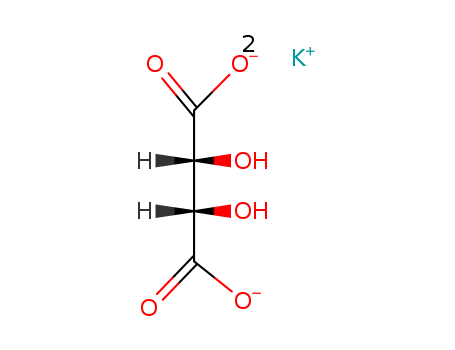
Dipotassium;2,3-dihydroxybutanedioate

Base Information
  • Chemical Name:Dipotassium;2,3-dihydroxybutanedioate
  • CAS No.:921-53-9
  • Molecular Formula:C4H4O6*2K
  • Molecular Weight:226.269
  • Hs Code.:29181300
  • European Community (EC) Number:213-067-8
  • Nikkaji Number:J1.990.332J
  • Wikidata:Q65770886
  • Mol file:921-53-9.mol
Dipotassium;2,3-dihydroxybutanedioate

Synonyms:921-53-9;Dipotassium;2,3-dihydroxybutanedioate;Soluble tartar;C4H6O6.2K;UNII-O9WLL1ZL8S;C4-H6-O6.2K;Dipotassium (R*,R*)-(+-)-tartrate;potassium tartarate;Potassiumtartrate&nbs;SCHEMBL80796;Tartaric acid, dipotassium salt;AVTYONGGKAJVTE-UHFFFAOYSA-L;AKOS015836341;AS-81988;Butanedioic acid, 2,3-dihydroxy- [R-(R*,R*)]-, dipotassium salt;Butanedioic acid, 2,3-dihydroxy- [R-(R,R)]-, dipotassium salt

Suppliers and Price of Dipotassium;2,3-dihydroxybutanedioate
Supply Marketing:
Business phase:
The product has achieved commercial mass production*data from LookChem market partment
Manufacturers and distributors:
  • Manufacture/Brand
  • Chemicals and raw materials
  • Packaging
  • price
  • Sigma-Aldrich
  • Potassium L-tartrate monobasic puriss., meets analytical specification of Ph.Eur., BP, FCC, 99.5-100.5% (related to dried substance)
  • 6 x 1 kg
  • $ 260.00
  • Sigma-Aldrich
  • Potassium L-tartrate monobasic puriss., meets analytical specification of Ph.Eur., BP, FCC, 99.5-100.5% (related to dried substance)
  • 1 kg
  • $ 96.30
  • Sigma-Aldrich
  • Potassium L-tartrate monobasic 99%
  • 500 g
  • $ 67.80
  • Sigma-Aldrich
  • Potassium L-tartrate monobasic 99%
  • 100 g
  • $ 26.10
  • American Custom Chemicals Corporation
  • POTASSIUM TARTRATE 98.00%
  • 500G
  • $ 4606.14
  • AHH
  • Potassiumtartrate 98%
  • 500g
  • $ 380.00
Total 85 raw suppliers
Chemical Property of Dipotassium;2,3-dihydroxybutanedioate
Chemical Property:
  • Appearance/Colour:white crystalline powder 
  • Vapor Pressure:0Pa at 25℃ 
  • Boiling Point:399.3 °C at 760 mmHg 
  • Flash Point:209.4 °C 
  • PSA:117.89000 
  • Density:1.954 g/mL at 25 °C(lit.) 
  • LogP:-3.45730 
  • Hydrogen Bond Donor Count:2
  • Hydrogen Bond Acceptor Count:6
  • Rotatable Bond Count:1
  • Exact Mass:225.92820081
  • Heavy Atom Count:12
  • Complexity:123
Purity/Quality:

99.9% *data from raw suppliers

Potassium L-tartrate monobasic puriss., meets analytical specification of Ph.Eur., BP, FCC, 99.5-100.5% (related to dried substance) *data from reagent suppliers

Safty Information:
  • Pictogram(s):  
  • Hazard Codes: 
  • Safety Statements: 24/25 
MSDS Files:

SDS file from LookChem

Total 1 MSDS from other Authors

Useful:
  • Canonical SMILES:C(C(C(=O)[O-])O)(C(=O)[O-])O.[K+].[K+]
  • Description Potassium tartrate, dipotassium tartrate or argol has formula K2C4H4O6. It is the potassium salt of tartaric acid. It is often confused with potassium bitartrate, also known as cream of tartar. As a food additive, it shares the E number E336 with potassium bitartrate.
  • Uses Manufacture of potassium salts, medicine (cathartic), lab reagent. Potassium tartrate is the acid potassium salt of tartaric acid occurring as crystals or powder. It is relatively poorly soluble having a solubility in 100 ml of water at 0.8 g at 25°c and 6.1 g at 100°c. A 1% solution at 30°c has a ph of 3.4. Chemical names are potassium acid tartrate, potassium hydrogen tartrate, and potassium bitartrate. It functions to complex with heavy metal ions and to regulate ph; it can have a gentle laxative action if given at adequate levels. The acidulant is used in chemical leavening to release carbon dioxide which produces the loaf volume. It has limited reactivity in the cold so when used in reduced-temperature batters it has little gas evolution during the initial mixing. At room temperatures, it has a relatively fast reaction rate. It functions as a taste regulator in sugar icing and in controlled crystallization of toffees and fondants by the regulated inversion of sucrose. It is used in baked goods, crackers, candy, and puddings.
Technology Process of Dipotassium;2,3-dihydroxybutanedioate

There total 11 articles about Dipotassium;2,3-dihydroxybutanedioate which guide to synthetic route it. The literature collected by LookChem mainly comes from the sharing of users and the free literature resources found by Internet computing technology. We keep the original model of the professional version of literature to make it easier and faster for users to retrieve and use. At the same time, we analyze and calculate the most feasible synthesis route with the highest yield for your reference as below:

synthetic route:
Guidance literature:
In water; byproducts: NH3; mixing boiling aq. solns. of NH4 hydrotartrate and KClO3; adding alc.; crystn. of K-hydrotartrate; filtration; boiling with BaCO3 to eliminate NH3; crystn.;
Post a RFQ

Enter 15 to 2000 letters.Word count: 0 letters

Attach files(File Format: Jpeg, Jpg, Gif, Png, PDF, PPT, Zip, Rar,Word or Excel Maximum File Size: 3MB)

1 Customer Service

What can I do for you?
Get Best Price

Get Best Price for 921-53-9