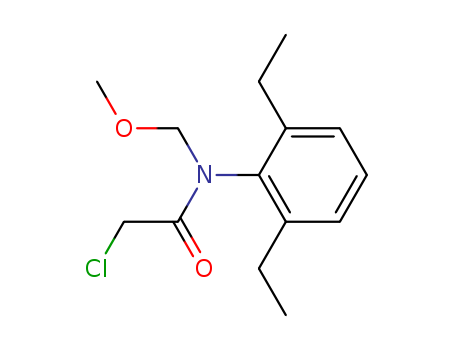
Chemical Property of Alachlor
Chemical Property:
- Appearance/Colour:yellowish crystal
- Vapor Pressure:9.74E-07mmHg at 25°C
- Melting Point:39-42 °C
- Refractive Index:1.539
- Boiling Point:404 °C at 760 mmHg
- PKA:1.20±0.50(Predicted)
- Flash Point:198.1 °C
- PSA:29.54000
- Density:1.119 g/cm3
- LogP:2.98710
- Storage Temp.:APPROX 4°C
- Water Solubility.:0.024 g/100 mL
- XLogP3:3.5
- Hydrogen Bond Donor Count:0
- Hydrogen Bond Acceptor Count:2
- Rotatable Bond Count:6
- Exact Mass:269.1182566
- Heavy Atom Count:18
- Complexity:248
- Transport DOT Label:Poison
- Purity/Quality:
-
98%min *data from raw suppliers
Alachlor *data from reagent suppliers
Safty Information:
- Pictogram(s):
 Xn,
Xn, N
N
- Hazard Codes:Xn;N,N,Xn,F,T
- Statements:
22-40-43-50/53-67-65-38-11-52/53-39/23/24/25-23/24/25-51/53
- Safety Statements:
36/37-46-60-61-62-45-16
- MSDS Files:
-
SDS file from LookChem
Useful:
- Chemical Classes:Pesticides -> Herbicides, Chloracetanilide
- Canonical SMILES:CCC1=C(C(=CC=C1)CC)N(COC)C(=O)CCl
- Inhalation Risk:Evaporation at 20 °C is negligible; a harmful concentration of airborne particles can, however, be reached quickly on spraying or when dispersed, especially if powdered.
- Effects of Long Term Exposure:Repeated or prolonged contact may cause skin sensitization. The substance may have effects on the kidneys and liver. The substance may have effects on the spleen. This may result in siderosis. This substance is possibly carcinogenic to humans.
-
description
Alachlor is a pre- and postemergence herbicide used to control annual grasses and many broad-leaved weeds in corn and in many other crops. There are liquid, dry flowable, microencapsulated, and granular formulations. Alachlor is applied by ground, aerial, and chemigation equipment. It can also be mixed with dry bulk fertilizer. It is lost from soil mainly through volatilization, photodegradation, and biodegradation. Alachlor and its degradation products may be found in soil, groundwater, and surface water.
-
Uses
It can be used as selective herbicide for dryland bud. If a plant bud absorbs the agent, it can inhibit the activity of the protease and hinder protein synthesis, resulting in the death of weeds. It is mainly used for the germination of weeds in the soil before the seedlings, which is basically ineffective for the unearthed weeds. It can prevent annual grasses in the fields of dryland crops such as soybean, cotton, sugar beet, corn, peanut and rape, such as barnyard grass, Goosegrass, autumn grass, crabgrass, Goosegrass, Setaria, Brachiaria etc. Alachlor is used pre- or early post-emergence to control annual grasses and many broadleaved weeds mainly in maize, but also in cotton, brassicas, oilseed rape, peanuts, radish, soy beans, and sugar-cane. Alachlor is one of the most widely used herbicides in the
United States and is used as an herbicide for grasses, broadleaf
seeds, corn, sorghum, soybeans, peanuts, cotton, vegetables,
and forage crops. Preemergence, early postemergence or soil-incorporated herbicide used to control
most annual grasses and many annual broad-leaved weeds in beans, corn, cotton, milo,
peanuts, peas, soybeans, sunflower and certain woody ornamentals.
-
Description
Alachlor is a herbicide. Occupational contact dermatitis
was rarely observed in agricultural workers.