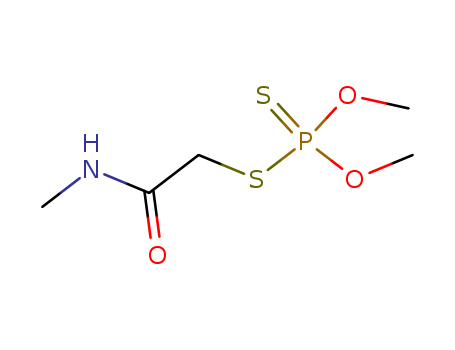
Chemical Property of Dimethoate
Chemical Property:
- Appearance/Colour:white crystalline solid
- Vapor Pressure:2.5 x 10⁻⁴ Pa (25 °C)
- Melting Point:52-52.5 °C
- Refractive Index:1.532
- Boiling Point:107 °C (0.05 torr)
- PKA:14.40±0.46(Predicted)
- Flash Point:107 °C
- PSA:114.76000
- Density:1.304 g/cm3
- LogP:2.02440
- Storage Temp.:0-6°C
- Water Solubility.:Slightly soluble. 2.5 g/100 mL
- XLogP3:0.8
- Hydrogen Bond Donor Count:1
- Hydrogen Bond Acceptor Count:5
- Rotatable Bond Count:5
- Exact Mass:228.99962259
- Heavy Atom Count:12
- Complexity:191
- Transport DOT Label:Poison
- Purity/Quality:
-
99%, *data from raw suppliers
ANTI-USF2 antibody produced in mouse clone 6A9, purified immunoglobulin, buffered aqueous solution *data from reagent suppliers
Safty Information:
- Pictogram(s):
 Xn,
Xn,  T,
T,  F
F
- Hazard Codes:Xn,T,F
- Statements:
21/22-63-43-36/37/38-23/24/25-45-36-20/21/22-11-67-40
- Safety Statements:
2-36/37-24/25-23-53-26-16
- MSDS Files:
-
SDS file from LookChem
Total 1 MSDS from other Authors
Useful:
- Chemical Classes:Pesticides -> Organophosphate Insecticides
- Canonical SMILES:CNC(=O)CSP(=S)(OC)OC
- Inhalation Risk:Evaporation at 20 °C is negligible; a harmful concentration of airborne particles can, however, be reached quickly.
- Effects of Short Term Exposure:The substance may cause effects on the nervous system at high levels. Cholinesterase inhibition. Exposure could cause death. The effects may be delayed. Medical observation is indicated.
- Effects of Long Term Exposure:Repeated or prolonged contact with skin may cause dermatitis. Cholinesterase inhibition. Cumulative effects are possible. See Acute Hazards/Symptoms. Animal tests show that this substance possibly causes toxic effects upon human reproduction.
-
Description
Dimethoate is a grey-white crystalline solid at room temperature. It is sparingly soluble in water, soluble in methanol and cyclohexane, but very soluble in chloroform and benzene. It has been classified by the U.S. EPA under GUP. Dimethoate is used extensively for the control of crop pests such as mites, aphids, thrips, plant hoppers, white-flies, and a wide range of other insects that damage, crops, fruits, vegetables, and ornamental plants. Dimethoate is also used for the control of cattle grubs that infect livestock. Thermal decomposition of dimethoate is highly hazardous due to the release of fumes of dimethylsulphide, methyl mercaptan, carbon monoxide, carbon dioxide, phosphorus pentoxide, and nitrogen oxides. Dimethoate
is colorless crystalline substance, mp 49 ?C, bp
117 ?C/0.1 mm Hg, vp 0.25 mPa (25 ?C). The solubility in
water is 23.8 g/L at 20 ?C and pH 7. It is readily soluble
in polar organic solvents. Log Kow = 0.7. Dimethoate
is relatively stable in aqueous media at pH 2–7 and
hydrolyzed in alkaline media; DT50 (20 ?C) at pH 9 is 12 d.
-
Uses
An organophosphate insecticide. It is an anticholinesterase which disables cholinesterase, an enzyme essential for central nervous system function. Neurotoxic in humans. Systemic and contact organophosphorus insecticide and acaricide used to control thrips and red spider mites on many agricultural crops, saw?ies on apples and plums, wheat bulb and olive ?ies. Dimethoate is used to control of a wide range of insect and mite
pests in many crops. It is also used to control flies in animal houses. Systemic and contact insecticide.