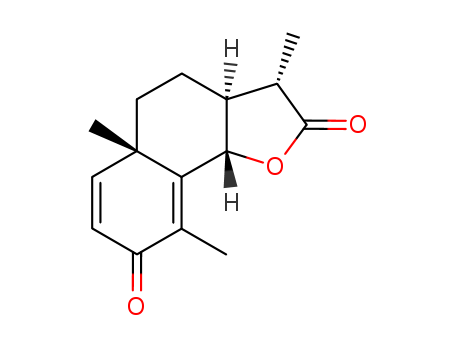
Chemical Property of Santonin
Chemical Property:
- Vapor Pressure:2.24E-07mmHg at 25°C
- Melting Point:172-173 °C(lit.)
- Refractive Index:-172.5 ° (C=2, CHCl3)
- Boiling Point:423.4°Cat760mmHg
- Flash Point:189.7°C
- PSA:43.37000
- Density:1.18g/cm3
- LogP:2.41960
- Storage Temp.:2-8°C
- Solubility.:Chloroform (Slightly)
- Water Solubility.:0.2g/L(17.5 oC)
- XLogP3:2.3
- Hydrogen Bond Donor Count:0
- Hydrogen Bond Acceptor Count:3
- Rotatable Bond Count:0
- Exact Mass:246.125594432
- Heavy Atom Count:18
- Complexity:500
- Purity/Quality:
-
99%, *data from raw suppliers
(-)-Santonin *data from reagent suppliers
Safty Information:
- Pictogram(s):
Toxic by ingestion, affects color vision.
- Hazard Codes:Xn,Xi,T+
- Statements:
22-36/37/38-26/27/28
- Safety Statements:
22-24/25-45-37-36-28-26
- MSDS Files:
-
Useful:
- Canonical SMILES:CC1C2CCC3(C=CC(=O)C(=C3C2OC1=O)C)C
- Isomeric SMILES:C[C@H]1[C@@H]2CC[C@]3(C=CC(=O)C(=C3[C@H]2OC1=O)C)C
-
Description
Santonin is a lactone compound extracted from the flower bud of Artemisia cina
Berg in Compositae, crown daisy chrysanthemum or other plants in Artemisia. It
has been recorded in ancient China . Its English name is santonica wormseed,
Chinese alias is ‘quhaosu’ and Latin name is Seriphidium cinum (Berg ex Poljak.)
Pol-jak. . Santonica wormseed, a variant name for Artemisia
cina Berg, is the leaf and anthotaxy of Artemisia cina Berg in sagebrush plants in
Compositae. There are more than 100 plus in sagebrush, in which about 30 plus live
in China, and parts of them can be used medicinally.Santonica wormseed, used as raw material to extract and manufacture santonin,
lives in cold, dry sandy loam. The place of origin is the Southern Central Asia in
the former Soviet Union. China introduced the earliest cultivation in Xinjiang, and
now it is introduced and cultivated in the North, Northeast and Northwest China.
Santonica wormseed mainly contains hispidulin, quercetin and caffeic acid, and its flower contains 1–3.5% α-santonin, 1–3% artemisinin and volatile oil (mainly
is 1, 8-cineole) and so on. Leaf also contains a small amount of α-santonin. In
addition, it also contains β-cintonin, 3,4,5,7-tetrahydroxy-3-methoxyflavone7-
glucoside and aglucone.
-
Physical properties
Appearance: a colourless prism crystal or white crystalline powder, odourless, a
little taste bitter and turning yellow in the sunlight. Solubility: hardly soluble in
water, sparingly soluble in ethanol, freely soluble in boiling ethanol and chloroform
and slightly soluble in diethyl ether. Melting point: 170–174 °C. Specific optical
rotation: ?170 to ?175°, determined on 1% ethanol solution at 25 °C.Santonin is a kind of ketolide with two double bonds. It forms a salt by the ring opening when dissolving in alkaline solutions and reforms ketolide by
acidification.
-
Uses
anthelmintic (-)-Santonin is a sesquiterpene lactone derivative which acts as an anti-pyretic agent when tested with subjects antagonized by haloperidol. Causes a decrease in temperature of mammals. (?)-α-Santonin has been used as a eudesmane-type sesquiterpene to study its effects on impairment of 231MFP breast cancer cell survival.
-
Indications
As a kind of deworming drug, santonin was effective for the treatment of human
roundworm infection, but it is no longer in use at present because of the develop�ment of more effective medicines.
-
Clinical Use
Santonin has been used for a long time as a kind of deworming drug. Its mechanism
is between inhibitory effect on γ-GABA and excitatory effect of cholinergic func tion. It also acts on the human central nervous system and can cause some adverse
effects, such as dizziness, leipopsychia, headache, epilepsy, xanthopsia, paresthesia
and so onSantonin is easily dissolved and absorbed in the intestine due to alkaline intesti nal fluid and solvent effect of bile salts. Especially, it can cause severe toxic reaction
more easily for increasing absorption because intake of fatty food promotes bile
production, secretion and release.Santonin has obvious central nervous system toxicity. A small amount can cause
colour deficiency, and a large amount can cause epileptiform, excessive excitement
turning into severe repression and even coma. Santonin is a highly toxic substance.
Children’s lethal dose is 0.15 g; adults’ lethal dose is about 1 g. Santonin has already
been phased out for the toxicity.