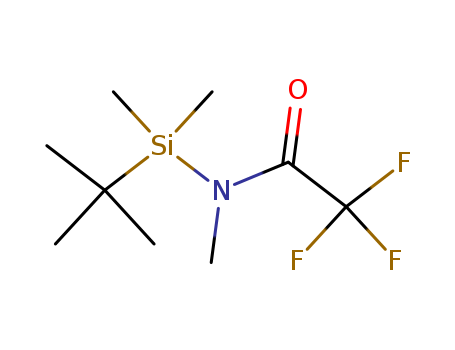
Chemical Property of N-(tert-Butyldimethylsilyl)-N-methyltrifluoroacetamide
Chemical Property:
- Appearance/Colour:clear colorless to slightly yellow liquid
- Vapor Pressure:0.517mmHg at 25°C
- Refractive Index:n20/D 1.402(lit.)
- Boiling Point:182.6 °C at 760 mmHg
- PKA:-1.50±0.70(Predicted)
- Flash Point:64.2 °C
- PSA:20.31000
- Density:1.032 g/cm3
- LogP:3.01230
- Storage Temp.:2-8°C
- Sensitive.:Moisture Sensitive
- Solubility.:sol most aprotic organic solvents.
- Water Solubility.:decomposes
- Hydrogen Bond Donor Count:0
- Hydrogen Bond Acceptor Count:4
- Rotatable Bond Count:2
- Exact Mass:241.11097522
- Heavy Atom Count:15
- Complexity:255
- Purity/Quality:
-
99.9% *data from raw suppliers
N-(tert-Butyldimethylsilyl)-N-methyltrifluoroacetamide(TechnicalGrade) *data from reagent suppliers
Safty Information:
- Pictogram(s):
 Xi,
Xi, F
F
- Hazard Codes:Xi,F
- Statements:
10-36/37/38
- Safety Statements:
26-36-16-37/39-36/37/39
- MSDS Files:
-
SDS file from LookChem
Useful:
- Chemical Classes:Metals -> Metalloid Compounds (Silicon)
- Canonical SMILES:CC(C)(C)[Si](C)(C)N(C)C(=O)C(F)(F)F
-
Physical properties
bp 168–170°C; d 1.12 g cm?3.
-
Uses
N-(tert-Butyldimethylsilyl)-N-methyl-trifluoroacetamide is a silylating agent used in the derivatization of various organic compounds (such as amino acids) for gas chromatogography-mass spectrometry (GC-MS) analysis. In the
presence of 1% of t-butyldimethylchlorosilane as the catalyst,
N-(t-butyldimethylsilyl)-N-methyltrifluoroacetamide (BSMTFA)
functions as an extremely reactive t-butyldimethylsilylating
reagent for alcohols, amines, carboxylic acids, and thiols. Silylation
is generally completed within 5 min at 25°C in acetonitrile.
This amide is more reactive than N-(t-butyldimethylsilyl)-N-methylacetamide.
In the protection of a hydroxy group, the resultant tbutyldimethylsilyl
(TBDMS) ethers are stable under the conditions
for acetate saponification and hydrogenation.These silyl
ethers also remain intact towards the Jones reagent and Wittig
reagents. The TBDMS ethers are approx. 10 times more stable
against hydrolysis than the corresponding trimethylsilyl (TMS)
ethers.Selective removal of the TBDMS group can be accomplished
by use of dilute acetic acid or tetra-n-butylammonium
fluoride in THF at 25°C.
Silylation of ketones by use ofBSMTFAoccurs in triethylamine
and DMF at 40–60°C to give the corresponding silyl enol ethers
in good to excellent yields (eq 1).In addition, silyl ether formation
takes place in N-hydroxysuccinimide (88% yield) and Nhydroxypyrrole
(99% yield) by use of BSMTFA in THF. N-tert-Butyldimethylsilyl-N-methyltrifluoroacetamide with 1% tert-butyldimethylchlorosilane is commonly used for the preparation of N-tert-butyldimethylsilyl ethanolamines resulting from the hydrolysis of nitrogen mustards. It is also used for selective O-silylation of N,O-diacylhydroxyl amines.