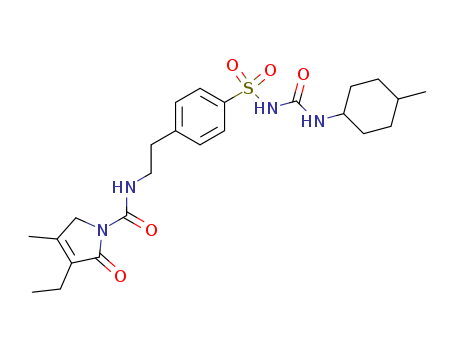
Chemical Property of Glimepiride
Chemical Property:
- Appearance/Colour:white cyrstalline solid
- Melting Point:212.2-214.5 °C
- Refractive Index:1.599
- PKA:5.10±0.10(Predicted)
- PSA:133.06000
- Density:1.29 g/cm3
- LogP:5.26540
- Storage Temp.:Room temp
- Solubility.:DMSO: >10 mg/mL
- Water Solubility.:DMSO: >10 mg/mL
- Purity/Quality:
-
99.5%min, *data from raw suppliers
Glimepiride *data from reagent suppliers
Safty Information:
- Pictogram(s):
 Xn,
Xn, Xi
Xi
- Hazard Codes:Xn,Xi
- Statements:
21-36/38-46-62-63
- Safety Statements:
25-26-36/37-53
- MSDS Files:
-
SDS file from LookChem
Useful:
-
Classification and Structure
Glimepiride is a third-generation sulfonylurea used in the treatment of type II diabetes mellitus. It shares a similar fundamental structure with glibenclamide and stimulates insulin secretion primarily by inhibiting the Sur1-regulated ATP-sensitive potassium channel.
-
Pharmacokinetics and Pharmacodynamics
Glimepiride exhibits high hypoglycemic efficacy and low systemic toxicity. It belongs to class II drugs according to the Biopharmaceutical Classification System (BCS), characterized by low solubility and high permeability. However, its poor water solubility leads to challenges in oral pharmaceutical preparation, dissolution profile, and bioavailability.
-
Enhancement Techniques
Various techniques are employed to enhance the solubility of poorly water-soluble drugs like glimepiride. These include prodrug formation, salt formation, crystal engineering, and solid dispersion methods using water-soluble polymers. Solid dispersion is particularly effective in improving aqueous solubility.
-
Physical Properties
Glimepiride does not undergo polymorphic transformations during processing, as indicated by studies using techniques like differential scanning calorimetry (DSC) and FT-IR spectroscopy. However, milling processes can induce changes in the hydrogen bonding patterns of glimepiride crystals.
-
Mechanism of Action
Glimepiride stimulates insulin release from beta cells in the pancreas and enhances the activity of intracellular insulin receptors. It undergoes slow gastrointestinal dissolution and exhibits inter-personal variations, affecting its bioavailability.
-
Adverse Effects and Strategies
Severe hypoglycemia can occur with large doses of glimepiride due to variations in absorption. Strategies such as inclusion complexes, solid dispersion, and micronization techniques have been employed to enhance dissolution, oral absorption, and bioavailability. Additionally, formulations like sublingual tablets and sustained-release tablets aim to improve drug absorption profiles and consistency.