Welcome to LookChem.com Sign In|Join Free
  • or

Encyclopedia

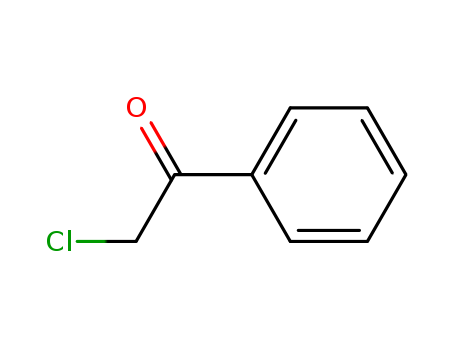
2-Chloroacetophenone

Base Information
  • Chemical Name:2-Chloroacetophenone
  • CAS No.:532-27-4
  • Molecular Formula:C8H7ClO
  • Molecular Weight:154.596
  • Hs Code.:2914700090
  • European Community (EC) Number:208-531-1,639-652-1
  • ICSC Number:0128
  • NSC Number:41666
  • UN Number:1697
  • UNII:88B5039IQG
  • DSSTox Substance ID:DTXSID9020293
  • Nikkaji Number:J2.629H
  • Wikipedia:Phenacyl_chloride
  • Wikidata:Q284209
  • NCI Thesaurus Code:C107326,C73902
  • Pharos Ligand ID:3L54FARDFBLA
  • ChEMBL ID:CHEMBL105712
  • Mol file:532-27-4.mol
2-Chloroacetophenone

Synonyms:2 Chloro 1 phenylethanone;2 Chloroacetophenone;2-Chloro-1-phenylethanone;2-Chloroacetophenone;3' Chloroacetophenone;3'-Chloroacetophenone;alpha Chloroacetophenone;alpha-Chloroacetophenone;Chloracetophenone;Chloroacetophenone;Mace;omega Chloroacetophenone;omega-Chloroacetophenone
Suppliers and Price of 2-Chloroacetophenone
Supply Marketing:
Business phase:
The product has achieved commercial mass production*data from LookChem market partment
Manufacturers and distributors:
  • Manufacture/Brand
  • Chemicals and raw materials
  • Packaging
  • price
Total 1 raw suppliers
Chemical Property of 2-Chloroacetophenone
Chemical Property:
  • Appearance/Colour:White to light yellow crystal 
  • Melting Point:54-56 °C 
  • Refractive Index:1.5438 
  • Boiling Point:244.5 °C at 760 mmHg 
  • Flash Point:104.8 °C 
  • PSA:17.07000 
  • Density:1.168 g/cm3 
  • LogP:2.10810 
  • Water Solubility.:insoluble. <0.1 g/100 mL at 19℃ 
  • XLogP3:2.3
  • Hydrogen Bond Donor Count:0
  • Hydrogen Bond Acceptor Count:1
  • Rotatable Bond Count:2
  • Exact Mass:154.0185425
  • Heavy Atom Count:10
  • Complexity:116
  • Transport DOT Label:Poison
Purity/Quality:
Safty Information:
  • Pictogram(s): Toxic
  • Hazard Codes: T:Toxic;
     
  • Statements: R23/25:; R36/37/38:; 
  • Safety Statements: S26:; S28A:; S36/37/39:; S45:; 
MSDS Files:

SDS file from LookChem

Useful:
  • Chemical Classes:Toxic Gases & Vapors -> Tear Gas Agents
  • Canonical SMILES:C1=CC=C(C=C1)C(=O)CCl
  • Inhalation Risk:A harmful contamination of the air will be reached rather slowly on evaporation of this substance at 20 °C.
  • Effects of Short Term Exposure:Lachrymation. The substance is severely irritating to the eyes. The substance is irritating to the skin and respiratory tract. Inhalation of the vapour or aerosol may cause lung oedema. The effects may be delayed. Medical observation is indicated.
  • Effects of Long Term Exposure:Repeated or prolonged contact with skin may cause dermatitis. Repeated or prolonged contact may cause skin sensitization.
Technology Process of 2-Chloroacetophenone

There total 185 articles about 2-Chloroacetophenone which guide to synthetic route it. The literature collected by LookChem mainly comes from the sharing of users and the free literature resources found by Internet computing technology. We keep the original model of the professional version of literature to make it easier and faster for users to retrieve and use. At the same time, we analyze and calculate the most feasible synthesis route with the highest yield for your reference as below:

synthetic route:
Guidance literature:
With hydrogenchloride; dihydrogen peroxide; In ethanol; at 91 - 93 ℃; for 0.25h; Further Variations:; Solvents; Temperatures; time; Product distribution;
DOI:10.1055/s-2004-834871
Guidance literature:
With iodine; sodium chloride; In dimethyl sulfoxide; at 20 ℃; for 4h;
DOI:10.1039/c9cc00346k
Refernces

Chirality-Economy Catalysis: Asymmetric Transfer Hydrogenation of Ketones by Ru-Catalysts of Minimal Stereogenicity

10.1021/acscatal.9b01535

The research focuses on the development of a novel and cost-effective asymmetric transfer hydrogenation (ATH) catalyst system using ruthenium (Ru) complexes with minimal stereogenicity. The study introduces a series of Ru-catalysts, denoted as B1-B12, which feature a single stereogenic element derived from (1-pyridine-2-yl)methanamine ligands. These catalysts were designed to simplify existing protocols and demonstrate high levels of stereoinduction across a broad range of ketone substrates, including those challenging for known catalyst systems. The experiments involved the use of achiral diphosphines and (1-(pyridine-2-yl)methanamine derivatives as reactants, with 2'-chloroacetophenone as a model substrate. The catalysts were evaluated under mild transfer hydrogenation conditions using isopropanol (iPrOH) as the hydrogen source and potassium tert-butoxide (BuOK) as the base. The performance of each catalyst was analyzed in terms of yield and enantioselectivity (ee), with catalyst B10 showing the highest enantioselectivity of up to 91% ee. The study also explored the synthetic utility of the new catalysis protocol in a three-step preparation of a chiral (1-(pyridine-2-yl)methanamine ligand in its enantio-pure form, highlighting the economic and efficiency advantages over traditional methods.

Post a RFQ

Enter 15 to 2000 letters.Word count: 0 letters

Attach files(File Format: Jpeg, Jpg, Gif, Png, PDF, PPT, Zip, Rar,Word or Excel Maximum File Size: 3MB)

1 Customer Service

What can I do for you?
Get Best Price

Get Best Price for 532-27-4
