Welcome to LookChem.com Sign In|Join Free
  • or

Encyclopedia

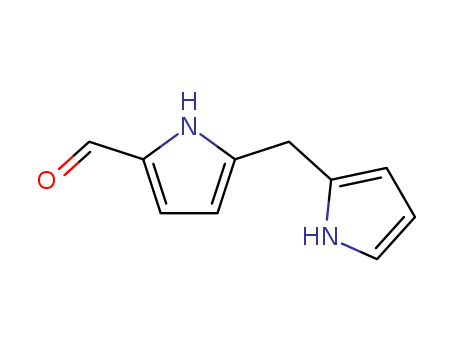
5-((1H-Pyrrol-2-YL)methyl)-1H-pyrrole-2-carbaldehyde

Base Information
  • Chemical Name:5-((1H-Pyrrol-2-YL)methyl)-1H-pyrrole-2-carbaldehyde
  • CAS No.:36746-27-7
  • Molecular Formula:C10H10N2O
  • Molecular Weight:174.202
  • Hs Code.:
  • DSSTox Substance ID:DTXSID90587451
  • Nikkaji Number:J1.063.270F
  • Wikidata:Q82479879
  • Mol file:36746-27-7.mol
5-((1H-Pyrrol-2-YL)methyl)-1H-pyrrole-2-carbaldehyde

Synonyms:1-formyldipyrromethane

Suppliers and Price of 5-((1H-Pyrrol-2-YL)methyl)-1H-pyrrole-2-carbaldehyde
Supply Marketing:
Business phase:
The product has achieved commercial mass production*data from LookChem market partment
Manufacturers and distributors:
  • Manufacture/Brand
  • Chemicals and raw materials
  • Packaging
  • price
  • American Custom Chemicals Corporation
  • 5-((1H-PYRROL-2-YL)METHYL)-1H-PYRROLE-2-CARBALDEHYDE 95.00%
  • 5MG
  • $ 503.54
Total 6 raw suppliers
Chemical Property of 5-((1H-Pyrrol-2-YL)methyl)-1H-pyrrole-2-carbaldehyde
Chemical Property:
  • Melting Point:118 °C 
  • Boiling Point:380.9±37.0 °C(Predicted) 
  • PKA:15.75±0.50(Predicted) 
  • Density:1.270±0.06 g/cm3(Predicted) 
  • XLogP3:1.3
  • Hydrogen Bond Donor Count:2
  • Hydrogen Bond Acceptor Count:1
  • Rotatable Bond Count:3
  • Exact Mass:174.079312947
  • Heavy Atom Count:13
  • Complexity:184
Purity/Quality:

99% *data from raw suppliers

5-((1H-PYRROL-2-YL)METHYL)-1H-PYRROLE-2-CARBALDEHYDE 95.00% *data from reagent suppliers

Safty Information:
  • Pictogram(s):  
  • Hazard Codes: 
MSDS Files:

SDS file from LookChem

Useful:
  • Canonical SMILES:C1=CNC(=C1)CC2=CC=C(N2)C=O
Technology Process of 5-((1H-Pyrrol-2-YL)methyl)-1H-pyrrole-2-carbaldehyde

There total 13 articles about 5-((1H-Pyrrol-2-YL)methyl)-1H-pyrrole-2-carbaldehyde which guide to synthetic route it. The literature collected by LookChem mainly comes from the sharing of users and the free literature resources found by Internet computing technology. We keep the original model of the professional version of literature to make it easier and faster for users to retrieve and use. At the same time, we analyze and calculate the most feasible synthesis route with the highest yield for your reference as below:

synthetic route:
Guidance literature:
With sodium hydroxide; In methanol; for 3h; Heating;
DOI:10.1021/jo980573i
Guidance literature:
N,N-dimethyl-formamide; With trichlorophosphate; at 0 ℃; for 0.166667h;
di(pyrrol-2-yl)methane; at 0 ℃; for 1.5h; Further stages.;
DOI:10.1021/jo070532z
Guidance literature:
N,N-dimethyl-formamide; With trichlorophosphate; at 0 ℃; for 0.166667h;
di(pyrrol-2-yl)methane; at 0 ℃; for 2h;
With water; sodium acetate; In ethyl acetate; at 20 ℃; for 4h;
DOI:10.1016/j.bmc.2013.09.036
Refernces

Synthesis and photochemical properties of 12-substituted versus 13-substituted chlorins

10.1021/jo900706x

This study focused on the synthesis and photochemical properties of 12- and 13-substituted chlorins, which are synthetic macrocyclic compounds related to natural photosynthetic pigments such as chlorophyll. This study is crucial to understand the effects of substituents on the spectral properties of chlorophyll molecules, which is important for the rational design of artificial photosynthetic systems and applications in solar energy conversion, biomedical fields, and photodynamic therapy. The chemicals used in this study include various chlorin derivatives such as 1-formyldipyrromethane, 8,9-dibromo-1-formyldipyrromethane, and several chlorins with different substituents at the 3- and 13-positions. These chemicals serve as precursors and products in synthetic routes to explore the effects of specific substituents on the photophysical and redox properties of chlorins. The study also involves bromination using reagents such as NBS (N-bromosuccinimide), condensation with TsOH (p-toluenesulfonic acid), and acetylation via Pd-mediated coupling. The purpose of these chemicals was to synthesize and modify chlorin molecules in order to compare the properties of isomeric 12- and 13-substituted chlorins, reveal distinct differences between them, and gain insight into the effects of substituents on their spectral, redox, and photochemical characteristics.


Post a RFQ

Enter 15 to 2000 letters.Word count: 0 letters

Attach files(File Format: Jpeg, Jpg, Gif, Png, PDF, PPT, Zip, Rar,Word or Excel Maximum File Size: 3MB)

1 Customer Service

What can I do for you?
Get Best Price

Get Best Price for 36746-27-7