94
R. Wijayapala et al. / Applied Catalysis A: General 480 (2014) 93–99
‘low-temperature’ CO-shift process [26–28]. Furthermore, another
study reports high CO conversion activity extends up to 500 ◦C
using this same W220 catalyst [29].
Silico) packed column and a MXT-1 (60 m 0.53 mm ID 5.00 m) cap-
illary column were employed for separation of inorganic gases and
light hydrocarbons. Gas phase product structures were identified
by comparing retention times to known standards. Liquid and solid
hydrocarbons were extracted from the reactor using ethyl acetate
(Sigma Aldrich, LC–MS Grade) and then analyzed using GCMS (Agi-
lent 7890A) equipped with DB-1 column (GC, DB-1–60 m 0.32 mm
1.0 m). The major hydrocarbon products were identified by com-
paring GC retention times and MS fragmentation patterns both with
authentic standards and the NIST 08 MS library. Quantification was
done using naphthalene as an internal standard. After quantita-
tion, the hydrocarbons were separated for structural identification
by removing the ethyl acetate through distillation. Hydrocarbons
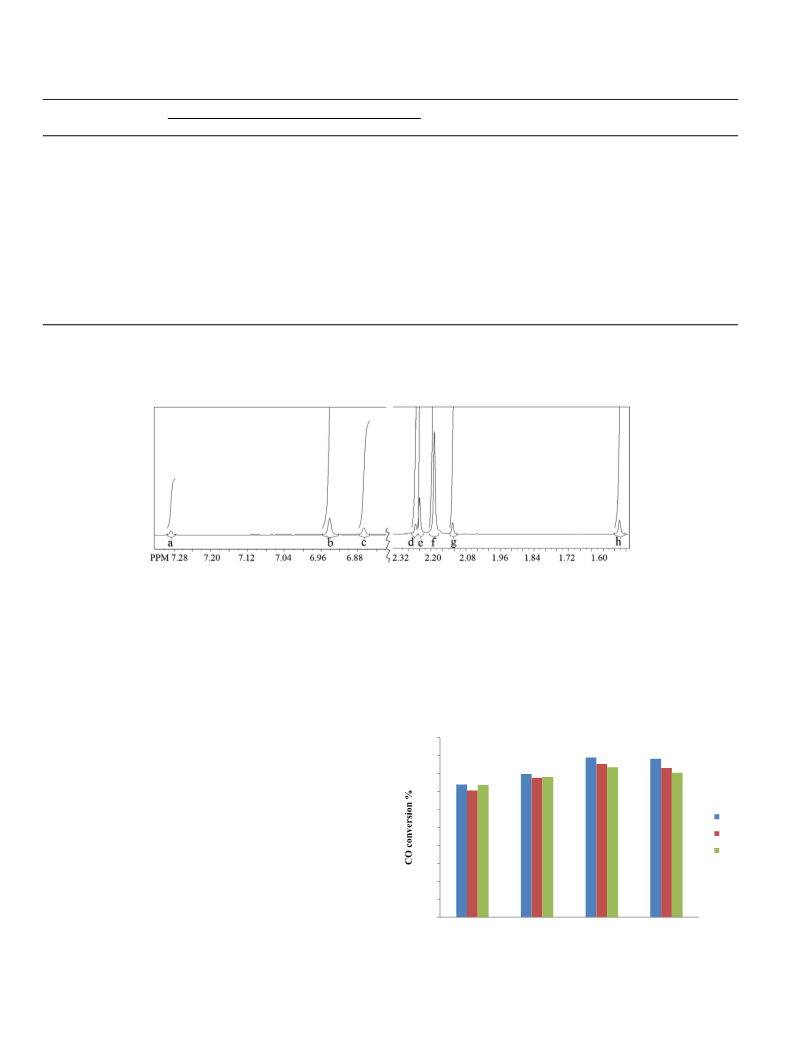
were analyzed by proton NMR (Bruker, 300 MHz) to determine the
alkyl/aromatic ring substitution ratio.
H2O + CO ꢀ H2 + CO2
(2)
Here we present novel mixed catalyst systems combining a
Mo/Co/K/ZSM-5 or Mo/Ni/K/ZSM-5 catalyst with this Cu-based
W220 low temperature WGS catalyst for the FT converting both
bio-syngas and a H2/CO (50/50) ratio syngas with remarkable selec-
tivity to methylated benzene ring products.
2. Experimental
2.1. Catalyst preparation
The Mo/Co/K zeolite catalyst was prepared using incipi-
ent wetness impregnation [6]. The ammonium form of ZSM-5
(SiO2/Al2O3 = 50) (50.0 g) obtained from Zeolyst International was
dried for 24 h and then impregnated with an aqueous solution
containing 4.60 g of (NH4)6Mo7O24·4H2O (Sigma Aldrich). This
Mo/ZSM-5 was then impregnated with an aqueous solution with
12.35 g of Co(NO3)2·6H2O (Sigma Aldrich). Finally this Mo/Co/ZSM-
5 was impregnated with an aqueous solution with 1.25 g of K2CO3
(Sigma Aldrich). The same procedure was followed for making
the Mo/Ni/K zeolite catalyst, using 7.78 g Ni(NO3)2·6H2O (Sigma
Aldrich) in place of the Co. The samples were then calcined in air at
500 ◦C for 3 h and pelletized into 0.45–0.8 mm particles for activity
tests. The designated (after calcination) loading was 5 wt.% for Co,
or Ni with 5 wt.% Mo and 1.4 wt.% K. The WGS catalyst was pur-
chased from Alfa Aesar (Copper based low temperature water gas
shift catalyst, HiFUEL W220 pellets 3.1 mm × 3.1 mm).
2.3. Catalyst characterizations
The catalyst surface areas were determined by N2 BET
(Monosorb Quantachrome). Prior to these measurements, the sam-
ples were pretreated at 280 ◦C under flow of 30% nitrogen in helium.
Atomic absorption (AAS) analyses were conducted using Mo, Ni,
Co, Cu, K standards (Sigma-Aldrich AAS standards) to quantitate
each metal’s composition. An acid digestion was performed on 0.1 g
of catalyst using 50.0 mL of 1:1 70% HNO3 (Sigma-Aldrich)/95%
H2SO4 (Sigma-Aldrich). Metals were dissolved from the catalyst
into the acid for 24 h with stirring and then diluted 10 fold with
deionized water prior to AAS analysis. Catalyst morphologies were
investigated with a Carl Zeiss EVO50VP variable pressure scan-
ning electron microscope (SEM) equipped with a Bruker Quantax
200× flash energy-diffusive X-ray spectroscopy (EDX) spectrome-
ter system, which simultaneously provided the surface elemental
composition information with spot size of 10 nm. The accelerating
voltage was 15 kV with a working distance of 10 mm.
2.2. Catalytic activity tests
All reactions were performed in a 500 mL stainless steel static
reactor equipped with an autoclave catalyst basket located 8.5 cm
above the bottom of the reactor (Fig. S1). Temperature was mea-
sured internally near the catalyst basket and was controlled
with a Parr 4843 Reactor Controller. The catalyst (either 8.0 g
of the metal/ZSM-5 or 4.0 g each of the WGS and metal/ZSM-
5) was used with two different syngas feeds: H2/CO (50:50)
H2—17.82%, N2—46.03%, CO—22.65%, CH4—1.76%, C2H4—0.25%,
O2—0.88%, CO2—10.59%). Bio-syngas was produced in a continuous
process conducted in the industrial gasifier located in Mississippi
State University [30]. The catalyst was loaded and the reactor was
achieved when reaching the selected reaction temperature (initial
ambient temperature pressure of 480 psig for a reaction tempera-
ture of 350 ◦C and 540 psig for a reaction temperature of 280 ◦C).
Table 1 summarizes 16 reactions. These reactions studied the four
catalyst combinations with both the 50/50 H2/CO and bio-syngas at
each of the two reaction temperatures. The reactor was then held at
a reaction temperature of either 280 ◦C or 350 ◦C for 18 h. Pressure
was monitored with time.
3.1. Characterization of the catalyst samples
The catalyst surface areas, metal and carbon compositions are
listed in Table 2. Impregnating ZSM-5 with metals significantly
reduced the surface area from 422 m2/g to approximately 300 m2/g,
indicating that the added metals block some zeolite channels
resulting in lower surface area. No significant surface area change
was observed when comparing metal-impregnated zeolite cata-
lysts before and after the catalytic reactions. This implies negligible
gas catalyst underwent significant surface area reduction possibly
due to coking or surface reconstruction. However, the WGS catalyst
did not exhibit significant loss in activity after 3 recycles as seen in
Section 3.2.3, and no significant increase in mass was observed for
the mixed catalysts after the reaction. The AAS analysis confirmed
metal composition at expected 1:1 wt ratios for Mo/Co and Mo/Ni
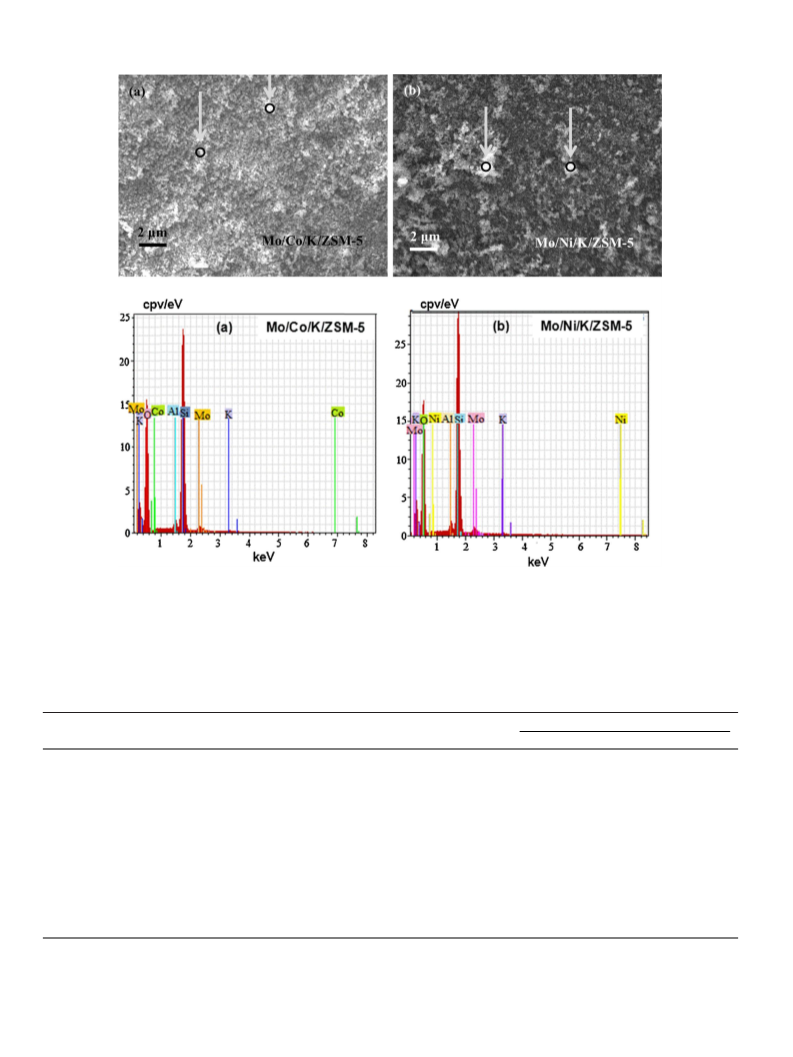
catalysts after calcination. The SEM images of Mo/Co/K/ZSM-5 and
Mo/Ni/K/ZSM-5 and EDX analysis are illustrated in Fig. 1. The EDX
surface analysis shows the presence of Mo, Co, K and Ni metals on
the catalyst surfaces.
In a typical reaction, pressure decreased rapidly over the first
few hours before the drop in pressure slowed and stopped within
15 h. After the pressure stabilized, the reactor was allowed to cool
to room temperature where the final pressures ranged from 175 to
450 psig. Sample plots of the pressure versus time for different cat-
alysts are given in Fig. S2. The effluent gas was collected into a 1 L
Tedlar bag and analyzed using a gas chromatograph (SRI 8610C)
equipped with thermal conductivity (TCD) and flame ionization
(FID) detectors. A shincarbon ST 100/120 (2 m 1 mm ID 1/16ꢀꢀ OD
3.2. Reaction products
3.2.1. CO conversion and CO2 selectivity
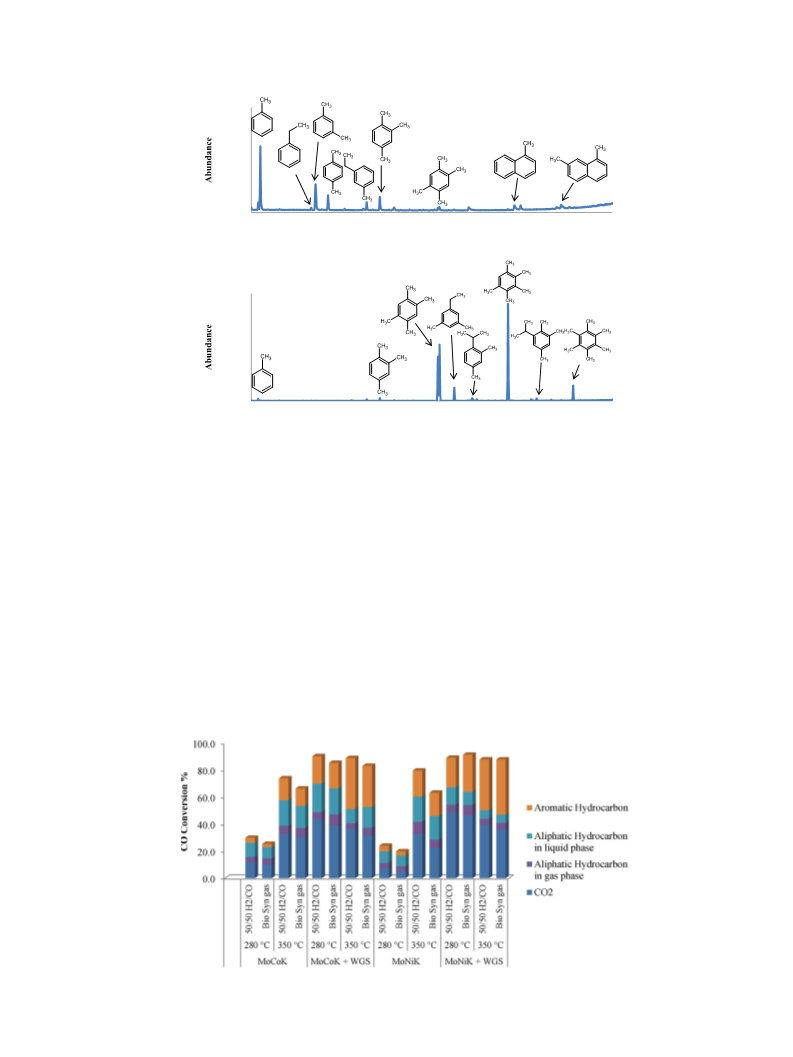
Catalyst activity tests were performed using the dual catalyst
systems (WGS + ZSM-5/Mo/Co/K or WGS + ZSM-5/Mo/Ni/K) and
these were compared to the performance of the ZSM-5/Mo/Co/K
or ZSM-5/Mo/Ni/K catalyst used alone. Collected gas samples were
analyzed as described in Section 2.2. These analyses were used for

 Wijayapala, Rangana