A Facile, Palladium-Catalyzed Synthesis of 1,1Ј-Bi(bicyclo[1.1.1]pentanes)
FULL PAPER
70%, based on 5). To a solution of [1.1.1]propellane 2 in diethyl
benzylideneacetone)palladium(0) [Pd(dba)2, 115 mg, 0.20 mmol],
ether was added the Grignard reagent (0.95 equivalents based on palladium (10%) on charcoal (180 mg), bis(triphenylphosphane)-
2; a: tert-butylmagnesium chloride; b: cyclohexylmagnesium chlor-
ide; c: 2-propylmagnesium chloride, d: cyclopentylmagnesium
chloride) at 0 °C and the solution was stirred for 48 h at room
temperature. After this time, the propellane 2 had disappeared and
the Grignard reagents 3aϪd had formed quantitatively.
palladium dichloride [(Ph3P)2PdCl2, 126 mg, 0.18 mmol], NiCl2
(23 mg, 0.18 mmol), or ammonium hexachloroplatinate
[(NH4)2PtCl6, 64 mg, 0.14 mmol]. After 72 h at room temperature
a standard workup afforded 1a in the yields given in Table 2.
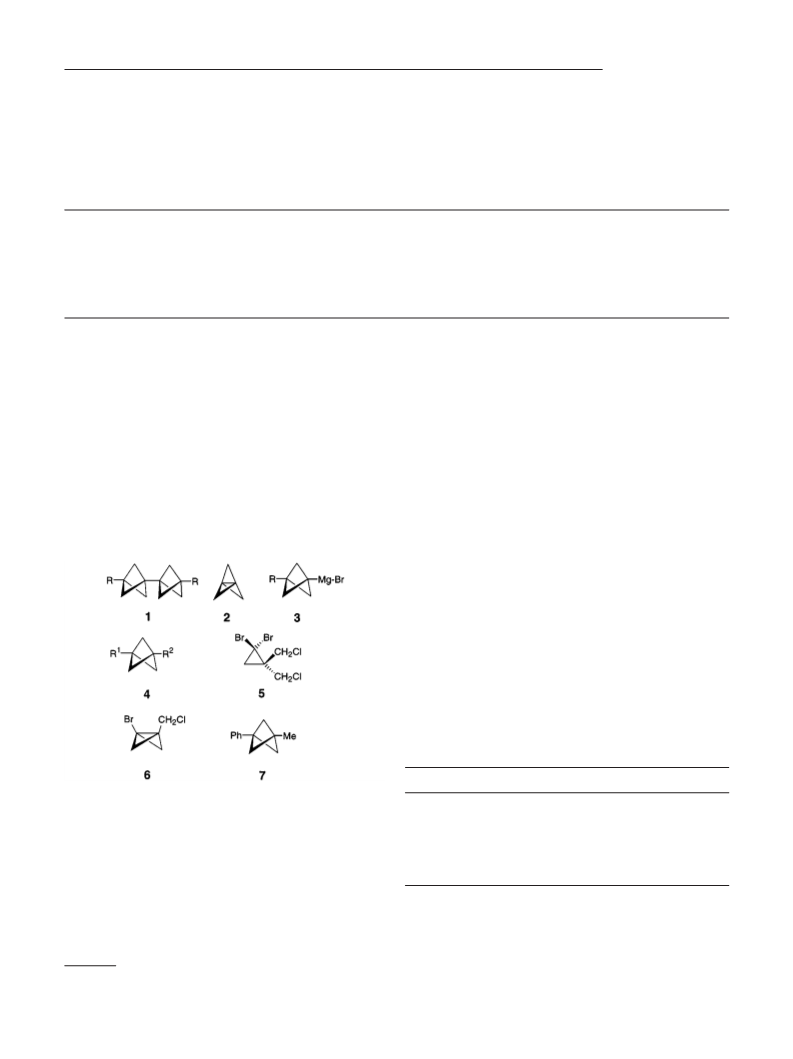
3,3Ј-Dicyclohexyl-1,1Ј-bi(bicyclo[1.1.1]pentane) (1b): Tetrahalide 5
(5.00 g, 16.8 mmol) was converted into 3b which, following the
standard procedure, gave rise to 1b (850 mg, 51%) as a colorless
b) Preparation of the Grignard Reagents 3e؊g: 1,1-Dibromo-2,2-
bis(chloromethyl)cyclopropane (5) was reacted with 2.00 equiv. of
MeLi[7,8] to yield the [1.1.1]propellane 2 (in an assumed yield of
70%, based on 5). To a solution of the [1.1.1]propellane 2 in di-
ethoxymethane was added the Grignard reagent [0.95 equiv. based
on 2; e: phenylmagnesium bromide; f: p-methylphenylmagnesium
bromide; g: p-(trimethylsilyl)phenylmagnesium bromide] at 0 °C
and the solution was stirred for 6 days at room temperature. After
this time the propellane 2 had disappeared and the Grignard re-
agents 3e؊g had formed quantitatively.
1
solid, m.p. 222 °C. Ϫ H NMR: δ ϭ 0.70Ϫ1.75 (m, 22 H), 1.33 (s,
12 H). Ϫ 13C NMR: δ ϭ 26.2 (t, 2 C), 26.4 (t, 4 C), 29.3 (t, 4 C),
38.3 (d, 2 C), 38.2 (s, 2 C), 42.2 (s, 2 C), 46.6 (t, 6 C). Ϫ IR (KBr):
ν˜ ϭ 2957, 2956, 2920, 2903, 2864, 2850, 1445, 1203 cmϪ1. Ϫ MS
(EI): m/z (%) ϭ 215 (10), 133 (50), 121 (30), 105 (62), 93 (60), 91
(64), 81 (50), 67 (87), 55 (100), 41 (84). Ϫ C22H34 (298.5): calcd. C
88.52, H 11.48; found C 88.17, H 11.54.
3,3Ј-Diisopropyl-1,1Ј-bi(bicyclo[1.1.1]pentane) (1c): Tetrahalide 5
(5.00 g, 16.8 mmol) was converted into 3c which, following the
standard procedure, gave rise to 1c (700 mg, 57%) as a colorless
General Procedure for the Palladium-Catalyzed Reaction:
[PdCl2(CH3CN)2] (1.1 mol-%, based on 2) was added to a solution
of 3a؊g. The solution turned brown and was then stirred for 48 h
at room temperature. For the workup, aqueous NH4Cl was added,
the organic layer was separated and the aqueous layer was ex-
tracted with pentane (2 ϫ 50 mL). The combined organic layers
were washed twice with water, dried with MgSO4, and the solvent
removed in vacuo. The crude coupling product 1 was purified by
flash chromatography with silica gel using pentane as the solvent.
The yields of 1 are based on the Grignard reagent RMgX, which
amounted to 64Ϫ67% of the starting tetrahalide 5.
1
solid, m.p. 35 °C. Ϫ H NMR: δ ϭ 0.79 (d, 12 H), 1.34 (s, 12 H),
1.62 (sp, 2 H). Ϫ 13C NMR: δ ϭ 18.8 (q, 4 C), 28.6 (d, 2 C), 37.9
(s, 2 C), 43.3 (s, 2 C), 46.3 (t, 6 C). Ϫ IR (KBr): ν˜ ϭ 2956, 2904,
2868, 1465, 1363, 1274, 1202, 893 cmϪ1. Ϫ MS (EI): m/z (%) ϭ
133 (28), 119 (65), 105 (58), 93 (64), 91 (100), 79 (54), 69 (66), 55
(50), 41 (94). Ϫ C16H26 (218.4): calcd. C 88.00, H 12.00; found C
87.98, H 11.67.
3,3Ј-Dicyclopentyl-1,1Ј-bi(bicyclo[1.1.1]pentane) (1d): Tetrahalide 5
(5.00 g, 16.8 mmol) was converted into 3d which, following the
standard procedure, gave rise to 1d (910 mg, 60%) as a colorless
3,3Ј-Di-tert-butyl-1,1Ј-bi(bicyclo[1.1.1]pentane) (1a): a) 3a and
[PdCl2(CH3CN)2]: The general procedures for the preparation of
3a from 5 and the subsequent reaction of 3a with [PdCl2(CH3CN)2]
were followed. Tetrahalide 5 (5.00 g, 16.8 mmol) was converted into
3a and then reacted with [PdCl2(CH3CN)2] to yield a crude prod-
uct. A standard workup and purification yielded 1a (778 mg, 57%)
1
solid, m.p. 122 °C. Ϫ H NMR: δ ϭ 1.20 (m, 4 H), 1.35 (s, 12 H),
1.51 (m, 12 H), 1.86 (m, 2 H). Ϫ 13C NMR: δ ϭ 25.7 (t, 4 C), 29.0
(t, 4 C), 39.0 (d, 2 C), 40.5 (s, 2 C), 41.2 (s, 2 C), 47.3 (t, 6 C). Ϫ
IR (KBr): ν˜ ϭ 2954, 2901, 2863, 1445, 1270, 1199 cmϪ1. Ϫ MS
(EI): m/z (%) ϭ 159 (11), 145 (18), 133 (30), 119 (65), 105 (38), 93
(50), 91 (100), 79 (59), 55 (33), 41 (97). Ϫ C20H30 (270.5): calcd. C
88.82, H 11.18; found C 88.42, H 10.85.
1
as a colorless solid, m.p. 180 °C. Ϫ H NMR: δ ϭ 0.80 (s, 18 H),
1.35 (s, 12 H). Ϫ 13C NMR: δ ϭ 25.9 (q, 6 C), 29.4 (s, 2 C), 36.3
(s, 2 C), 46.5 (s, 2 C) 45.2 (t, 6 C). Ϫ IR (KBr): ν˜ ϭ 2958, 2953,
2927, 2902, 2864, 1358, 1210, 697 cmϪ1. Ϫ MS (EI): m/z (%) ϭ
133 (38), 119 (28), 105 (33), 91 (46), 83 (27), 67 (22), 57 (100), 55
(52), 41 (77). Ϫ C18H30 (246.4): calcd. C 87.73, H 12.27; found C
87.56, H 11.92.
3,3Ј-Diphenyl-1,1Ј-bi(bicyclo[1.1.1]pentane) (1e) and 3-Methyl-1-
phenylbicyclo[1.1.1]pentane (7): Tetrahalide 5 (5.00 g, 16.8 mmol)
was converted into 3e which, following the standard procedure,
gave rise to a mixture of 1d (850 mg, 53%; the analytical data match
the previously published data[2]) and 7 (750 mg, 42%) as a colorless
liquid, b.p. 80Ϫ85 °C (0.1 Torr). Ϫ 1H NMR: δ ϭ 1.27 (s, 3 H),
1.93 (s, 6 H), 7.25 (m, 5 H). Ϫ 13C NMR: δ ϭ 18.2 (q), 35.3 (s),
38.68 (s), 53.89 (t, 3 C), 126.0 (d, 1 C), 128.0 (d, 5 C), 141.5 (s). Ϫ
IR (KBr): ν˜ ϭ 2958, 2918, 2905, 2865, 1277, 1153, 739 cmϪ1. Ϫ
MS (EI): m/z (%) ϭ 154 (37), 91 (48), 77 (50), 55 (38), 43 (76), 41
(53), 39 (78), 29 (74), 18 (100). Ϫ C12H14 (158.2): calcd. C 91.08,
H 8.92; found C 90.98, H 8.70.
b) 3a and [PdCl2(CH3CN)2] without Bromomethane: Tetrahalide 5
(5.00 g, 16.8 mmol) was reacted with methyllithium (1.4 ,
24.0 mL, 33.6 mmol) and then with tert-butylmagnesium chloride
(2.0 in diethyl ether, 5.40 mL, 10.80 mmol) to yield a solution of
3a. The volatile materials were removed in vacuo and anhydrous
diethyl ether was added. This solution was then charged with
[PdCl2(CH3CN)2] (50 mg, 0.19 mmol). A standard workup and
purification of the crude product yielded only traces of 1a (as deter-
1
mined by H NMR spectroscopy).
3,3Ј-Bis(4-methylphenyl)-1,1Ј-bi(bicyclo[1.1.1]pentane) (1f): Tetra-
halide 5 (5.00 g, 16.8 mmol) was converted into 3f which, following
the standard procedure, afforded 1f (1.04 g, 59%) as a colorless
c) 3a, Purified, and [PdCl2(CH3CN)2] with Bromomethane: Tetra-
halide 5 (5.00 g, 16.8 mmol), methyllithium (24.00 mL, 33.6 mmol)
1
solid, m.p. 214 °C: H NMR: δ ϭ 1.90 (s, 12 H) 2.32 (s, 6 H) 7.15
and tert-butylmagnesium chloride (2.0
in diethyl ether,
(s, 8 H). Ϫ 13C NMR: δ ϭ 21.1 (q, 2 C), 38.2 (s, 2 C), 40.5 (s, 2
C), 51.1 (t, 6 C) 125.9 (d, 4 C), 128.8 (d, 4 C), 135.8 (s, 2 C), 138.6
(s, 2 C). Ϫ IR (KBr): ν˜ ϭ 2992, 2964, 2918, 1904, 2867, 2851, 1520,
1443, 1333, 1208, 1110, 823 cmϪ1. Ϫ MS (EI): m/z (%) ϭ 314 [Mϩ]
(1), 299 (15), 209 (39), 196 (95), 183 (49), 181 (61), 167 (50), 115
(57), 105 (100), 91 (64), 51 (17). Ϫ C24H26 (314.5): calcd. C 91.67,
H 8.33; found C 91.43, H 8.16.
5.40 mL,10.80 mmol) were treated according to the procedure de-
scribed in b). The volatile materials were removed in vacuo and the
residue was dissolved in anhydrous diethyl ether to yield a solution
of 3a. Bromomethane (about 5 mL) and [PdCl2(CH3CN)2] (50 mg,
0.19 mmol) were added to the solution of 3a and the reaction mix-
ture was maintained at room temperature for 48 h. A standard
workup and purification yielded 1a (739 mg, 54%)
d) 3a and Several Catalysts: Individual solutions of 3a in ether,
prepared by the procedure described in a) were charged with bis(di-
3,3Ј-Bis[3-(trimethylsilyl)phenyl]-1,1Ј-bi(bicyclo[1.1.1]pentane) (1g):
Tetrahalide 5 (5.00 g, 16.8 mmol) was converted into 3g which, fol-
Eur. J. Org. Chem. 2001, 1049Ϫ1052
1051

 Rehm, J. D. Daniel