Page 5 of 7
Chemical Science
Please do not adjust margins
Journal Name
ARTICLE
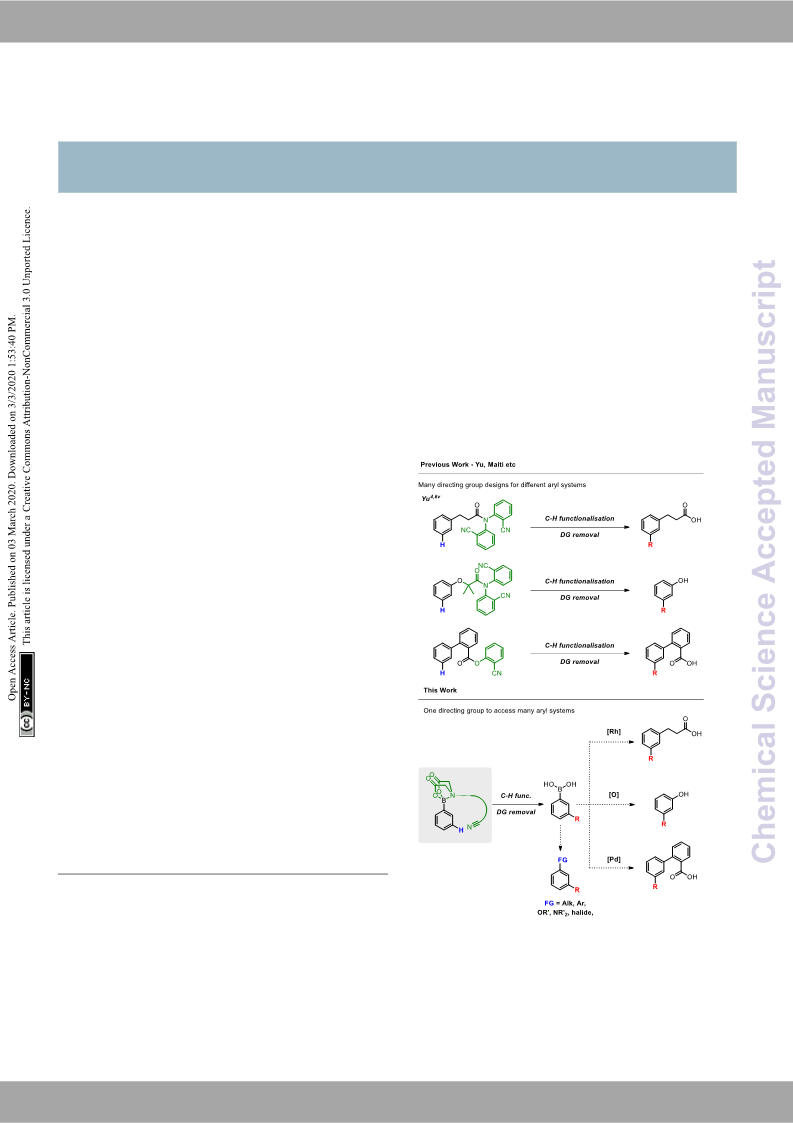
available reagents. Removal of the DG is fast, mild and provides
DOI: 10.1039/D0SC00230E
access to synthetically useful aryl boronic acids with quantitative
recovery of the MIDA-DG 8. Finally, the technique enables iterative
C–H functionalisation/cross-coupling pathways, with the potential
for future automation. Studies to expand the breadth of
transformations possible with the MIDA-DG 8 are underway.
Conflicts of interest
There are no conflicts to declare.
Acknowledgements
We acknowledge financial support from Imperial College London, the
EPSRC (PhD Studentship, A.F.W.), and the Royal Society for a
University Research Fellowship (C.J.C.). We thank Dr Li-Jie Cheng for
early prototype work, Alexander Dudnik for helpful discussions
during the concept stage, Ben Deadman for assistance performing
DOE optimisation and Peter Haycock for NMR assistance.
Notes and references
1
2
Wencel-Delord, J.; Glorius, F. Nat. Chem. 2013, 5, 369.
For selected reviews on directed C–H functionalisation see: (a)
Lyons, T. W.; Sanford, M. S. Chem. Rev. 2010, 110, 1147–1169.
(b) Engle, K. M.; Mei, T.-S.; Wasa, M.; Yu, J.-Q. Acc. Chem. Res.
2012, 45, 788–802. (c) Rouquet, G.; Chatani, N. Angew. Chemie
Int. Ed. 2013, 52, 11726–11743. (d) Zhang, F.; Spring, D. R.
Chem. Soc. Rev. 2014, 43, 6906–6919. (e) Li, G.; Wan, L.; Zhang,
G.; Leow, D.; Spangler, J.; Yu, J.-Q. J. Am. Chem. Soc. 2015, 137,
4391–4397. (f) Sambiagio, C.; Schönbauer, D.; Blieck, R.; Dao-
Huy, T.; Pototschnig, G.; Schaaf, P.; Wiesinger, T.; Zia, M. F.;
Wencel-Delord, J.; Besset, T.; Maes, B. U. W.; Schnürch, M.
Chem. Soc. Rev. 2018, 47, 6603–6743.
Scheme 4. Deprotection and derivatisation of C–H functionalised
aryl MIDA-DG boronate. The boronic acid was used directly after
deprotection without purification. All yields given are over two steps.
3
For selected reviews on meta selective C–H functionalisations
see: (a) Yang, J. Org. Biomol. Chem. 2015, 13, 1930–1941. (b)
Frost, C. G.; Paterson, A. J. ACS Cent. Sci. 2015, 1, 418–419. (c)
Dey, A.; Agasti, S.; Maiti, D. Org. Biomol. Chem. 2016, 14, 5440–
5453. (d) Dey, A.; Sinha, S. K.; Achar, T. K.; Maiti, D. Angew.
Chemie Int. Ed. 2019, 58, 10820–10843.
Scheme 5. An iterative C–H functionalisation / cross-coupling
a
procedure allows access to 1,3,5-trisubstituted aromatic systems.
For recent examples of non-covalently bound meta-selective
DGs see:(e) Davis, H. J.; Madalina, M. T.; Phipps, R. J. J. Am.
Chem. Soc. 2016, 138, 12759–12762. (f) Davis, H. J.; Genov, G.
R.; Phipps, R. J. Angew. Chemie Int. Ed. 2017, 56, 13351–13355.
(g) Zhang, Z.; Tanaka, K.; Yu, J.-Q. Nature, 2017, 543, 538–542.
Leow, D.; Li, G.; Mei, T.-S.; Yu, J.-Q. Nature 2012, 486, 518–522.
Ping, Y.; Wang, L.; Ding, Q.; Peng, Y. Adv. Synth. Catal. 2017,
359, 3274–3291.
For nitrile based meta directing groups bound via carbonyl
linkages see: (a) Yang, Y.-F.; Cheng, G.-J.; Liu, P.; Leow, D.; Sun,
T.-Y.; Chen, P.; Zhang, X.; Yu, J.-Q.; Wu, Y.-D.; Houk, K. N. J. Am.
Chem. Soc. 2014, 136, 344–355. (b) Deng, Y.; Yu, J.-Q. Angew.
Chemie Int. Ed. 2015, 54, 888–891. (c) Tang, R.-Y.; Li, G.; Yu, J.-
Q. Nature 2014, 507, 215–220. (d) Bera, M.; Modak, A.; Patra,
T.; Maji, A.; Maiti, D. Org. Lett. 2014, 16, 5760–5763. (e) Li, S.;
Ji, H.; Cai, L.; Li, G. Chem. Sci. 2015, 6, 5595–5600. (f) Li, S.; Cai,
L.; Ji, H.; Yang, L.; Li, G. Nat. Commun. 2016, 7, 10443–10450.
(g) Fang, L.; Saint-Denis, T. G.; Taylor, B. L. H.; Ahlquist, S.; Hong,
K.; Liu, S.; Han, L.; Houk, K. N.; Yu, J.-Q. J. Am. Chem. Soc. 2017,
139, 10702–10714. (h) Maity, S.; Hoque, E.; Dhawa, U.; Maiti,
D. Chem. Commun. 2016, 52, 14003–14006. (i) Xu, H.-J.; Lu, Y.;
Pd(OAc)2 (10 mol%), Ac-Gly-OH (20 mol%), PhI(OAc)2 (1.2 eq.), HFIP
(0.1 M), rt, 18 h. Pd(OAc)2 (20 mol%), Ac-Gly-OH (40 mol%), tert-
butyl acrylate (2.5 eq.), AgOAc (1.75 eq.), HFIP (0.1 M), rt, 18 h.
cPd(OAc)2 (10 mol%), xPhos (20 mol%), 5-bromopyrimidine (1.0 eq.),
K3PO4 (3.0 eq.), 1,4-dioxane:H2O (4:1), 75 °C, 18 h
b
4
5
In this manner, an iterative C–H functionalisation/cross-coupling
procedure was envisaged, enabling access to poly-substituted
aromatic systems, in just three catalytic steps using the ‘catch and
release’ purifications (Scheme 5). To demonstrate the feasibility of
this approach, the hetero-tetrasubstituted arene 31 was expediently
accessed using this method. Importantly, the procedures appear to
be amenable to automation using the platform developed by Burke.
6
Conclusions
In conclusion, a new MIDA derivative 8 has been developed which
condenses to aryl boronic acids, enabling their meta-selective C–H
functionalisation at room temperature. Installation of the DG and C–
This journal is © The Royal Society of Chemistry 20xx
J. Name., 2013, 00, 1-3 | 5
Please do not adjust margins

 Cordier, Christopher J.