D. Zhou et al. / Bioorganic & Medicinal Chemistry Letters xxx (2016) xxx–xxx
5
Table 2
References
Effects of transformed products from the suspension cultures on NO production by
LPS-activated microglia cells (Mean SEM).
10. PetioleⅠof A. sinensis was placed running tap water for 30 min to wash dust and
other particles, then surface-sterilized for 1 min by soaking in 75% (v/v)
ethanol, after that overall-sterilized in 0.1% (w/v) aqueous solution of mercuric
chloride for 8–10 min, finally washed 5 times in sterilized water. Furthermore,
it was cut into pieces of 1.5 cm in size, and induced on MS (Murashige and
a
a
Sample name
IC50
Sample name
IC50
Extract
38.58 3.15
﹥100
﹥100
1.22 2.30
﹥100
10.57 3.05
﹥100
Compound 9
Compound 10
Compound 11
Compound 12
Compound 13
Compound 14
Compound 15
Minocyclineb
﹥100
Compound 1
Compound 2
Compound 3
Compound 4
Compound 5
Compound 6
Compound 7
Compound 8
1.02 2.16
0.76 2.52
﹥100
﹥100
﹥100
﹥100
35.82 3.60
﹥100
﹥100
a
IC50
(l
g/mL for extracts and
lM for compounds).
Skoog) medium, supplemented with 5 mg/L NAA (a-naphthaleneacetic acid),
b
Positive control.
0.5 mg/L BA (6-benzyladenine), 0.7 mg/L 2, 4-D (2, 4-dichlorophenoxy acetic
acid), 30 g/L sucrose and 7.5 g/L agar, kept in darkness at 25 °C 1 °C, the
medium pH was adjusted to 5.75 before autoclaving for 20 min at 121 °C. After
15 days of pre-culturing on a gyratory platform shaker at 100 rpm, then the
primary calli was subcultured in 250 mL conical flasks containing B5 medium
with 1.0 mg/L 2, 4-D, 0.2 mg/L BA and 30 g/L sucrose at 25 °C 1 °C in darkness
every three weeks. B5 liquid medium (15 g/L sucrose) containing 1.0 mg/L NAA,
0.5 mg/L 2, 4-D and 0.05 mg/L KT (kinetin) was the medium for culture of fresh
A. sinensis callus. And the pH value of the medium was adjusted to 5.75 before
autoclaving for 20 min at 121 °C. 6 g callus cells were inoculated into a 250 mL
Erlenmever flask with 120 mL B5 medium, which were kept in the dark at
25 °C 1 °C on a rotary shaker at 110 rpm for 20 days.
activities were assayed to avoid possible effects of reduced viabil-
ity on NO release (Fig. S9).30 Results showed that the total extract
inhibited NO production remarkably with IC50 value of 38.58 lg/
mL. Among isolated compounds, 3, 5, 10 and 11 exhibited signifi-
cant inhibition on NO production in a concentration-dependent
manner with their IC50 values of 1.22 2.30, 10.57 3.05,
1.02 2.16
and
0.76 2.52
l
M
respectively
(Table
2,
11. Extraction and isolation: Isofraxetin-6-O-b-D-glucopyranoside (859 mg) was
Fig. 5A and B), comparing with positive control (IC50 35.82
lM),
dissolved in CH3OH (86.0 mL) and distributed into 59 bottles of the suspension
cultures of A. sinensis callus equally. The mixture was co-cultured for 7 days,
then the cells and medium were separated by filtration. The medium was
concentrated to 200 mL and partitioned by the same volume of EtOAc (ethyl
acetate) and n-BuOH (n-butyl alcohol) successively for three times. Next, the
organic phase was collected and concentrated under the reduced pressure to
yield EtOAc extract (Fr. 1, 0.25 g) and n-BuOH extract (Fr. 2, 1.20 g)
respectively. The cells were dried under 50 °C, and then were extracted in an
ultrasonic bath with CH3OH for 30 min. After that, the extract was further
partitioned by EtOAc and n-BuOH respectively to afford EtOAc extract (Fr. 3,
0.62 g) and n-BuOH extract (Fr. 4, 1.46 g). Compared with the experimental
and they are no cytotoxicity on the effective concentration except
that compound 10 are slender toxic to the cells at the concentra-
tions of 10 lM (Fig. S9). So, compounds 3, 5, 10 and 11 might be
a promising therapeutical approach for inflammatory diseases.
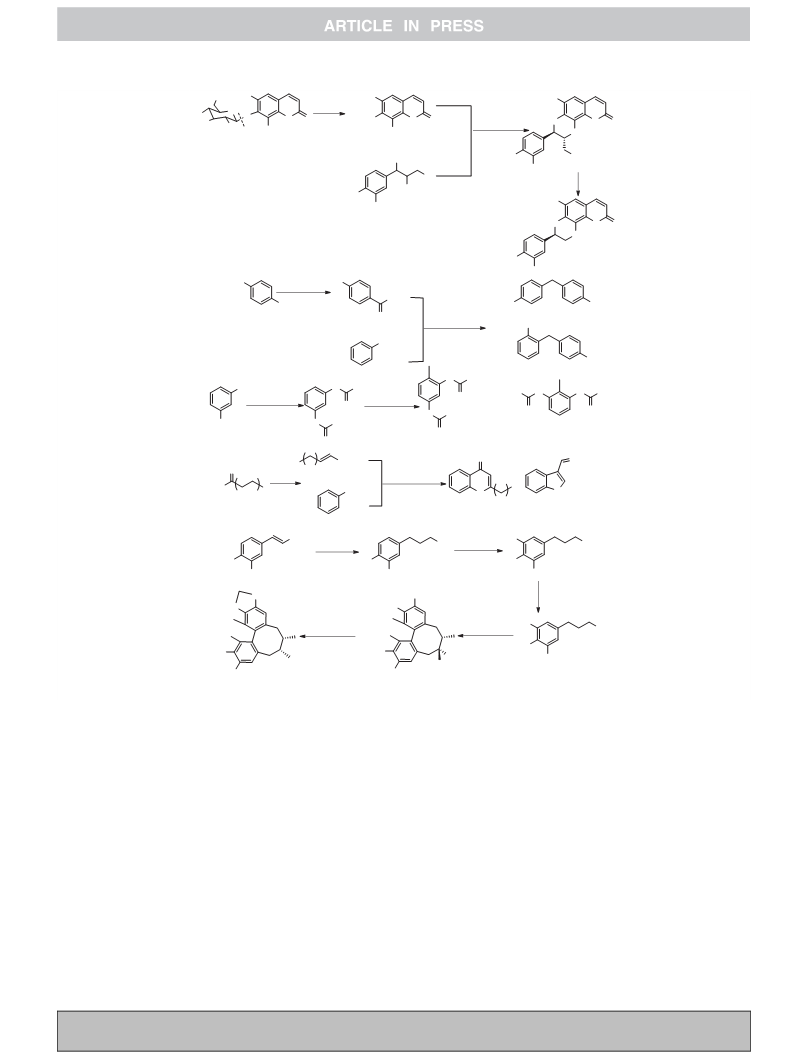
In our research, it’s the first time to biotransform coumarin gly-
cosides using the A. sinensis callus. Isofraxetin-6-O-b-
D-glucopyra-
noside, natural coumarin, was biotransformed through
a
deglycosylating. Moreover, a new compound were produced by
the system with the stimulation of substrate and the biosynthesis
pathway was also suggested. The extract and isolated compounds
showed anti-inflammation activities in LPS-induced BV2 microglial
cells. Moreover, compounds 3, 5, 10 and 11 exhibited significant
inhibition on NO production with their IC50 values of 1.22 2.30,
group, cultures and medium without isofraxetin-6-O-b-D-glucopyranoside act
as control group and was processed to get Fr. 5–8 by the same procedures. The
combination of Fr. 1 and Fr. 3 (EE, 0.87 g) was subjected on ODS column
chromatography (CC) with gradient elution CH3OH/H2O (from 0:100 to 100:0)
to get five subfractions (Fr. 1a–5a). Next, Fr. 1a was separated by HPLC with
ODS column (250 mm ꢀ 10 mm, flow rate 3 mL/min) eluted with CH3OH/H2O
(49: 51) to afford compounds 5 (2.1 mg, tR = 14 min), 6 (2.3 mg, tR = 18 min)
10.57 3.05, 1.02 2.16 and 0.76 2.52 lM, respectively. Based
and
3 (5.9 mg, tR = 39 min). Fr. 2a was firstly fractioned by silica gel CC
on structures of transformed products, it suggested that com-
pounds were prone to be condensation, deglycosylation, hydroxy-
lation and methylation. Polymerase, hydrolase, hydroxylase and
methylase are mainly systhesis enzymes, which are existed in A.
sinensis callus. Our continuing efforts to discover more biotransfor-
mation regulars in A. sinensis callus.
(3 ꢀ 50 cm) with gradient elution petroleum/acetone (0:100–100:0) to get
substraction 2a-1 and 2a-2. Then Fr. 2a-1 was purified by HPLC with ODS
column (250 mm ꢀ 10 mm, flow rate 3 mL/min) with CH3CN/H2O (37: 63) to
provide compounds 8 (1.0 mg, tR = 22 min), 10 (1.1 mg, tR = 27 min) and 14
(1.2 mg, tR = 35 min). While compound 15 (0.9 mg, tR = 25 min) was purified
from substration Fr. 2a-2, using HPLC with ODS column (250 mm ꢀ 10 mm,
flow rate 3 mL/min) eluted with CH3CN/H2O (39: 61). And Fr. 3a was
chromatographied on HPLC with ODS column (250 mm ꢀ 10 mm, flow rate
3 mL/min) to yield compounds
9 (1.1 mg, tR = 40 min) and 11 (0.9 mg,
tR = 56 min) using CH3OH/H2O (35: 65) as elute. However, compounds 12
(0.8 mg, tR = 37 min) and 13 (1.3 mg, tR = 49 min) were obtained from Fr. 4a by
HPLC with ODS column (250 mm ꢀ 10 mm, flow rate 3 mL/min) using CH3CN/
H2O (8:92) as eluting solvent. Equally, Fr. 2 and Fr. 4 was combined as BE
(2.66 g) to subject on ODS CC with CH3OH/H2O (from 0:100 to 100:0) to get
seven fractions (Fr. 1b–7b). Fr. 1b was isolated using HPLC with ODS column
(250 mm ꢀ 10 mm, flow rate 3 mL/min) eluted by CH3OH/H2O (20: 80) and
then purified by Sephadex LH-20 chromatography eluted with CH3OH to afford
compounds 1 (1.1 mg) and 2 (1.7 mg). Furthermore, compound 4 (2.0 mg) was
obtained from Fr. 3b by recrystallization in CH3OH. Next, Fr. 4b was subjected
on silica gel CC (3 ꢀ 50 cm) with gradient elution CH2Cl2/CH3OH (0:100-100:0)
to get substraction Fr. 4b-1 and Fr. 4b-2. Then Fr. 4b-1 was purified by HPLC
with ODS column (250 mm ꢀ 10 mm, flow rate 3 mL/min) with CH3CN/H2O
Acknowledgements
The work was supported partially by the National Natural
Science Foundation of China (Grant No. U1403102, 81173531,
81473330, 81673323), the Shenyang Science and Technology
Research Project, Liaoning, China (F15-199-1-26), the Research
Project for Key Laboratory of Liaoning Educational committee,
Liaoning, China (Grant No. LZ2015067), the Natural Science
Foundation of Liaoning Province, China (Grant No. 2015020732),
the Innovation Team Project of Liaoning Province, China (Grant
No. LT2015027), the Fund for Long-term Training of Young
Teachers in Shenyang Pharmaceutical University, Liaoning, China
(ZCJJ2013409).
(13: 87) to provide compounds
R = 39 min).
7 (1.1 mg, tR = 19 min) and 16 (1.8 mg,
t
A. Supplementary data
Supplementary data associated with this article can be found, in

 Zhou, Di