3
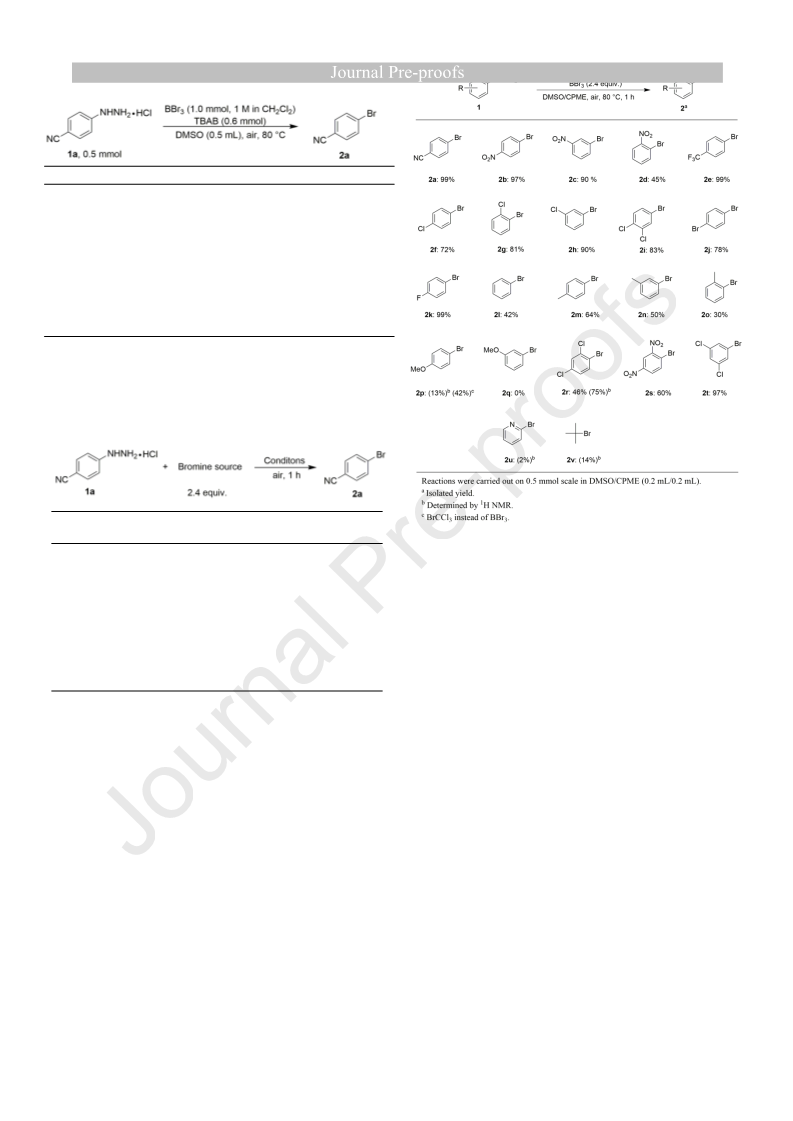
bromobenzonitrile (2a), 1-bromo-4-triflouromethylbenzene (2e),
-bromo-4-fluorobenzene (2k). The brominaiton of
TEMPO to afford 3, which strongly supported a radical
pathway.
4
b
1
arylhydrazines consisting meta substituents also provided very
good yields of 1-bromo-3-nitrobenzene (2c, 90%), and 1-bromo-
3
-chlorobenzene (2h, 90%). In contrast, the ortho substituents
resulted in moderate yields of 1-bromo-2-nitrobenzene (2d, 45%)
and 2-bromotoluene (2o, 30%) due to their steric hindrance. In
particular, in the case of the chloro substituent, the effectivity of
electron-withdrawing ability at the meta position is higher than
that at the para position; thus, the yield of 2h is higher than that
of 2f. The disubstituents of phenyllhydrazine hydrochlorides also
tolerated the optimal conditions to generate the corresponding
aryl bromides. While 1-bromo-2,4-dinitrobenzene (2s) was
obtained in moderate yield (60%), 1-bromo-3,4-dichlorobenzene
(
2i), 1-bromo-2,4-dichlorobenzene (2r), and 1-bromo-3,5-
dichlorobenzene (2t) were synthesized in good yields (83%,
5%, and 97%, respectively). Moreover, the bromination of
7
substrates bearing a methyl group could afford the corresponding
products (2m, 2n, and 2o). Unfortunately, the bromination of p-
or m-methoxyphenyl hydrazine hydrochloride barely occurred
(
2p, 2q), presumably because of the complexation of the
1
2
3 3
methoxy group and BBr . When BrCCl was used instead of
BBr
When the 2-hydrazinopyridine hydrochloride was used as a
substrate, the complexation between pyridine and BBr inhibited
3
, p-methoxyphenyl bromide (2p) was obtained in 42% yield.
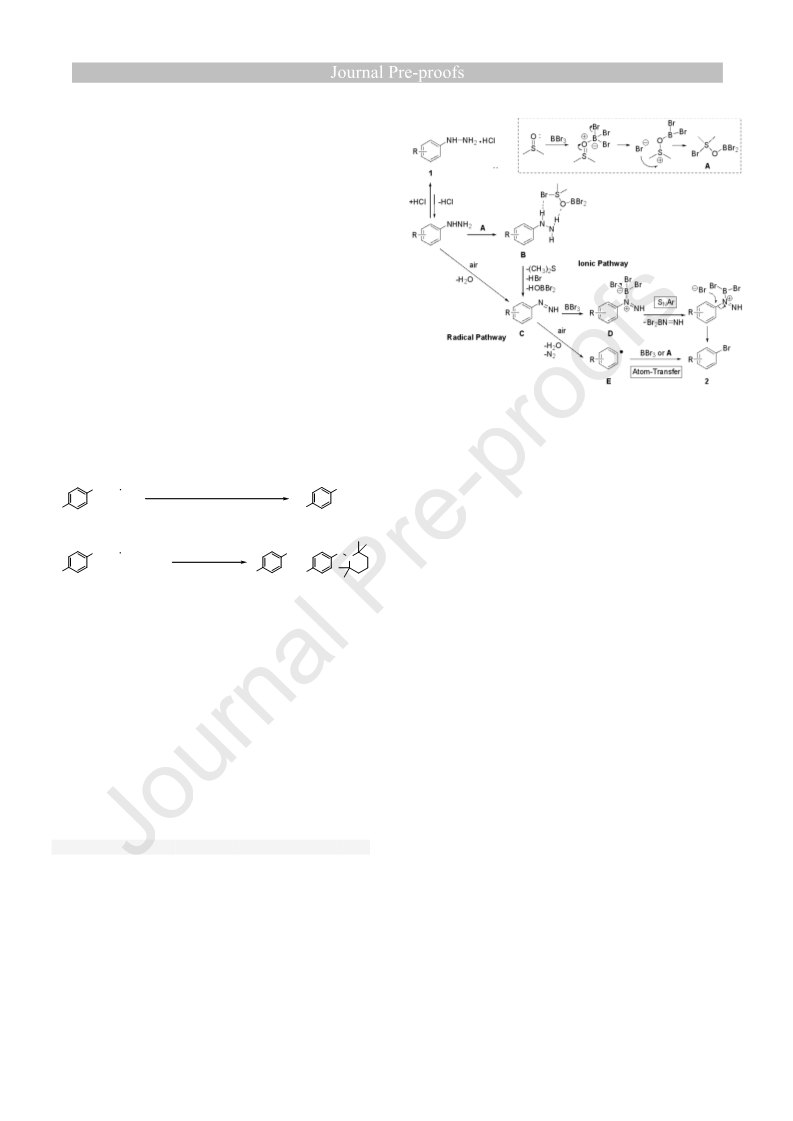
Scheme 4. Possible pathways.
3
the desired bromination (2u). Moreover, tert-butyl bromide as an
alkyl bromide was formed in only 14% yield (2v).
Proposed pathways, which include both ionic and radical
mechanisms, are shown in Scheme 4. First, the starting material,
arylhydrazine hydrochloride (1) generates arylhydrazine in
equilibrium. Dimethyl sulfoxide (DMSO) serves as a Lewis base
NHNH2 HCl
BBr3 (2.4 equiv.)
Br
(
a)
Deoxygenated DMSO, Ar, 80 °C, 1 h
NC
and reacts with a Lewis acid, BBr , to form A as a key species,
NC
NC
3
1
a
a
2a, 33%
which can be generated both under argon and under air. In the
case of argon atmosphere, A interacts with the hydrogen atoms of
hydrazine (see B) to form diazene C, where DMSO acts as an
oxidizing agent. Under air, A might play a similar role as the case
under argon, and moreover, air-oxidation of arylhydrazine to C
might be accelerated by the formation of B, although air can
directly oxidize arylhydrazine to C. In an ionic pathway, C
NHNH2 HCl
+
Br
O
TEMPO (3 equiv.)
N
BBr3
+
(b)
DMSO/CPME, air
(1 M in CH Cl )
2
2
NC
NC
8
0 °C, 1 h
1
2.4 equiv.
2a, >99%
3, N.D
Scheme 3. Control experiments.
To understand the bromination mechanism, some control
undergoes coordination with BBr
nucleophilic substitution (S Ar) to afford 2. In a radical pathway,
air-oxidation of C leads to aryl radical E, which abstracts
bromine atom from BBr or A to afford 2 (atom-transfer
reaction) . If E abstracts Br from A, the concomitantly formed
Br BO• might contribute to the formation of arylhydrazine to C.
3
or A (see D) and then aromatic
N
experiments were investigated (Scheme 3). Although, under
argon, 2a was formed in 33% yield (reaction (a)), atmospheric
exposure led to 2a in almost quantitative yield (entry 6 in Table
3
17
2
2
). Therefore, air plays as an important role in bromination.13 To
clarify whether the bromination involves a radical pathway,
,2,6,6-tetramethylpiperidine 1-oxyl (TEMPO) was added to the
bromination of 1a (reaction (b)). The almost quantitative
formation of 2a even in the presence of TEMPO without the
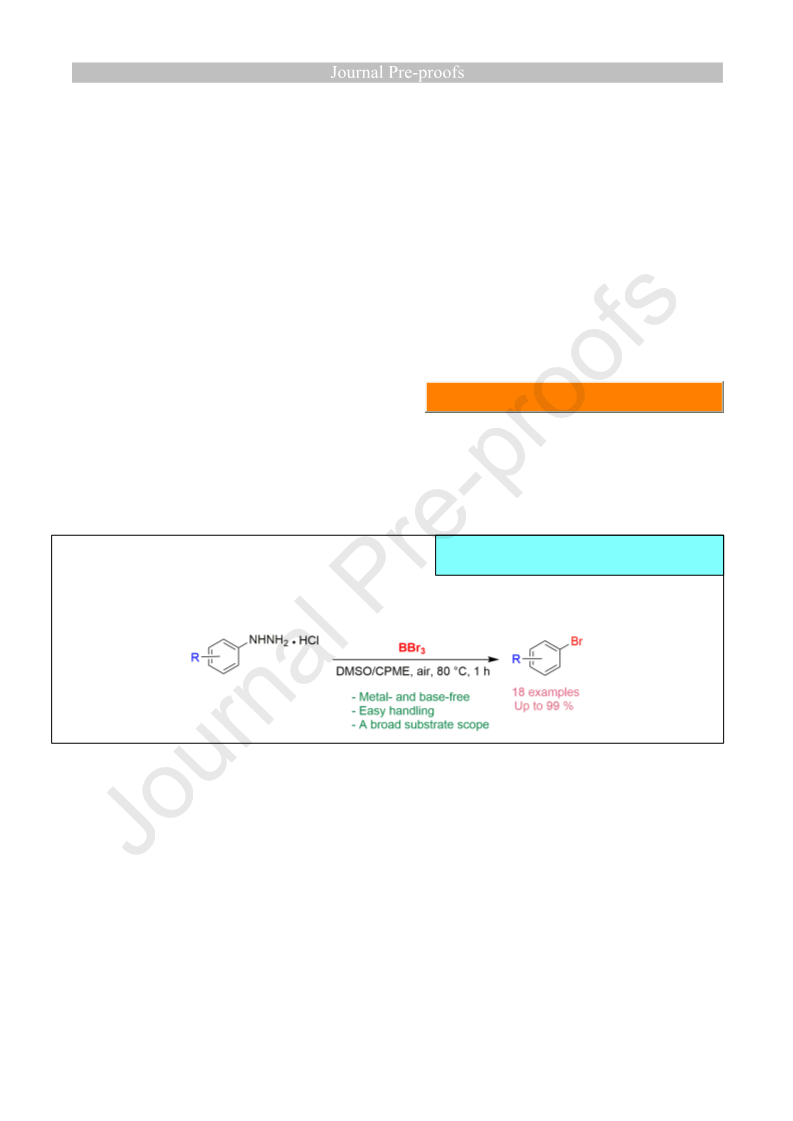
Conclusion
A metal- and base-free synthetic method of aryl bromides
from arylhydrazine hydrochlorides is developed. Various aryl
bromides can be successfully prepared without using any metal
catalysts or bases.
2
formation
of
4-((2,2,6,6-tetramethylpiperidin-1-yl)oxy)-
benzonitrile 3 strongly suggests the present bromination reaction
might not involve a radical process at least in the key steps.
Acknowledgments
To get more information about the mechanism, we
investigated a Hammett linear free energy relationship study of
the bromination using four kinds of arylhydrazines 2b, 2e, 2l, and
D.P.T. is grateful for the support of the Ministry of Education,
Culture, Sports, Science and Technology (MEXT) Scholarship
Program. This research was supported by JSPS KAKENHI ( B,
19H02791) and (B, 19H02756), from the Ministry of Education,
Culture, Sports, Science and Technology, Japan, and by Kyoto-
Advanced Nanotechnology Network.
2
m (for the detailed experiments, see Supporting Information).
The determined ρ value, ρ = +0.63, is inconclusive to determine
the mechanism; namely, a radical pathway such as an atom-
transfer reaction14,15 and an ionic pathway such as an aromatic
1
6
N
nucleophilic substitution (S Ar) are both possible .
References and notes
In our previous study of the iodination of arylhydrazines with
2
, however, a TEMPO trapping experiment indicated the
formation of 3, suggesting a radical pathway. In addition, Stack’s
report concerning the bromination of anilines to give aryl
bromides also described a successful trapping of aryl radical by
5
I
1
. (a) I. P. Beletskaya, A. V. Cheprakov, Chem. Rev. 100 (2000) 3009-3066.
b) W. Cabro, I. Candiani, Acc. Chem. Rev. 95 (1995) 2457-2483.
(
2. (a) N. Miyaura, A. Suzuki, Chem. Rev. 95 (1995) 2457-2483.
(b) R. Chinchilla, C. Nájera, Chem. Soc. Rev. 40 (2011) 5084-5121.
3
. (a) G.W. Gribble, J. Chem. Educ. 81 (2004) 1441-1449.

 Phuc Tran, Dat