J. Chil. Chem. Soc., 59, Nº 2 (2014)
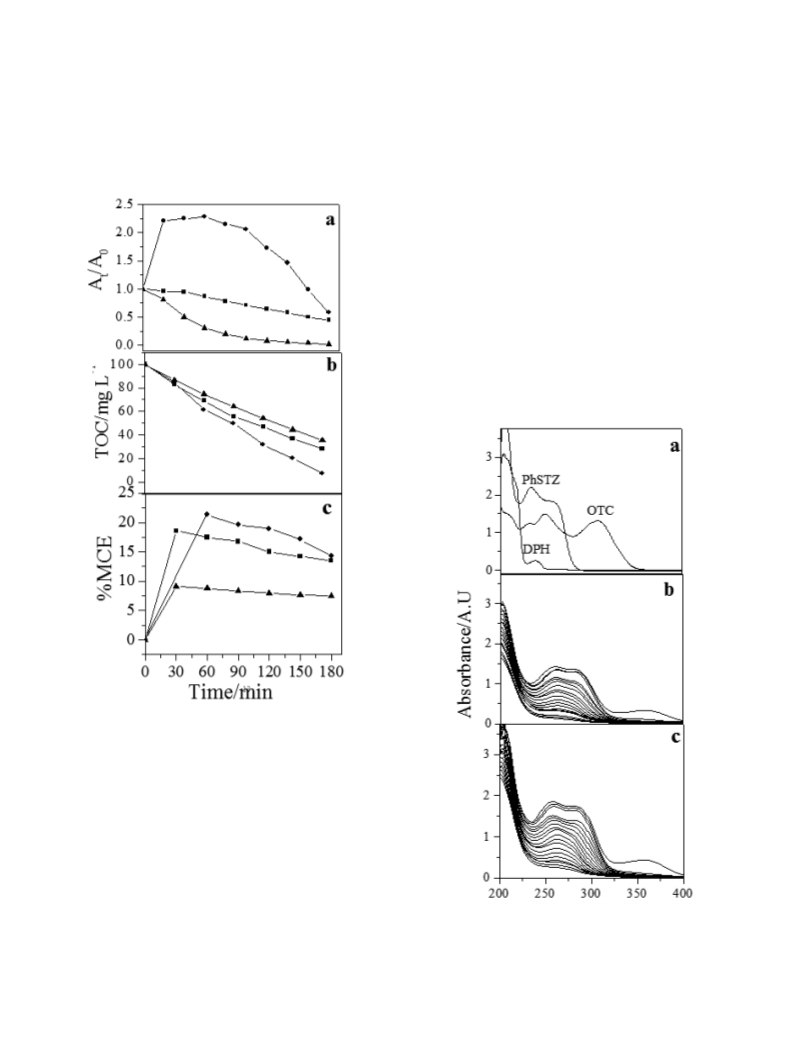
It was found that for both mixtures, FSS (Fig. 3b) and CFS (Fig. 3c),
bands corresponding to both OTC and PhSTZ decay during electrolysis. These
results allow us to conclude that the method is applicable to the removal of
both drugs from waters containing them, under the experimental conditions
employed. In both cases it is seen that the band at 360 nm corresponding to
OTC decays completely after the first 10 minutes of electrolysis. The bands
in the range of 250-300 nm associated with OTC and PhSTZ decay gradually
during electrolysis, reaching a value close to zero at the end of the process. The
difference between the FSS and CFS solutions is the presence of excipients in
CFS (Table 2). As can be seen in Figs. 3 a and b, commercial tablets do not
show a significant difference when analyzing the decay of the absorbance of
each component of the mixture. In both cases, complete elimination of TOC is
achieved after 3 hours of electrolysis (Table 2).
5
6
7
D.I. Andersson, D. Hughes. Drug Resistance Updates 15, 162, (2012).
M. Klavarioti, D. Mantzavinos, D. Kassinos. Environ. Int. 35, 402, (2009).
C.A. Martínez-Huitle, E. Brillas. Appl Catalysis B: Environ 87, 105,
(2009).
Ch. Comninellis, G. Chen. Electrochemistry for the Environment. 1st ed.
New York. Springer, 2009, pp.1-23.
8
9
M. Panizza, A. Kapalka, Ch. Comninellis. Electrochim. Acta 53, 2289,
(2008).
10 J. Urzúa, C. González-Vargas, F. Sepúlveda, M.S. Ureta-Zañartu, R.
Salazar. Chemosphere 93, 2774, (2013).
11 R. Salazar, M.S. Ureta-Zañartu. Water Air Soil Pollut. 223, 4199, (2012).
12 M. Panizza, G. Cerisola. Water Res. 43, 339, (2009).
13 P.A. Carneiro, M.E. Osugi, J.J. Sene, M.A. Anderson, M. Valnice, B.
Zanoni. Electrochim. Acta 49, 3807, (2004).
14 R. Salazar, M.S Ureta, J. Chil. Chem. Soc. 57, 999, (2012).
15 S. Garcia-Segura, R. Salazar, E. Brillas. Electrochim. Acta 113, 609,
(2013).
-1
Table 2. Composition of 100 mg L of FSS and CFS and total organic
carbon before and after the electro-oxidation treatment. Experimental
-2
conditions: 0.1 M Na SO at 35 ºC and pH 7.0 applying 50 mA cm using
2
4
the BDD/stainless steel system. Data are the average of three independent
experiments.
16 R. Salazar, E. Brillas, I. Sirés. Appl. Catalysis B: Environ. 115– 116, 107,
(2012).
1
7
Jong Young Choia, You-Jin Leea, Jina Shina, Ji-Won Yanga. J. Hazard.
Mat. 179, 762, (2010).
-1
-1
Composition (mg L )
TOC (mg L )
Solution PhSTZ DPH OTC Excipients
Initial
36.0
Final
2.8
18 C.I. Brinzila, M.J. Pacheco, L. Ciríaco, R.C. Ciobanu, A. Lopes. Chem.
Eng. J. 209, 54, (2012).
CFS
FSS
49.5
49.2
1.2
1.3
12.4
12.2
0.037
-
1
9
E. Tsantaki, T. Velegraki, A. Katsaounis, D. Mantzavinos. J. Hazard. Mat.
07–208, 91, (2012)..
2
24.0
2.7
2
2
2
0
1
2
M. Panizza, G. Cerisola. Electrochim. Acta 48, 3491, (2003).
M. Panizza, G. Cerisola. Electrochim. Acta 51, 191, (2005).
E. Guinea, F. Centellas, E. Brillas, P. Cañizares, C. Sáez, M.A. Rodrigo.
Appl Catalysis B: Environ 89, 645, (2009).
4
. CONCLUSIONS
OTC, PhSTZ and DPH could be degraded by EO with the generation
of hydroxyl radicals on the anode surface, reaching >70% of mineralization
for each compound separately. On the other hand, complete degradation and
mineralization is obtained for solution containing 100 mg L-1 of Fantetra
in solutions prepared from each drug or from the commercial formulation.
Finally, the mineralization process of Fantetra components by EO generates
organic intermediates as carboxylic acids (oxalic, oxamic, maleic, acetic),
ammonia and nitrate ions before their complete transformation into CO2.
2
2
2
2
2
2
2
3
4
5
6
7
8
9
C.A. Martinez-Huitle, E. Vieira dos Santos, D. Medeiros de Araujo, M.
Panizza. J. Electroanal. Chem. 674, 103, (2012).
Ministerio de agricultura de Chile. Medicamentos veterinarios autorizados
por el Servicio Agrónomo y ganadero, SAG
X.Liang, Z.Wang, C. Wang, K. Wen, T. Mi, J. Zhang, S. Zhang. Anal.
Biochem. 438, 110, (2013).
S.M. Miller, K.L. Cumpston. Encyclopedia of Toxicology (Third Edition),
2
014, pp 195-197.
K. Li, A. Yediler, M.Yang, S. Schulte-Hostede, M. Hung Wong.
Chemosphere 72, 473, (2008).
ACKNOWLEDGMENTS
L. M. Pastrana-Martínez, J.L. Faria, J.M. Doña-Rodríguez, C. Fernández-
Rodríguez, A. Silva. Appl Catalysis B: Environ 113– 114, 221, (2012).
M. Velázquez, I. P. Santander, D.R. Contreras, J. Yáñez, C. Zaror, R.A.
Salazar, M. Pérez-Moya, H.D. Mansilla. Journal of Environmental Science
and Health, Part A 49, 661, (2014).
Financial support of FONDECYT under Project 1130391 and DICYT-
USACH is gratefully acknowledged.
REFERENCES
3
3
3
0
1
2
S. Morales-Torres, L.M. Pastrana-Martínez, J.L. Figueiredo, J.L. Faria, A.
Silva. Appl. Surf. Sci. 275, 361, (2013).
R. Salazar, S. Garcia-Segura, M.S. Ureta-Zañartu, E. Brillas. Electrochim.
Acta 56, 6371, (2011).
M. Skoumal, C. Arias, P. L. Cabot, F. Centellas, J.A. Garrido, R. M.
Rodrıguez, E. Brillas
1
2
J. Rivera-Utrilla, M. Sánchez-Polo, M.A. Ferro-García, G. Prados-Joya, R.
Ocampo-Pérez. Chemosphere 93, 1268, (2013).
I. Arslan-Alaton, T. Olmez-Hanci. New and Future Developments in
Catalysis. Catalysis for Remediation and Environmental Concerns.
Chapter 12 – Sources of Environmental Pollution: Persistent Organic
Pollutants. Elsevier, 2013, pp 303–398.
G. Mascolo, L. Balest, D. Cassano, G. Laera, A. Lopez, A. Pollice, C.
Salerno. Bioresource Technol 101, 2585, (2010).
O.A. Jones, J.N. Lester, N. Voulvoulis, Trends in Biotechnol 23, 163,
Chemosphere 71, 1718, (2008).
3
3
3
4
3
4
S. Garcia-Segura, E. Brillas. Water Res. 45, 2975, (2011).
M. Hamza, R. Abdelhedi, E. Brillas, I. Sires. J. Electroanal. Chem. 627,
4
1, (2009).
(2005).
2
511

 Espinoza, C.