RSC Advances
Paper
equilibrium concentration of MB (at reaction time 0). A and A0
are the corresponding values of absorbance, respectively.
Experimental
Sample preparation
All chemicals used in this study were received from Shanghai
Chemical Regent Factory of China. The AgNbO3 samples were
prepared by hydrothermal method, as we reported previously.34
Ag@AgCl nanoparticles were deposited on the surface of as-
synthesized AgNbO3 powders via an impregnating-
precipitation-photoreduction method.35 The AgNbO3 powders
(0.2 g) were added to 50 mL of deionized water, and the
suspension was sonicated for 10 min at room temperature.
10 mL of 0.5–2.0 mol Lꢀ1 AgNO3 solution and 10 mL 0.5–2.0 mol
Lꢀ1 HCl aqueous solution were added and stirred for 20 min,
respectively. The mixture were collected by washed with deion-
ized water and dried at 80 ꢁC for 10 h. Finally, the powders were
irradiated with the xenon lamp (350 W) for 30 min. They then
obtained a dark color, revealing the presence of silver particles.
Conclusion
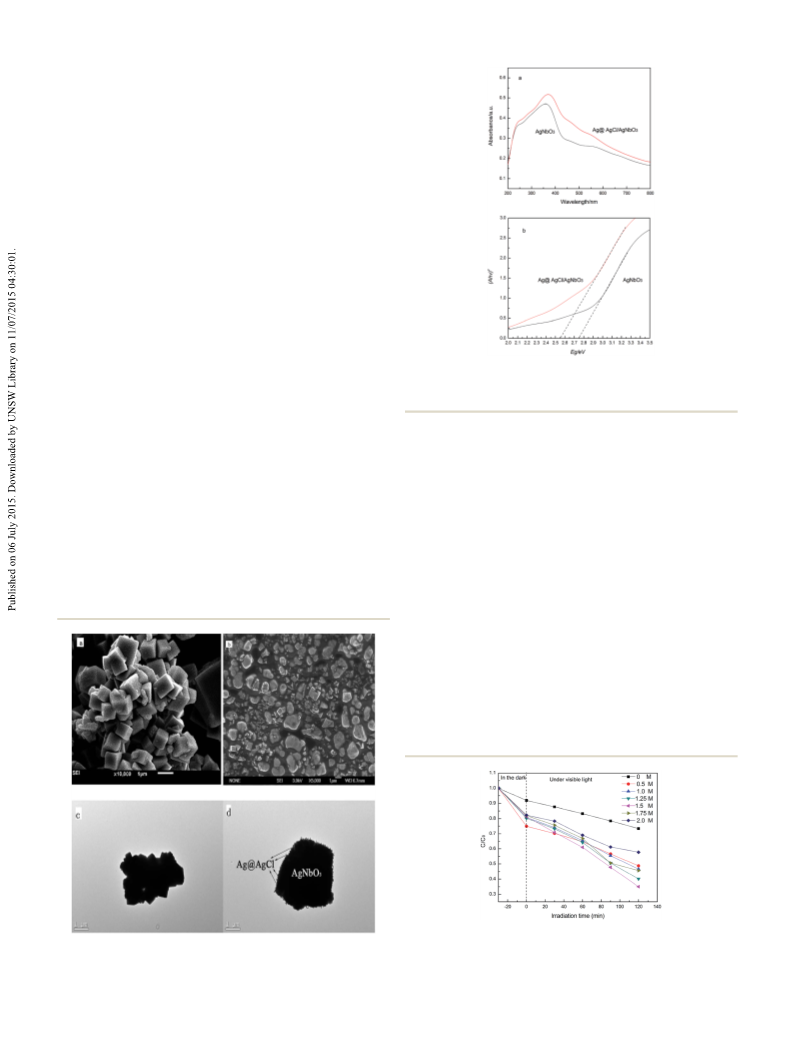
In summary, Ag@AgCl/AgNbO3 particles are successfully
prepared by precipitation and photoreduction reaction. Partial
Ag+ ions of the AgCl particles were reduced to Ag0 species under
xenon light irradiation. Ag@AgCl/AgNbO3 exhibits strong
absorption in the whole visible-light region, and reveals much
higher photocatalytic activity for the degradation of MB under
visible-light irradiation than pure AgNbO3 owing to surface
plasmon resonance. The photoexcited electrons on the surface
of the silver nanoparticles are injected and formed active
species O2ꢀ,$HOO, H2O2 and $OH. The holes transfer to the
surface of the AgCl particles to form Cl0 atoms. Therefore, they
can be used as efficient visible-light-induced material in
wastewater treatment and air purication.
Characterizations of the prepared composites
Acknowledgements
The powder XRD data were collected on a Rigaku D/Max 2500
The National Natural Science Foundation of China (No.
21302062) is gratefully acknowledged. The Science and tech-
nology developmental plan (No. 20130206099SF), and Science
and Technology Develop-ment Plan of Jilin Province (No.
20150101018JC) also supported this work.
V/PC X-ray diffractometer (Tokyo, Japan) with CuKa radiation
˚
(l ¼ 1.5418 A) at 50 kV and 200 mA at room temperature by step
scanning mode in the range 20ꢁ # 2q # 80ꢁ with increments of
0.02ꢁ. X-ray photoelectron spectroscopy (XPS) was performed
with a PHI 1600 spectroscope using MgKa X-ray source for
excitation. The nanoparticle morphology was measured using a
scanning electronic microscope (SEM, JEOL JSM-7001F). UV-vis
diffuse reectance spectra (DRS) were recorded on a UV-vis
spectrophotometer (Hitachi U-4100) with BaSO4 as the reec-
tance standard material.
Notes and references
1 A. Kudo, K. Omori and H. Kato, J. Am. Chem. Soc., 1999, 121,
11459.
2 S. Tokunaga, H. Kato and A. Kudo, Chem. Mater., 2001, 13,
4624.
3 M. Valant, A. Axelsson and N. Alford, J. Eur. Ceram. Soc.,
2007, 27, 2549.
4 G. Q. Li, T. Kako, D. Wang, Z. Zou and J. Ye, J. Solid State
Chem., 2007, 180, 2845.
5 D. Wang, T. Kako and J. Ye, J. Am. Chem. Soc., 2008, 130,
2724.
6 H. Kato, H. Kobayashi and A. Kudo, J. Phys. Chem. B, 2002,
106, 12441.
7 G. Li, S. Yan, Z. Wang, X. Wang and Z. Li, Dalton Trans., 2009,
8519.
8 G. Li, T. Kako, D. Wang and Z. Zou, Dalton Trans., 2009, 2423.
9 H. Shu, J. Xie and H. Xu, J. Alloys Compd., 2010, 496, 633.
Photocatalytic degradation of MB
For the evaluation of visible-light photocatalytic activity, the 350
W xenon lamp equipped with a UV-cutoff-lter (providing
visible-light with $400 nm) was used as a visible-light source,
and the average light intensity striking the surface of the reac-
tion solution was about 80 mW cmꢀ2. Xenon lamp was posi-
tioned 15 cm away from the quartz reactor. Visible-light
photocatalytic activities of prepared samples were evaluated by
the photocatalysis of MB (40 mL of 10 mg Lꢀ1) solution. The
photocatalyst (0.15 g) was stirred to reach an adsorption–
desorption equilibrium among the photocatalyst in the dark for
30 min. The MB concentration was determined by an UV-vis
spectrophotometer (UV-2550). 5 mL of the dye solution was 10 A. Veres, T. Rica, L. Janovak, M. Domok, N. Buzas,
taken out to measure the concentration change of MB aer
visible light irradiation for some time. When the 5 mL MB
V. Zollmer, T. Seemann, A. Richardt and I. Dekany, Catal.
Today, 2012, 181, 156.
solution was taken out every 0.5 h, the xenon lamp was closed at 11 M. Es-Souni, S. Habouti, N. Pfeiffer, A. Lahmar, M. Dietze
the same time. Aer centrifugation, the absorbance of the dye and C. H. Solterbeck, Adv. Funct. Mater., 2010, 20, 377.
was measured. Then, both the degradation liquid and the 12 M. J. Uddin, F. Cesano, D. Scarano, F. Bonino, G. Agostini,
catalyst were re-added to the original reactor (the nally volume
of the solution is still 40 mL). The xenon lamp was opened
G. Spoto, S. Bordiga and A. Zecchina, J. Photochem.
Photobiol., A, 2008, 199, 64.
again. The photocatalytic degradation efficiency (E) of MB was 13 R. H. Wang, X. W. Wang and J. H. Xin, ACS Appl. Mater.
obtained by the following formula: E ¼ (C0 ꢀ C)/C0 ꢂ 100% ¼ Interfaces, 2010, 2, 82.
(A0 ꢀ A)/A0 ꢂ 100%, where C is the concentration of the MB 14 J. B. Zhou, Y. Cheng and J. G. Yu, J. Photochem. Photobiol., A,
solution at reaction time t, and C0 is the adsorption–desorption
2011, 223, 82.
59974 | RSC Adv., 2015, 5, 59970–59975
This journal is © The Royal Society of Chemistry 2015

 Yang, Leifei