Inorg. Chem. 1998, 37, 5583-5587
5583
Flux Synthesis of LiAuS and NaAuS: “Chicken-Wire-Like” Layer Formation by
Interweaving of (AuS)nn- Threads. Comparison with r-HgS and AAuS (A ) K, Rb)
Enos A. Axtell, III, Ju-Hsiou Liao, and Mercouri G. Kanatzidis*
Department of Chemistry and Center for Fundamental Materials Research, Michigan State University,
East Lansing, Michigan 48824-1322
ReceiVed April 2, 1998
From the reaction of Au with alkali metal polysulfide liquids, LiAuS and NaAuS were discovered. Orange crystals
of LiAuS crystallize in the monoclinic space group C2/c, (no. 15), with a ) 8.994(2) Å, b ) 8.956(2) Å, c )
7
.201(3) Å, â ) 128.68(1)°, and Z ) 8. Light-yellow planks of NaAuS crystallize in the orthorhombic space
group Ccca, (no. 68), with a ) 14.658(5) Å, b ) 21.043(7) Å, c ) 7.118(4) Å, and Z ) 32. Both compounds
contain infinite one-dimensional (AuS)n chains, featuring alternating sulfide anions and linear coordinated Au
n-
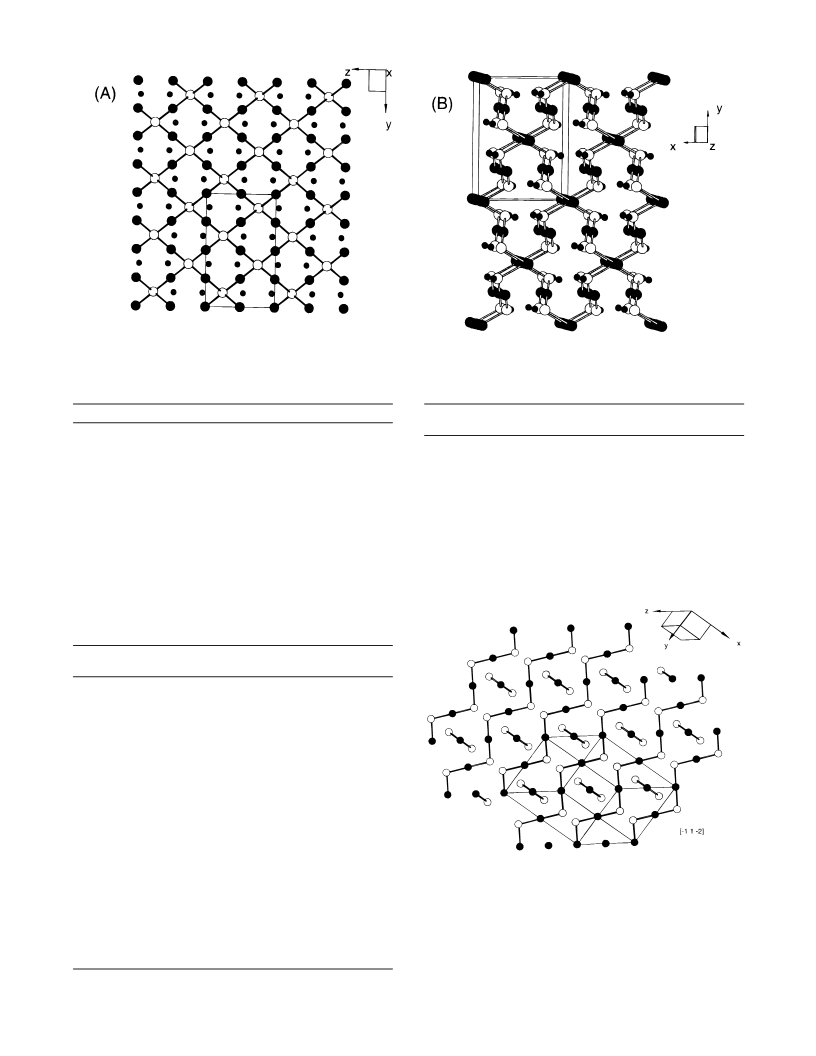
centers. In LiAuS, the chains are zigzag and fully extended and they pack in two mutually perpendicular sets.
In NaAuS, the same chains coil in an unusual fashion so that they become interwoven to form layers reminiscent
of “chicken-wire”. This novel coiling mode allows Au-Au contacts to form, which help to stabilize the structure.
The structural relationships between LiAuS, NaAuS, Na7Au5S6, AAuQ (A ) K, Rb, Cs; Q ) S, Se), and R-HgS
are explored.
Introduction
Experimental Section
Reactions of gold with polychalcogenide melts can go quickly
to completion at temperatures as low as 190 °C. This reactivity
Reagents. Elemental sulfur was purchased from Spectrum Chemical
Manufacturing Corporation. Sodium and lithium were obtained from
Aldrich. Au metal (99.99%) was acquired from Liberty Coins, Lansing,
MI. Chemicals were measured and loaded in Pyrex tubes under a dry
nitrogen atmosphere in a Vacuum Atmospheres Dri-Lab glovebox.
Lithium metal was manipulated under an argon atmosphere to avoid
1
was pointed out by Bertholet in the early 1800’s when he
reported that gold dissolved in alkali metal polysulfide melts
but not in molten sulfur.2 This high reactivity makes the
A/Au/Q systems (A ) alkali metal; Q ) S, Se, Te) interesting
for study from a chemical standpoint because many ternary
phases are possible. The strong affinity of gold for chalcogen
atoms is evident in the number of ternary compounds that have
3
the formation of Li N.
Synthesis. a. Finely Divided Au Metal. A gold coin (99.99%,
31.1 g) was dissolved in 400 mL of aqua regia (300 mL of concentrated
3
4
HCl and 100 mL of concentrated HNO ). The solution was boiled in
been reported, NaAuSe, KAuQ (Q ) S, Se), AAuQ (A ) K,
3
5
6a
6b
an acid-resistant fume hood to a volume of approximately 100 mL.
The solution was neutralized with ammonium hydroxide, and the gold
was reduced with excess hydrazine hydrochloride dissolved in 100 mL
of distilled water. The resulting black suspension was heated gently,
with stirring, for 1 h to allow particle aggregation. After the suspension
was filtered and washed with copious amounts of distilled water and
acetone, the resulting gold powder was heated in air for 2 h at 300 °C
to drive off any remaining impurities, yielding 30.9 g of Au powder.
Note: heating too long or at too high a temperature results in impractical
grain sizes.
Rb, Cs), AAuTe (A ) Na, K, Rb, Cs), Na3AuS2, Na7Au5S6,
7
7
8
9
AAu3S2 (A ) Cs, Rb), CsAu3Se2, Cs4Au6S5, K4Au6S5, K7-
9
13
Au5S7, and AAuSe2 (A ) Na, K), containing monochalco-
10,11
10,11
genide ligands as well as K3AuSe13,
Na3AuSe8,
K5-
AuSe12, KAuQ5 (Q ) S, Se), and CsAuSe3,13 which feature
1
2
12
long-chain polychalcogenides. Here, we describe LiAuS and
n-
NaAuS, both of which feature infinite (AuS)n chains in
remarkable conformations and arrangements.
(
1) Kanatzidis, M. G.; Sutorik, A. C. Prog. Inorg. Chem. 1995, 43, 151-
64.
2 2
b. Li S and Na S. Lithium sulfide and sodium sulfide were
2
(
2) Bertholet, C. L. Essai de Statique Chimique, 2nd Partie; Paris, 1803;
p 437.
produced in liquid ammonia. In a nitrogen-filled glovebox, the
stoichiometric amounts of alkali metal chunks and elemental sulfur
powder necessary to produce 20 g of starting material were loaded
into a 250 mL round-bottom flask. A Teflon stir bar was added, and
each flask was closed to air with a glass adapter and valve. The
apparatus was removed to a Schlenk line, where approximately 150
mL of liquid ammonia was condensed under nitrogen, with stirring,
into the dry-ice/acetone-cooled round-bottom flask. After the flask was
allowed to warm to room temperature, the apparatus was put under
vacuum for several hours, followed by heating with a hot air gun to
drive off any remaining ammonia. The apparatus was returned to the
glovebox, and the product was ground to a fine powder before use.
The resulting powders were pale yellow in color.
(
(
3) Klepp, K. O. J. Alloys Compd. 1996, 234, 199-202.
4) Klepp, K. O.; Bronger, W. J. Less-Common Met. 1987, 132, 1173-
9.
(
5) (a) Bronger, W.; Kathage, H. U. J. Alloys Compd. 1992, 184, 87. (b)
Bronger, W.; Kathage, H. U. J. Less-Common Met. 1990, 160, 181.
6) (a) Klepp, K. O.; Bronger, W. J. Less-Common Met. 1987, 127, 65-
(
7
2
1. (b) Klepp, K. O.; Brunnbauer, G. J. Alloys Compd. 1992, 183,
52-62.
(
(
(
7) Klepp, K. O.; Weithaler, C. J. Alloys Compd. 1996, 243, 1-5.
8) Klepp, K. O.; Weithaler, C. J. Alloys Compd. 1996, 243, 12-18.
9) Klepp, K. O.; Bronger, W. J. Less-Common Met. 1988, 137, 13-20.
(
10) Park, Y.; Kanatzidis, M. G. Angew. Chem., Int. Ed. Engl. 1990, 29,
914-5.
(
(
11) Kanatzidis, M. G. Chem. Mater. 1990, 2, 353-363.
12) Klepp, K. O.; Weithaler, C. Abstracts of the European Meeting on
Solid State Chemistry, Montpellier, VT, Sept 1995; A95.
13) Park, Y. Ph.D. Dissertation, Michigan State University, East Lansing,
MI, 1991.
c. LiAuS. Orange crystals of LiAuS were obtained by the reaction
of 1-4 equiv of Li S, 1 equiv of Au metal, and 8 equiv of elemental
2
S. This charge was sealed inside an evacuated Pyrex tube. The tube
(
was placed inside a computer-controlled furnace and heated at 500 °C
1
0.1021/ic980360b CCC: $15.00 © 1998 American Chemical Society
Published on Web 09/25/1998

 Axtell III, Enos A.