Vol. 26, No. 18 (2014)
Microbial Transformation of Topical Corticosteroid: Prednicarbate 6045
Da which is 128 mass unit less than the substrate (488.241)
which showed the removal of CH
TABLE-3
H- (400 MHz, CDCl ) CHEMICAL SHIFT
ASSIGNMENTS OF METABOLITE PRODUCED (4)
1
3
2 2
CH CO (56 mass units) and
removal of CH CH OCO (72 mass units). This metabolite was
2
2
12
H NMR
.605 (d)
J = 9
δC
Multiplicity δH (J = Hz)
thus characterized as prednisolone (3) .
7
130.0
CH
CH
CH
158.7 (Q), 130.0 (CH), 39.6
(CH ), 128 (Q)
2
TABLE-2
6.846 (d)
J = 9
116.4
129.7
128 (Q), 158 (Q), 116.4
1
13
H (400 MHz, CDCl ) AND C NMR (100 MHz, CDCl )
3
3
CHEMICAL SHIFT ASSIGNMENTS OF COMPOUND 3
6
.54 (dd)
115.02 (Q), 132.4 (CH),
128.4 (Q), 39.6 (CH2)
Carbon
No.
J = 8.4
J = 2.0
6.47 (d)
J = 8
δC
Multiplicity
δH (J = Hz)
1
2
3
4
5
6
7
8
9
155.8
128.0
186.4
122.6
169.6
31.9
33.9
31.3
55.2
43.9
70.2
39.8
48.1
51.2
23.9
34.2
88.6
17.5
21.1
212.0
67.5
CH
CH
C
7.22, d (10)
6.25, dd (2,10)
115.0
132.4
CH
CH
155.02 (Q), 125.3 (Q), 128.4
(Q)
-
6.00, s
6.41 (d)
J = 2
129.7 (CH), 155.02 (Q), 39.6
CH
C
-
2.32, m; 2.56, td (4.4, 13.2)
5.05 (t)
3.75(s)
3.40 (s)
123.6
53.6
39.6
28.7
25.9
CH
MEO
CH2
CH2
CH3
28.7 (CH ), 132.9 (Q)
2
CH2
CH2
CH
CH
C
172.1 (Q)
1.16, m; 2.08, m
2.12, m
1.08, m
128.4 (Q)
3
.06 (d)
.65 (s)
128.3 (Q), 123.6 (CH)
123.6 (CH), 132.9 (Q), 17.7
1
10
11
12
13
14
15
16
17
18
19
20
21
-
4.48, br, t
1.46, m; 2.02, dd (3.6,14.4)
(
CH3)
CH
1.56 (s)
17.7
CH3
25.9 (CH ), 123.6 (CH), 132.9
3
CH2
(Q)
C
-
1.66, m
CH
CH2
CH2
C
as green chemistry while chemical synthesis involved hazardous
chemicals lead to the environmental pollution. Cunninghamella
elegans had an ability to hydrolyze the compounds due to the
1.48, m; 1.85, m
1.54, m; 2.70, m
-
0.96, s
1.43, s
CH3
CH3
C
13
presence of hydrolase enzymes in its enzyme system . The
reaction involved in the synthesis of metabolites was ester
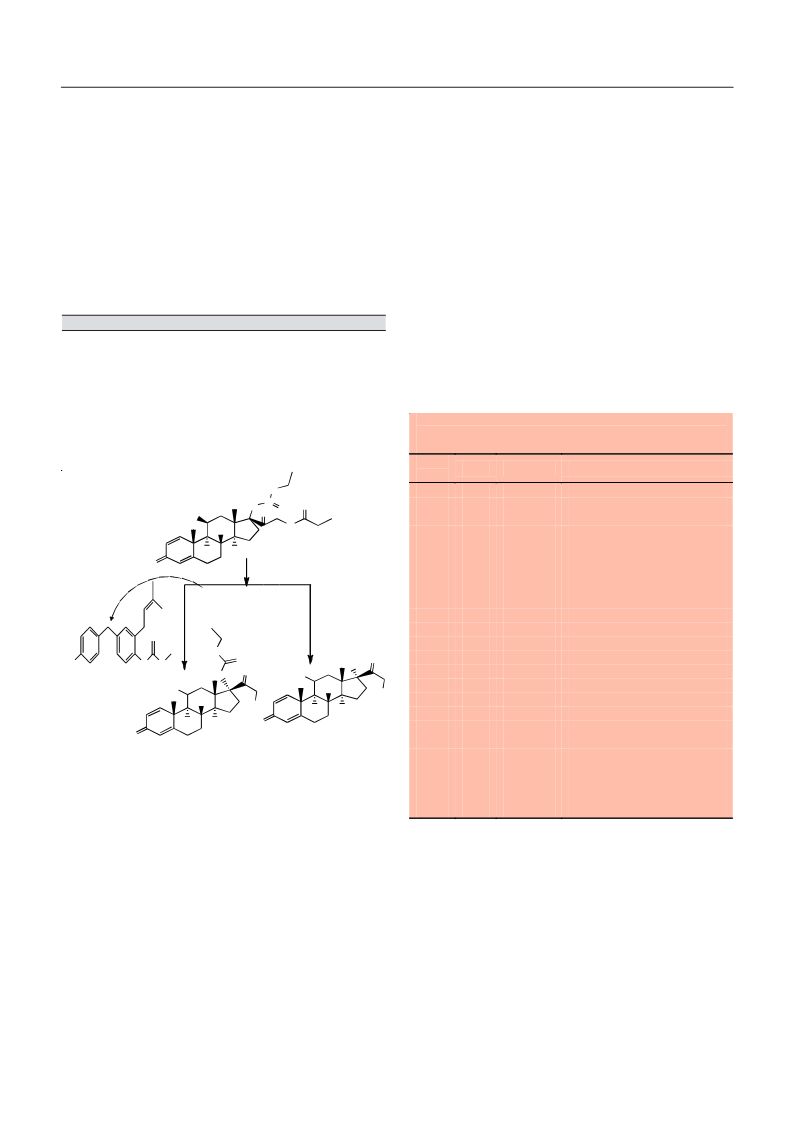
hydrolysis shown in Fig. 1. It is expected that the new meta-
bolites formed may have more antiinflammatory activity, better
therapeutic profile, safety, efficacy and least resistance and
can be employed in the treatment of asthma as that of the parent
compound.
-
4.27, dd; 4.62, dd (4.8,19.6)
CH2
4-(4-Hydroxybenzyl)-2-(3-methylbut-2-enyl)phenyl methyl
carbonate (4) was isolated as colourless amorphous powder.
The molecular formula of the compound was found to be
It is expected that the new metabolites formed may have
more antiinflammatory activity related to skin, better thera-
peutic profile, safety, efficacy and least resistance and can be
employed in the treatment of inflammatory skin diseases i.e.
dermatitis, eczema, etc. as that of the parent compound. In the
present study we could produce these compounds outside the
body which showed the definite potential of the emerging route
of metabolism of drug as well as new drug discovery from the
existing one.
20 22 4
C H O which was established by EI-MS. Molecular weight
of the compound was 310 and melting point was 390 °C.
1
13
H and C NMR data for metabolite 4 is given in Table-3.
1
The H NMR shows the peak at 7.605 (d) with J-9 and another
peak at 6.846 (d) with J = 9 of benzene ring so it is again a
para substituted ring. It also showed doublet of doublet at
6
.54 (d,d) with J = 8.4, 2 and 6.47 (d) J = 8 so it's ortho in
position and 6.41 (d) with J = 2 so it's meta substituted and
thus benzene ring is tri substituted. It also showed a triplet
methine at 5.05 which attribute double bond present in
molecule. It also shows two methylene group at 3.40 (s) and
Conclusion
3
.06 (d) and two methyl at 1.65 and 1.56 which are singlet so
Microbial biotransformation of prednicarbate by Cunning-
hamella elegans resulted first time from this fungus into two
known and one new metabolite which illustrates the enzymatic
potential of the fungus. The new metabolite was not reported
in literature and its structure did not showed structural
resemblance with substrate so it was assumed to be a fungal
metabolite.
attached to quaternary center. By using the HMBC correlation
and COSY correlation structure was established and important
correlation was given in Table-3 to established structure. The
1
3
C-NMR shows the signals at 130.0 (CH), 116.4 (CH), 129.7
CH), 115 (CH), 132.4 (CH), of benzene ring and 123.6 (CH)
(
of double bond. A signal at 53.6 shows Methoxy and two
methylene signals at 39.6 and 28.7. It also shows two signals
of methyl present at 25.9 and 17.7.
The two known compounds included prednisolone and
prednisolone 17-ethylcarbonate and one new metabolite as
4-(4-hydroxybenzyl)-2-(3-methylbut-2-enyl) phenyl methyl
carbonate. It is expected that new derivative may have more
anti-inflammatory activity than the parent compound. Their
structures of these compounds were elucidated by using
This was potential route of synthesis of these compounds.
Chemical reactions required variety of chemicals and condi-
tions to accomplish the reactions while in biotransformation a
number of reactions can be accomplished in one container
and reactions under mild conditions was required even at room
temperature. As there was no hazardous substances used for
the production of these metabolites so it could be denominated
1
3
1
modern spectroscopic techniques e.g., C NMR, H NMR,
HMQC, HMQC, COSY, NOESY and mass spectrometry e.g.
EI-MS.

 Ahmad, Saeed