Angewandte
Communications
Chemie
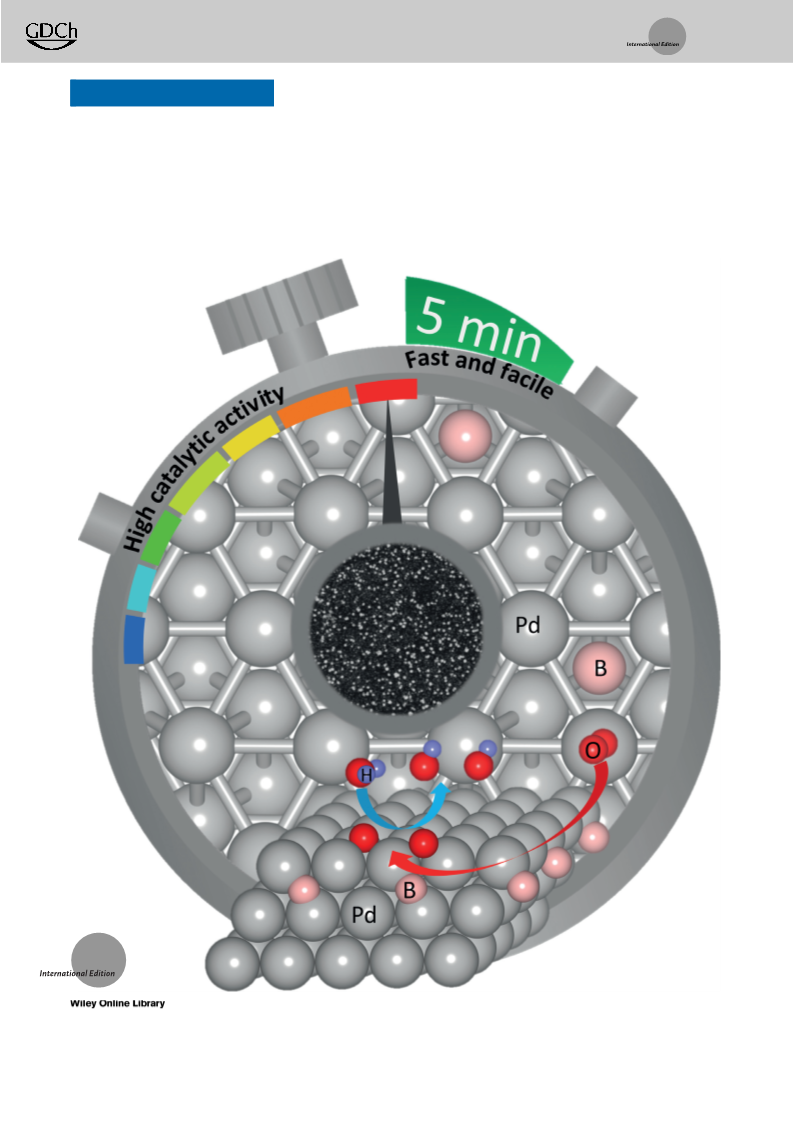
Abstract: A highly active alternative to Pt electrocatalysts for
gen.[1d–f, 6] According to these curves, the pure metals Pt and
the oxygen reduction reaction (ORR), which is the cathode-
electrode reaction of fuel cells, is sought for higher fuel-cell
performance. Our theoretical modelling reveals that B-doped
Pd (Pd-B) weakens the absorption of ORR intermediates with
nearly optimal binding energy by lowering the barrier asso-
ciated with O2 dissociation, suggesting Pd-B should be highly
active for ORR. In fact, Pd-B, facile synthesized by an
electroless deposition process, exhibits 2.2 times and 8.8 times
higher specific activity and 14 times and 35 times less costly
than commercial pure Pd and Pt catalysts, respectively.
Another computational result is that the surface core level of
Pd is negatively shifted by B doping, as confirmed by XPS, and
implies that filling the density of states related to the anti-
bonding of oxygen to Pd surfaces with excess electrons from B
doping, weakens the O bonding to Pd and boosts the catalytic
activity.
Pd exhibit superior catalytic activities for oxygen reduction,
which can be further improved by alloying them with other
elements to weaken the oxygen binding strength. This notion
has been confirmed by the enhanced ORR activity of Pt3M
alloys (M = Ni, Co, Fe, V, Ti, Sc, Y) in which the d-band center
of the Pt atoms is lower than that of pure Pt.[1e,f, 6] Pt-
alternative catalysts that will lower the cost while maintaining
the high ORR activity have also been researched.[7] The
activities of Pd-alloy catalysts (Pd–Co and Pd–Fe) are
comparable with that of Pt.[7b,c,f] Despite a recent report on
P-doped Pd that exhibited very high catalytic activity owing to
its amorphous structure,[8] much less work has been devoted
to doping non-metallic elements into Pd. In the present study,
we seek to understand how the ORR is enhanced in an
alloyed catalyst (e.g. B-doped Pd). The investigation com-
bines density functional theory (DFT) calculations[1e, 6b,9] with
experimental studies. We first investigated the adsorption of
ORR intermediates onto the Pd material, constructed the
ORR mechanism, and identify the preferential mechanism on
the pure Pd and B-doped Pd catalysts. We then synthesized
a real B-doped Pd and pure Pd catalyst by our previously
developed stepwise electroless deposition process.[8] In this
method, the electrode is sequentially dipped into two differ-
ent solutions, the first containing a reducing agent (in this
study, dimethylaminoborane (DMAB) or hydrazine (N2H4))
and the second containing a metal salt (metal ion source,
PdCl2). During the second dipping, Pd nanoparticles are
electrochemically deposited onto the electrode surface. The
Pd nanoparticles become doped with B atoms released by the
decomposition of DMAB (herein, the B-doped Pd is denoted
as Pd–B) while pure Pd is deposited (no doping) when
hydrazine is used (the synthesized pure Pd is denoted as Pd–
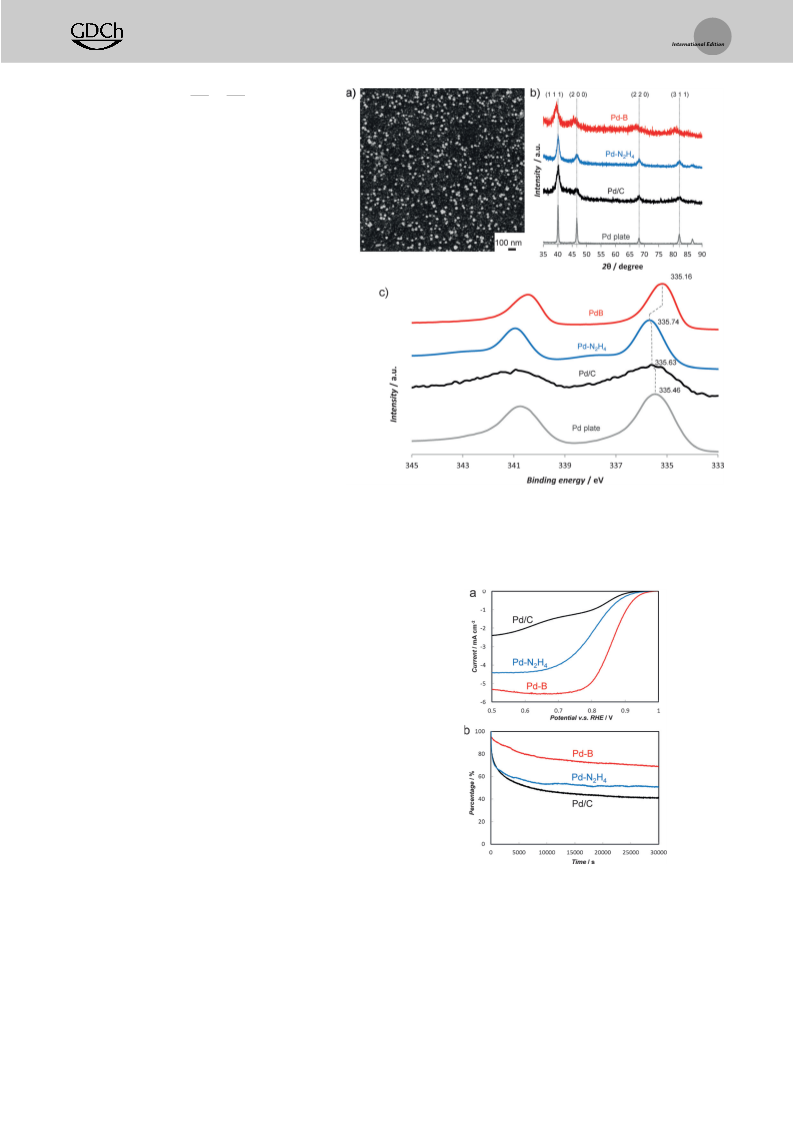
N2H4). As predicted by the theoretical modelling, the
synthesized Pd–B exhibits superior catalytic activity to the
Pd–N2H4 and a commercial Pd-loaded carbon (denoted as Pd/
C). Finally, to further understand the mechanism of the ORR
enhancement in Pd–B, we compute the surface core level shift
(SCLS), defined as the difference in core level binding energy
between the surface and bulk, for the pure Pd and Pd–B
catalysts, and experimentally confirm the computations by X-
ray photoelectron spectroscopy (XPS).
I
n fuel cells, the oxygen reduction reaction (ORR) plays an
important role, because oxygen is a common fuel for cathodic
=
reduction. However, the ORR is non-facile because the O O
bond is very strong.[1] Developing highly active oxygen-
reduction electrocatalysts at low cost remains a great chal-
lenge, although intensive efforts have been expended on the
development of cathode materials. Non-precious metal-based
catalysts, such as transition-metal nitrogen carbon (M-N-C,
M = Co, Fe, Ni, Mn)[2] and transition-metal oxides (MOx, M =
Mn, Fe, Co, Cu,)[3] exhibit high ORR catalytic activity and
have drawn much attention owing to their abundance and low
cost. Metal-free materials ,such as nitrogen-doped carbon
have shown significant improvement in ORR catalytic
activity that reaches the level of commercial Pt/C in term of
onset potential and half-wave potential.[3d,4] They are very
promising catalysts but need further improvement in terms of
durability, synthesis process (mostly high vacuum, high
temperature, or long synthesis time is required), or electric
conductivity.[5] Platinum is thus still the practically used ORR
catalyst and platinum-alternative precious-metal catalysts
have been intensively investigated.
Nørskov and co-workers established the so-called volcano
curve, which relates the oxygen reduction activity of different
metals and alloys to the binding energy of atomic oxy-
The ORR intermediate species (especially the radical
species) adsorb more weakly on the surface of Pd–B
than on Pd as summarized from Table S1 in the Supporting
Information. On the pure Pd surface, O prefers the fcc
hollow, that is, the f site with a binding energy of À4.44 eV,
whereas on B doped Pd surface (Pd–B), the f2 site is pre-
ferred with a binding energy of À4.12 eV: the B doping
weakens the O adsorption by 0.32 eV. According to the work
by Stamenkovic et al.,[6b] the highest ORR catalyst is pre-
dicted to bind O more weakly than pure Pt by 0.20 eV. Since
O adsorbs 0.06 eV more strongly to Pd(111) than to Pt-
(111),[7b, 10] the downshift should be 0.26 eV (relative to pure
Pd) to reach the maximum activity. Therefore, Pd–B exhibits
nearly optimal O adsorption and should have high catalytic
activity for ORR.
[*] T. T. Vo Doan,[+] K. C. Poon, D. C. L. Tan, Prof. H. Sato
School of Mechanical and Aerospace Engineering
Nanyang Technological University
50 Nanyang Avenue, Singapore 639798 (Singapore)
E-mail: hirosato@ntu.edu.sg
J. Wang,[+] Prof. H. Su
School of Materials Science & Engineering
Nanyang Technological University
50 Nanyang Avenue, Singapore 639798 (Singapore)
E-mail: hbsu@ntu.edu.sg
B. Khezri, Prof. R. D. Webster
Division of Chemistry & Biological Chemistry, School of Physical and
Mathematical Sciences, Nanyang Technological University
21 Nanyang Link, Singapore 637371 (Singapore)
[+] These authors contributed equally to this work.
OH and O2 preferentially bind to the f sites on the pure Pd
surface with binding energies of À2.58 eV and À0.99 eV,
Supporting information for this article can be found under:
Angew. Chem. Int. Ed. 2016, 55, 6842 –6847
ꢀ 2016 Wiley-VCH Verlag GmbH & Co. KGaA, Weinheim

 Vo Doan, Tat Thang