Yasmin et al.
Nitrogen-Doped Graphene Supported Cobalt Oxide Nanocomposite as High Performance Electrocatalyst for ORR
Acknowledgments: This research has supported by the
National Research Foundation of Korea (NRF) funded
by the Ministry of Education, Science and Technology
(NRF-2015R1D1A1A09059344).
References and Notes
1. R. Bashyam and P. Zelenay, Nature 443, 63 (2006).
2. M. S. Ahmed and S. Jeon, ACS Catal. 4, 1830 (2014).
3. H. S. Han, M. S. Ahmed, H. Jeong, and S. Jeon, J. Nanosci. Nan-
otechnol. 16, 333 (2016).
4. J. E. Choe, J.-M. You, M. Yun, K. Lee, M. S. Ahmed, Z. Üstündag,
and S. Jeon, J. Nanosci. Nanotechnol. 15, 5684 (2015).
5. H. Jeong, M. S. Ahmed, and S. Jeon, J. Nanosci. Nanotechnol.
11, 987 (2011).
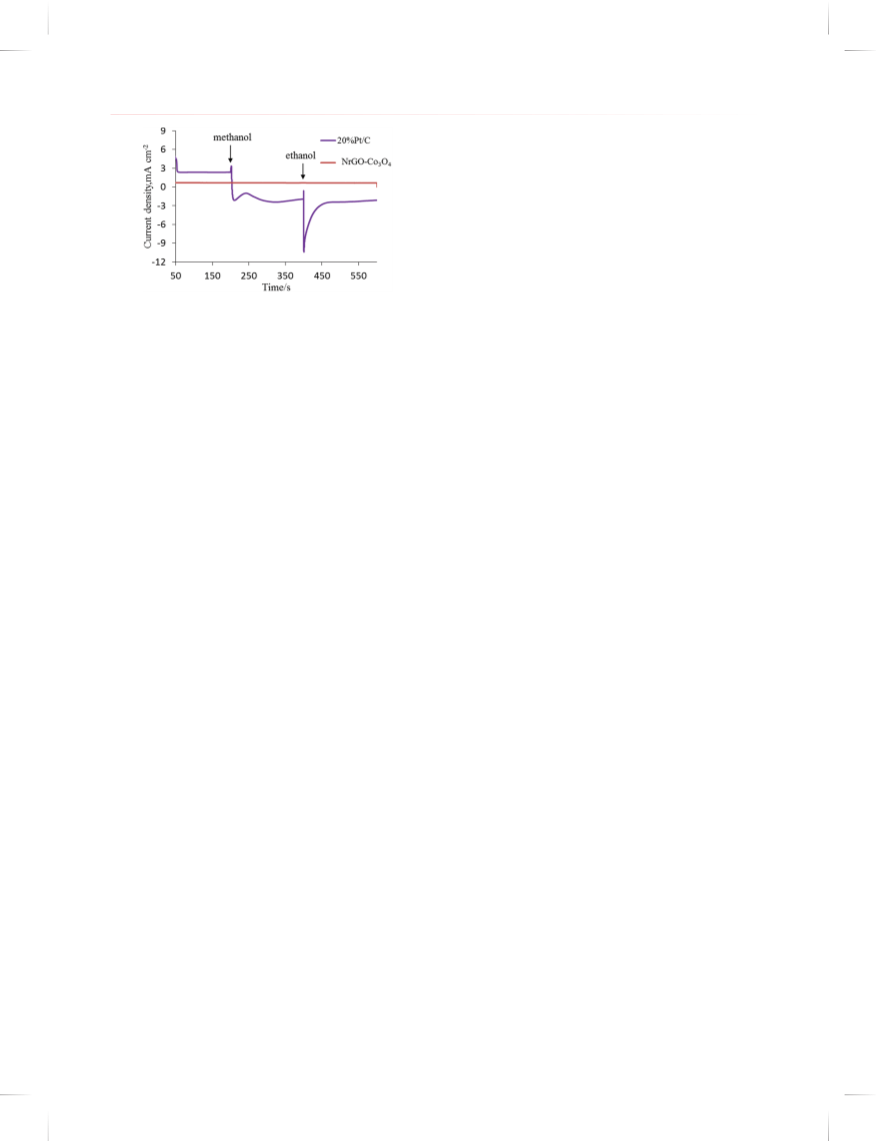
Figure 8. Chronoamperometric response of NrGO–Co3O4 and Pt/C
with addition of 1 M methanol and ethanol, respectively.
6. G. Wu, K. L. More, C. M. Johnston, and P. Zelenay, Science 332, 443
(2011).
7. M. S. Ahmed and S. Jeon, J. Power Sources 218, 168 (2012).
8. M. Yun, M. S. Ahmed, and S. Jeon, J. Power Sources 293, 380
(2015).
9. J. E. Choe, M. S. Ahmed, and S Jeon, J. Electrochem. Soc.
163, B113 (2016).
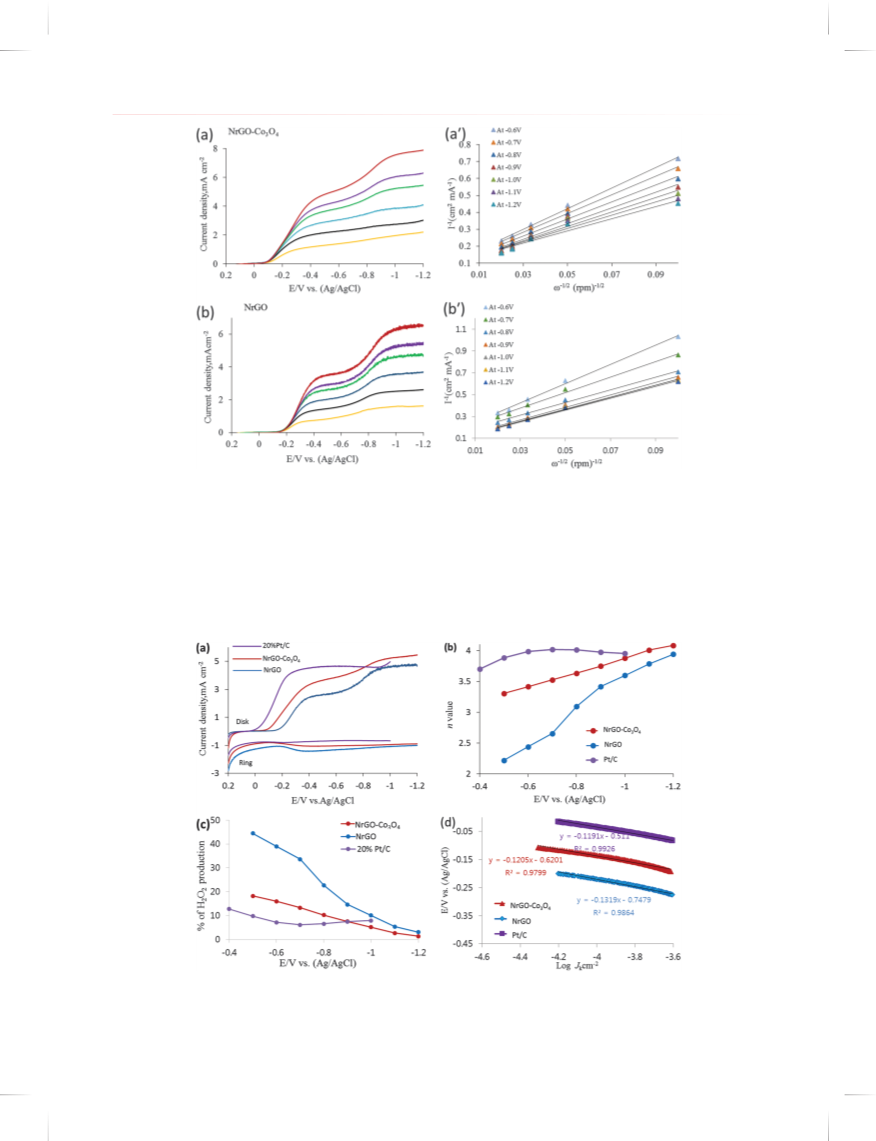
transfer inside NrGO–Co3O4, which is better than NrGO
and similar to Pt/C. The results indicate that the similar
behaviors of the Tafel slopes and the reaction mechanism
and the rate-determining step is much better at NrGO–
Co3O4 catalyst.36ꢀ44
10. Y. J. Wang, D. P. Wilkinson, and J. J. Zhang, Chem. Rev. 111, 7625
(2011).
11. A. Serov and C. Kwak, Appl. Catal. B Environ. 90, 313 (2009).
12. X. Lin, Y. Liu, S. D. Poynton, A. L. Ong, J. R. Varcoe, L. Wu, Y. Li,
X. Liang, Q. Li, and T. Xu, J. Power Sources 233, 259 (2013).
13. M. S. Ahmed, H. Jeong, J.-M. You, and S. Jeon, Electrochim. Acta
56, 4924 (2011).
3.3. Crossover Effect
The crossover effect is also a critical issue in FCs
application. To investigate the crossover effect of the
NrGO–Co3O4 electrocatalysts toward ORR, we performed
amperometric measurement on NrGO–Co3O4 and 20%
Pt/C electrodes at −0.3 V (vs. Ag/AgCl) in an O saturated
14. H. Yun, M. S. Ahmed, K. Lee, S. Jeon, C. W. Lee, Appl. Surf. Sci.
360, 915 (2016).
15. K. Geim and K. S. Novoselov, Nat. Mater. 6, 183 (2007).
Delivered by Ingenta to2: State University of New York at Binghamton
16. S. Yasmin, M. S. Ahmed, and S. Jeon, J. Electrochem. Soc.
0.1 M KOH electrolyte (Fig. 8).IPA:s5s.h1o8w9n.20in1.F3i4guOren:8W, ed, 28 Jun 2017 07:07:47
162, B363 (2015).
Copyright: American Scientific Publishers
a sharp signal change in current is observed at Pt/C elec-
17. A. Ejaz, M. S. Ahmed, and S. Jeon, Sens. Actuators B 221, 1256
(2015).
trode upon addition of 1 M methanol and ethanol, respec-
tively. However, the corresponding amperometric response
for the NrGO–Co3O4 modified electrode remains nearly
unchanged after the addition of methanol and ethanol. This
result strongly indicates that the NrGO–Co3O4 electrocat-
alyst has higher fuel selectivity toward ORR than that of
commercial Pt/C electrocatalyst.
18. M. D. Stoller, S. J. Park, Y. W. Zhu, J. H. An, and R. S. Ruoff, Nano
Lett. 8, 3498 (2008).
19. F. Zhang, T. Zhang, X. Yang, L. Zhang, K. Leng, Y. Huang, and
Y. Chen, Energy Environ. Sci. 6, 1623 (2013).
20. L. F. Lai, Energy Environ. Sci. 5, 7936 (2012).
21. L. Y. Feng, Sci. Rep. 3, 3306 (2013).
22. Y. Xu, X. Wang, C. An, Y. Wang, L. Jiao, and H. Yuan, J. Power
Sources 272, 328 (2014).
23. G. D. Park, J. S. Cho, and Y. C. Kang, Nano Energy 17, 17 (2015).
24. M. S. Ahmed, D. Park, and S. Jeon, J. Power Sources 308, 180
(2016).
25. Y. Liang, Y. Li, H. Wang, J. Zhou, J. Wang, T. Regier, and H. Dai,
Nat. Mater. 10, 780 (2011).
26. M. S. Ahmed, J.-M. You, H. S. Han, D.-C. Jeong, and S. Jeon,
J. Nanosci. Nanotechnol. 14, 5722 (2014).
27. J. E. Choe, M. S. Ahmed, and S. Jeon, J. Electrochem. Soc.
163, B113 (2016).
28. H. Begum, M. S. Ahmed, and S. Jeon, RSC Adv. 6, 50572 (2016).
29. M. S. Ahmed and S. Jeon, J. Nanosci. Nanotechnol. 13, 306 (2013).
30. M. S. Ahmed, D. Kim, and S. Jeon, Electrochim. Acta 92, 168
(2013).
31. M. S. Ahmed and S. Jeon, J. Power Sources 282, 479 (2015).
32. Y. Zhang, J. Ge, L. Wang, D. Wang, F. Ding, X. Tao, and W. Chen,
Sci. Rep. 3, 2771 (2013).
33. J. Pu, Z. Wang, K. Wu, N. Yu, and E. Sheng, Phys. Chem. Chem.
Phys. 16, 785 (2014).
34. A. C. Mtukula, J. Shen, X. Bo, and L. Guo, J. Alloys Compounds
655, 229 (2016).
4. CONCLUSIONS
A simple method is reported for the synthesis of NrGO–
Co3O4 and NrGO electrocatalysts which have been
demonstrated as catalysts for ORR. The structural, mor-
phological properties and stability have been deduced from
TEM, XPS and Raman spectra analysis. The ORR activity
was evaluated by RDE technique in O2 saturated alka-
line medium. K–L plot proved that the hydrogen perox-
ide by product formation using NrGO–Co3O4 was lesser
than NrGO, and it followed four electron transfer path-
way mechanism. Kinetic parameter such as Tafel slope
(120 mV dec−1) is indicating one electron transfer as
rate determining step. The kinetic current density, Eonset
and half wave potential values confirm that NrGO–Co3O4
has better ORR activity than NrGO. The as synthesized
NrGO–Co3O4 electrocatalysts showed better alcohol-like
fuel tolerance than commercial Pt/C (20 wt%).
35. K. Lee, M. S. Ahmed, and S. Jeon, J. Power Sources 288, 261
(2015).
J. Nanosci. Nanotechnol. 17, 3959–3966, 2017
3965

 Yasmin, Sabina