Welcome to LookChem.com Sign In|Join Free
  • or

Encyclopedia

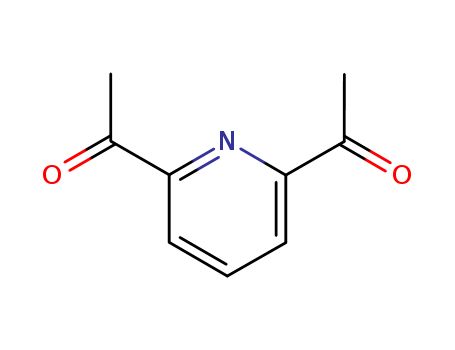
2,6-Diacetylpyridine

Base Information
  • Chemical Name:2,6-Diacetylpyridine
  • CAS No.:1129-30-2
  • Molecular Formula:C9H9NO2
  • Molecular Weight:163.176
  • Hs Code.:29333990
  • European Community (EC) Number:214-442-9
  • NSC Number:63355
  • UNII:P34UXL3MYV
  • DSSTox Substance ID:DTXSID10150202
  • Nikkaji Number:J149.829K
  • Wikipedia:2,6-Diacetylpyridine
  • Wikidata:Q4596808
  • Mol file:1129-30-2.mol
2,6-Diacetylpyridine

Synonyms:2,6-Diacetylpyridine;1129-30-2;1-(6-acetylpyridin-2-yl)ethanone;1,1'-(pyridine-2,6-diyl)diethanone;Pyridine-2,6-diacetyl;MFCD00006304;Ethanone, 1,1'-(2,6-pyridinediyl)bis-;P34UXL3MYV;1-(6-acetylpyridin-2-yl)ethan-1-one;EINECS 214-442-9;NSC-63355;1,1'-(2,6-Pyridinediyl)bis[ethanone];1,1'-(2,6-PYRIDINEDIYL)BIS(ETHANONE);1-(6-Acetyl-pyridin-2-yl)-ethanone;NSC63355;2,6diacetylpyridine;UNII-P34UXL3MYV;2 pound not6-Diacetylpyridine;2,6-Diacetylpyridine, 99%;SCHEMBL455687;BEZVGIHGZPLGBL-UHFFFAOYSA-;DTXSID10150202;1,1'-pyridine-2,6-diyldiethanone;AMY14457;BBL100152;GEO-00906;NSC 63355;STK087382;AKOS003595902;AC-6429;CS-W001999;NCGC00340769-01;BP-20094;SY010398;TS-03571;D2377;FT-0610526;D58390;2,6-Diacetylpyridine, purum, >=98.0% (GC);AB01332223-02;EN300-6736941;Q4596808;W-108632

Suppliers and Price of 2,6-Diacetylpyridine
Supply Marketing:
Business phase:
The product has achieved commercial mass production*data from LookChem market partment
Manufacturers and distributors:
  • Manufacture/Brand
  • Chemicals and raw materials
  • Packaging
  • price
  • TRC
  • 2,6-Diacetylpyridine
  • 50mg
  • $ 60.00
  • TCI Chemical
  • 2,6-Diacetylpyridine >98.0%(GC)
  • 25g
  • $ 397.00
  • TCI Chemical
  • 2,6-Diacetylpyridine >98.0%(GC)
  • 5g
  • $ 120.00
  • SynQuest Laboratories
  • 2,6-Diacetylpyridine 98%
  • 5 g
  • $ 115.00
  • SynQuest Laboratories
  • 2,6-Diacetylpyridine 98%
  • 25 g
  • $ 300.00
  • Sigma-Aldrich
  • 2,6-Diacetylpyridine 99%
  • 25g
  • $ 320.00
  • Sigma-Aldrich
  • 2,6-Diacetylpyridine 99%
  • 1g
  • $ 35.00
  • Sigma-Aldrich
  • 2,6-Diacetylpyridine 99%
  • 5g
  • $ 116.00
  • Matrix Scientific
  • 2,6-Diacetylpyridine 97%
  • 5g
  • $ 65.00
  • Matrix Scientific
  • 2,6-Diacetylpyridine 97%
  • 1g
  • $ 15.00
Total 150 raw suppliers
Chemical Property of 2,6-Diacetylpyridine
Chemical Property:
  • Appearance/Colour:white to off-white crystalline needles or powder 
  • Vapor Pressure:0.00251mmHg at 25°C 
  • Melting Point:79-82 °C 
  • Refractive Index:1.521 
  • Boiling Point:287.2 °C at 760 mmHg 
  • PKA:0.88±0.10(Predicted) 
  • Flash Point:131.9 °C 
  • PSA:47.03000 
  • Density:1.119 g/cm3 
  • LogP:1.48680 
  • Storage Temp.:Inert atmosphere,Room Temperature 
  • Water Solubility.:Soluble in water, chloroform, and DMSO. 
  • XLogP3:0.9
  • Hydrogen Bond Donor Count:0
  • Hydrogen Bond Acceptor Count:3
  • Rotatable Bond Count:2
  • Exact Mass:163.063328530
  • Heavy Atom Count:12
  • Complexity:181
Purity/Quality:

99% *data from raw suppliers

2,6-Diacetylpyridine *data from reagent suppliers

Safty Information:
  • Pictogram(s): IrritantXi,Flammable
  • Hazard Codes:Xi,F 
  • Statements: 36/37/38-15-10 
  • Safety Statements: 26-36-43-7/8 
MSDS Files:

SDS file from LookChem

Total 1 MSDS from other Authors

Useful:
  • Chemical Classes:Nitrogen Compounds -> Pyridines
  • Canonical SMILES:CC(=O)C1=NC(=CC=C1)C(=O)C
  • Uses 2,6-Diacetylpyridine is used as intermediate in organic synthesis. It is a precursor to ligands in coordination chemistry.
Technology Process of 2,6-Diacetylpyridine

There total 12 articles about 2,6-Diacetylpyridine which guide to synthetic route it. The literature collected by LookChem mainly comes from the sharing of users and the free literature resources found by Internet computing technology. We keep the original model of the professional version of literature to make it easier and faster for users to retrieve and use. At the same time, we analyze and calculate the most feasible synthesis route with the highest yield for your reference as below:

synthetic route:
Guidance literature:
With copper(l) iodide; In tetrahydrofuran; at -78 ℃;
DOI:10.1016/0040-4039(95)02298-8
Guidance literature:
N2,N2,N6,N6-tetraethyl-2,6-pyridinedicarboxamide; methylmagnesium chloride; In tetrahydrofuran; at 0 - 20 ℃; for 3h;
With hydrogenchloride; In tetrahydrofuran; water; at 0 ℃;
DOI:10.1016/j.tetlet.2012.11.004
Guidance literature:
diethyl-2,6-pyridinedicarbonyl ester; With sodium ethanolate; In ethyl acetate; for 20h; Reflux;
With hydrogenchloride; In ethyl acetate; at 0 ℃; for 20h; Reflux;
Refernces

Synthesis and spectroscopic properties of Ni(II) complexes of some aroyl hydrazone ligands with 2,6-diacetyl pyridine monooxime: X-ray crystal structure of the salicyloylhydrazone Ni(II) complex

10.1016/j.ica.2010.05.009

The study focuses on the synthesis and characterization of five new Ni(II) complexes with aroyl hydrazone ligands derived from 2,6-diacetyl pyridine monooxime. The complexes were found to have a distorted octahedral N4O2 coordination environment around the Ni(II) ion, with the ligands coordinating through the pyridine nitrogen, imino-hydrazone nitrogen, and the deprotonated oxygen of the hydrazone moiety. The uncoordinated iminooxime groups and the orthogonal orientation of the CH3–C@N–OH groups relative to the adjacent pyridine rings were observed. The ligands and their corresponding Ni(II) complexes exhibited luminescence, with the complexes showing a lower quantum yield compared to the free ligands. The study also includes the X-ray crystal structure of the Ni(II) salicyloylhydrazone complex, which revealed details about the molecular structure and hydrogen bonding interactions in the crystal lattice. The research provides insights into the coordination chemistry of aroyl hydrazone ligands and their potential applications in areas such as pharmaceuticals and materials science.

Highly enantioselective reduction of symmetrical diacetylaromatics with baker's yeast

10.1016/S0957-4166(97)00462-X

The research investigates the asymmetric reduction of various symmetrical diacetylaromatic compounds using baker's yeast (Saccharomyces cerevisiae) to obtain optically active secondary alcohols with high enantiomeric purity. The study explores the reduction of compounds such as 2,6-diacetylpyridine (la), 2,6-diacetylpyridine 1-oxide (lb), 1,2-diacetylb°enzene (lc), 1,3-diacetylbenzene (ld), 1,4-diacetylbenzene (le), 2,5-diacetylfuran (If), 2,5-diacetylthiophene (lg), and 2,5-diacetylpyrrole (lh). The researchers optimized reaction conditions to selectively produce monoalcohols over diols, achieving excellent yields and enantiomeric purities. Key chemicals involved in the research include the diacetylaromatic substrates, baker's yeast, sucrose, and various reagents used in the synthesis and analysis of the compounds, such as methoxymethoxyethyl groups, maleic acid, hydrogen peroxide, oxalyl chloride, dimethyl sulfoxide, and triethylamine. The study highlights the effectiveness of baker's yeast as a biocatalyst for enantioselective reductions under mild conditions, offering a valuable alternative to traditional chemical methods.


Post a RFQ

Enter 15 to 2000 letters.Word count: 0 letters

Attach files(File Format: Jpeg, Jpg, Gif, Png, PDF, PPT, Zip, Rar,Word or Excel Maximum File Size: 3MB)

1 Customer Service

What can I do for you?
Get Best Price

Get Best Price for 1129-30-2