Welcome to LookChem.com Sign In|Join Free
  • or

Encyclopedia

Germanium

Base Information
  • Chemical Name:Germanium
  • CAS No.:7782-65-2
  • Deprecated CAS:129827-75-4
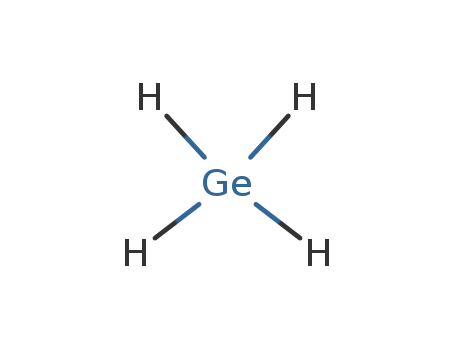
  • Molecular Formula:GeH4
  • Molecular Weight:76.6218
  • Hs Code.:
  • European Community (EC) Number:231-164-3
  • UNII:619P6J82AE,00072J7XWS
  • DSSTox Substance ID:DTXSID8052483,DTXSID7052521,DTXSID30422913,DTXSID901318637
  • Wikipedia:Germanium
  • Wikidata:Q867,Q27113865,Q27113859
  • NCI Thesaurus Code:C95170
  • Mol file:7782-65-2.mol
Germanium

Synonyms:Germanium

Suppliers and Price of Germanium
Supply Marketing:
Business phase:
The product has achieved commercial mass production*data from LookChem market partment
Manufacturers and distributors:
  • Manufacture/Brand
  • Chemicals and raw materials
  • Packaging
  • price
Total 6 raw suppliers
Chemical Property of Germanium
Chemical Property:
  • Appearance/Colour:Colorless 
  • Melting Point:-165°C 
  • Boiling Point:-88°C 
  • PSA:0.00000 
  • Density:1,53 g/cm3 
  • LogP:0.06920 
  • Water Solubility.:insoluble H2O; soluble liquid ammonia, slightly soluble hot HCl [HAW93] 
  • Hydrogen Bond Donor Count:0
  • Hydrogen Bond Acceptor Count:0
  • Rotatable Bond Count:0
  • Exact Mass:73.9211778
  • Heavy Atom Count:1
  • Complexity:0
Purity/Quality:

99% *data from raw suppliers

Safty Information:
  • Pictogram(s): Toxic material. TLV: 0.2 ppm. 
  • Hazard Codes:F,T,T+,F+ 
  • Statements: 17-21/22-23-26-22-12 
  • Safety Statements: 16-24-26-36/37/39-45 
MSDS Files:

SDS file from LookChem

Total 1 MSDS from other Authors

Useful:
  • Chemical Classes:Metals -> Metalloid Compounds (Germanium)
  • Canonical SMILES:[Ge]
  • Recent EU Clinical Trials:A phase 3b, open-label, multi-country, multi-centre, long-term follow-up study of ZOSTER-049 (follow-up of ZOSTER-006/022 studies) to assess the prophylactic efficacy, safety and persistence of immune response of a Herpes Zoster subunit vaccine and assessment of persistence of immune response and safety of 1 or 2 additional doses administered in ZOSTER-049 in 2 subgroups of older adults
  • General Description Germane (GeH4), also known as germanium tetrahydride or monogermane, is a key precursor in the synthesis of organogermanium compounds. The study highlights a catalytic hydrogen-halogen exchange method using PdCl2 or NiCl2 to convert hydrosilanes and germanes into bromo- or iododerivatives, offering a practical and economical route for producing these reagents. While the method efficiently yields fully halogenated products, selective partial halogenation remains a challenge. This approach enhances the accessibility of germanes for applications in organogermanium chemistry.
Technology Process of Germanium

There total 67 articles about Germanium which guide to synthetic route it. The literature collected by LookChem mainly comes from the sharing of users and the free literature resources found by Internet computing technology. We keep the original model of the professional version of literature to make it easier and faster for users to retrieve and use. At the same time, we analyze and calculate the most feasible synthesis route with the highest yield for your reference as below:

synthetic route:
Guidance literature:
In hydrogen bromide; according to T.S. Piper, M.K. Wilson, J. Inorg. Nucl. Chem., 4, 22 (1957) and J.E.Griffiths, Inorg. Chem., 2, 375 (1963); collected into -134°C trap, purified by passing through a columnwith silica gel and mol. sieve 5A at -30 °C, detd. by chromy. and mass spectrometric analysis;
Guidance literature:
In solid matrix; byproducts: LiCl, AlCl3; distilling gaseous GeCl4 in vac. on solid matrix of LiAlH4 in ether (cooled with liq. N2), heating to room temp.;; fractional condensation at -111.9 °C;;
Refernces

PdCl2 and NiCl2-catalyzed hydrogen-halogen exchange for the convenient preparation of bromo- and iodosilanes and germanes

10.1016/S0022-328X(02)02147-2

The research investigates a method for synthesizing bromo- and iodosilanes, as well as germanes, using a hydrogen–halogen exchange reaction catalyzed by PdCl2 or NiCl2. The purpose of the study is to develop a versatile and convenient synthetic route for these compounds, which are important reagents in the creation of various organosilicon and germanium compounds. The researchers found that treating hydrosilanes with alkyl or allyl bromides in the presence of a catalytic amount of PdCl2 or NiCl2 resulted in the formation of bromosilanes in good to high yields. Similarly, using alkyl iodides led to the formation of iodosilanes. The reactions were more efficient with PdCl2, but NiCl2 was also effective, albeit with lower activity. The study concludes that this method provides a practical and economic way to synthesize a variety of bromo- and iodosilanes and germanes, which could be useful in the synthesis of complex organosilicon and germanium compounds. However, the selective halogenation of partially halogenated products remains a challenge, as the reactions tend to produce fully halogenated compounds even at early stages.


Post a RFQ

Enter 15 to 2000 letters.Word count: 0 letters

Attach files(File Format: Jpeg, Jpg, Gif, Png, PDF, PPT, Zip, Rar,Word or Excel Maximum File Size: 3MB)

1 Customer Service

What can I do for you?
Get Best Price

Get Best Price for 7782-65-2