Welcome to LookChem.com Sign In|Join Free
  • or

Encyclopedia

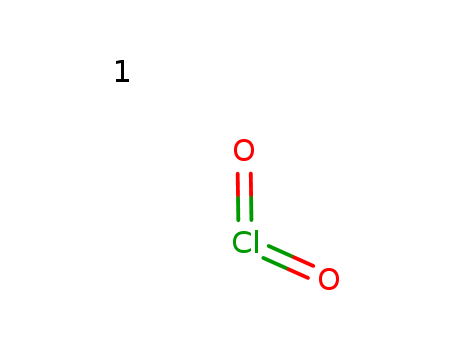
Chlorine Dioxide

Base Information
  • Chemical Name:Chlorine Dioxide
  • CAS No.:10049-04-4
  • Deprecated CAS:1002158-67-9,1014743-76-0,1018807-91-4,1333-81-9,1428979-52-5,155808-17-6,56310-06-6,69049-77-0,70134-37-1,72061-90-6,74296-11-0,744149-53-9,77546-17-9,77546-18-0,807261-60-5,93085-22-4
  • Molecular Formula:ClO2
  • Molecular Weight:67.4518
  • Hs Code.:
  • European Community (EC) Number:233-162-8
  • ICSC Number:0127
  • UN Number:9191
  • DSSTox Substance ID:DTXSID5023958
  • Nikkaji Number:J342.197J
  • Wikipedia:Chlorine dioxide,Chlorine_dioxide,Chlorine_peroxide
  • NCI Thesaurus Code:C172619
  • RXCUI:20799
  • Mol file:10049-04-4.mol
Chlorine Dioxide

Synonyms:Alcide;Aseptrol;chlorine dioxide;chlorine dioxide, 17O-labeled;chlorine dioxide, 35Cl,1-(18)O-labeled;chlorine dioxide, 35Cl-labeled;chlorine dioxide, 37Cl,1-(18)O-labeled;chlorine dioxide, 37Cl-labeled;chlorine dioxide, monohydrate;chlorine oxide;ClO2;DioxiClear;MicroClear;RenNew-D;Tristel

Suppliers and Price of Chlorine Dioxide
Supply Marketing:
Business phase:
The product has achieved commercial mass production*data from LookChem market partment
Manufacturers and distributors:
  • Manufacture/Brand
  • Chemicals and raw materials
  • Packaging
  • price
Total 23 raw suppliers
Chemical Property of Chlorine Dioxide
Chemical Property:
  • Appearance/Colour:gas 
  • Melting Point:-59 °C 
  • Boiling Point:11 °C 
  • PSA:34.14000 
  • Density:3.09 g/L 
  • LogP:0.56440 
  • Water Solubility.:Soluble℃ 
  • XLogP3:1.4
  • Hydrogen Bond Donor Count:0
  • Hydrogen Bond Acceptor Count:1
  • Rotatable Bond Count:0
  • Exact Mass:66.9586819
  • Heavy Atom Count:3
  • Complexity:7.5
  • Transport DOT Label:Oxidizer Poison
Purity/Quality:

99% *data from raw suppliers

Safty Information:
  • Pictogram(s): OxidizingO,VeryT+,Dangerous
  • Hazard Codes:O,T+,N 
MSDS Files:

Total 1 MSDS from other Authors

Useful:
  • Chemical Classes:Toxic Gases & Vapors -> Oxidizers
  • Canonical SMILES:O=Cl[O]
  • Recent ClinicalTrials:Chlorine Dioxide Versus Saline for Wound Irrigation
  • Recent NIPH Clinical Trials:Comparative test on the preventive effect of chlorine dioxide gas on infections such as influenza
  • Inhalation Risk:A harmful concentration of this gas in the air will be reached very quickly on loss of containment.
  • Effects of Short Term Exposure:The substance is severely irritating to the eyes, skin and respiratory tract. Inhalation of this gas may cause lung oedema. Exposure far above the OEL could cause death. The effects may be delayed. Medical observation is indicated.
  • Effects of Long Term Exposure:The substance may have effects on the lungs. This may result in chronic bronchitis.
Technology Process of Chlorine Dioxide

There total 297 articles about Chlorine Dioxide which guide to synthetic route it. The literature collected by LookChem mainly comes from the sharing of users and the free literature resources found by Internet computing technology. We keep the original model of the professional version of literature to make it easier and faster for users to retrieve and use. At the same time, we analyze and calculate the most feasible synthesis route with the highest yield for your reference as below:

synthetic route:
Guidance literature:
In water; Electrolysis;
Refernces

Chlorination and oxidation products formed from 1,2,4-trimethylbenzene in aqueous solution under the action of chlorine dioxide

10.1134/S107042720707018X

The study investigates the reaction products of 1,2,4-trimethylbenzene (1,2,4-TMB) with chlorine dioxide (ClO2) in aqueous solution. The primary purpose of the study is to understand the transformation pathways of 1,2,4-TMB under the influence of ClO2, which is significant in the context of water disinfection and the reduction of secondary toxicants. Chemicals used include 1,2,4-TMB as the organic substrate, ClO2 as the oxidizing agent, sodium chlorite (used to prepare ClO2), hydrochloric acid (reacted with sodium chlorite to produce ClO2), and sodium thiosulfate (to deactivate excess ClO2). The study serves to explore the potential water pollutants' transformation in petrochemical-adjacent regions and to assess the effectiveness of ClO2 as a disinfectant, particularly in reducing the formation of toxic disinfection byproducts.

Post a RFQ

Enter 15 to 2000 letters.Word count: 0 letters

Attach files(File Format: Jpeg, Jpg, Gif, Png, PDF, PPT, Zip, Rar,Word or Excel Maximum File Size: 3MB)

1 Customer Service

What can I do for you?
Get Best Price

Get Best Price for 10049-04-4