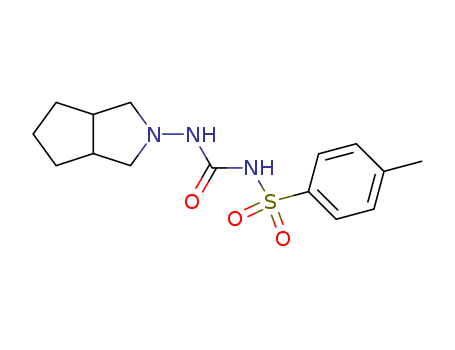
Chemical Property of Diamicron
Chemical Property:
- Appearance/Colour:white cyrstalline solid
- Melting Point:163-169 °C(lit.)
- Refractive Index:1.623
- PKA:6.07±0.10(Predicted)
- PSA:86.89000
- Density:1.35 g/cm3
- LogP:3.43030
- Storage Temp.:-20°C Freezer
- Solubility.:methylene chloride: soluble
- XLogP3:1.5
- Hydrogen Bond Donor Count:2
- Hydrogen Bond Acceptor Count:4
- Rotatable Bond Count:3
- Exact Mass:323.13036271
- Heavy Atom Count:22
- Complexity:497
- Purity/Quality:
-
99%, *data from raw suppliers
Gliclazide *data from reagent suppliers
Safty Information:
- Pictogram(s):
 Xn,
Xn, Xi
Xi
- Hazard Codes:Xn,Xi
- Statements:
21-36/38-46-62-63
- Safety Statements:
25-26-36/37-53-24/25
- MSDS Files:
-
SDS file from LookChem
Useful:
- Canonical SMILES:CC1=CC=C(C=C1)S(=O)(=O)NC(=O)NN2CC3CCCC3C2
- Isomeric SMILES:CC1=CC=C(C=C1)S(=O)(=O)NC(=O)NN2C[C@H]3CCC[C@H]3C2
- Recent ClinicalTrials:Clinical Bioequivalence Study on Two Gliclazide 80mg Tablet Formulations
- Recent EU Clinical Trials:Dipeptidyl peptidase-4 Inhibition in Psoriasis patients with diabetes (DIP): A Randomized Clinical Trial.
-
Description
Gliclazide is an oral antihyperglycemic agent used for the treatment of diabetes mellitus type II. It belongs to the sulfonylurea class of insulin secretagogues, which stimulates β cells of the pancreas to release insulin. Gliclazide binds to the β cell sulfonyl urea receptor (SUR1), further blocking the ATP sensitive potassium channels. Therefore, the potassium efflux substantially decreases, causing depolarization of the β cells. Then the voltage-dependent calcium channels in the β cell are open, resulting in calmodulin activation, which in turn leads to exocytosis of insulin containing secretorty granules. Recent studies have also shown that gliclazide can effectiveimprove anti-oxidant status and nitric oxide-mediated vasodilation in Type 2 diabetes and protect pancreatic beta-cells from damage by hydrogen peroxide.
-
Uses
Gliclazide is an oral hypoglycemic agent used to treat non-insulin-dependent diabetes mellitus.Treatment of diabetes associated with obesity or vascular disease, for adults with type 2 diabetes.Diabetes is a chronic (long-lasting) health condition that affects how your body turns food into energy. Gliclazide reduces blood glucose levels by stimulating insulin secretion from the β-cells of the islets of Langerhans.
-
Therapeutic Function
Oral hypoglycemic
-
Drug interactions
Potentially hazardous interactions with other drugs
Analgesics: effects enhanced by NSAIDs.
Antibacterials: effects enhanced by chloramphenicol,
sulphonamides, tetracyclines and trimethoprim;
effect reduced by rifamycins.
Anticoagulants: effect possibly enhanced by
coumarins; also possibly changes to INR.
Antifungals: concentration increased by fluconazole
and miconazole and possibly voriconazole - avoid
with miconazole.
Lipid-regulating drugs: possibly additive
hypoglycaemic effect with fibrates.
Sulfinpyrazone: enhanced effect of sulphonylureas.When gliclazide is used with nonsteroidal anti-inflammatory drug (especially salicylates), sulfa antibiotic, double coumarin anticoagulants, monoamine oxidase inhibitors, β-blockers, tetracycline, chloramphenicol, dicyclohexyl B piperidine, clofibrate, ethanol and other drugs, its dosage should be reduced to avoid hypoglycemia reaction.