Welcome to LookChem.com Sign In|Join Free
  • or

Encyclopedia

Aluminum hydride

Base Information
  • Chemical Name:Aluminum hydride
  • CAS No.:7784-21-6
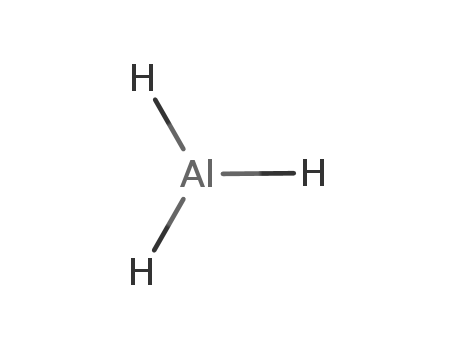
  • Molecular Formula:AlH3
  • Molecular Weight:30.0054
  • Hs Code.:
  • European Community (EC) Number:232-053-2
  • UN Number:2463
  • DSSTox Substance ID:DTXSID80895037
  • Wikipedia:Aluminium_hydride
  • Wikidata:Q412361
  • Mol file:7784-21-6.mol
Aluminum hydride

Synonyms:7784-21-6;Aluminum hydride;Aluminum trihydride;KZJ3T010RQ;alumane;AlH3;trihydridoaluminium;[AlH3];CHEBI:30136;DTXSID80895037;Q412361

Suppliers and Price of Aluminum hydride
Supply Marketing:
Business phase:
The product has achieved commercial mass production*data from LookChem market partment
Manufacturers and distributors:
  • Manufacture/Brand
  • Chemicals and raw materials
  • Packaging
  • price
Total 8 raw suppliers
Chemical Property of Aluminum hydride
Chemical Property:
  • Melting Point:decomposes at 160℃ [HAW93] 
  • Boiling Point:°Cat760mmHg 
  • Flash Point:°C 
  • PSA:0.00000 
  • Density:g/cm3 
  • LogP:0.33750 
  • Water Solubility.:evolves H2 in H2O [HAW93] 
  • Hydrogen Bond Donor Count:0
  • Hydrogen Bond Acceptor Count:0
  • Rotatable Bond Count:0
  • Exact Mass:30.0050135
  • Heavy Atom Count:1
  • Complexity:0
  • Transport DOT Label:Dangerous When Wet
Purity/Quality:

98%,99% *data from raw suppliers

Safty Information:
  • Pictogram(s):  
  • Hazard Codes: 
MSDS Files:

SDS file from LookChem

Useful:
  • Chemical Classes:Metals -> Metals, Inorganic Compounds
  • Canonical SMILES:[AlH3]
  • General Description Aluminium hydride (AlH3) is a highly reactive and unstable compound that decomposes into aluminum and hydrogen upon heating, with its surface oxide layer playing a critical role in hydrogen desorption kinetics. It can be synthesized catalytically using palladium and has potential applications in hydrogen storage due to reversible electrochemical regeneration, though its instability and sensitivity to moisture pose challenges. Functionalized aluminum nanoparticles derived from AlH3 exhibit strong reductive properties, enabling spontaneous alkyl layer grafting for stabilization.
Technology Process of Aluminum hydride

There total 43 articles about Aluminum hydride which guide to synthetic route it. The literature collected by LookChem mainly comes from the sharing of users and the free literature resources found by Internet computing technology. We keep the original model of the professional version of literature to make it easier and faster for users to retrieve and use. At the same time, we analyze and calculate the most feasible synthesis route with the highest yield for your reference as below:

synthetic route:
Guidance literature:
With sulfuric acid; Product distribution / selectivity;
Guidance literature:
In solid matrix; Irradiation (UV/VIS); condensation of Al atoms (evaporated from graphite vessel, 1273 K) in Ar or Kr matrix contg. 5% H2 (16 K), then broadband irradiation (200-800 nm, 10-40 min); not isolated, detd. by NMR spectroscopy;
Refernces

Synthesis of enantiopure highly substituted trans-8a- hydroxydecahydroisoquinolines by sequential diastereoselective IMDA reaction and oxanorbornene nucleophilic ring opening

10.1021/jo981075c

The research focuses on the synthesis of enantiopure highly substituted trans-8a-hydroxydecahydroisoquinolines, which are significant components of over 500 alkaloids and hold synthetic interest due to their potential biological activity. The study employs a diastereoselective approach involving a sequential intramolecular Diels-Alder (IMDA) reaction and oxanorbornene nucleophilic ring opening, utilizing chiral perhydrobenzoxazines derived from (-)-8-aminomenthol as a chirality inductor. Key chemicals in the process include 2-furaldehyde, (-)-8-((3′-butenyl)amino)menthol, aluminum hydride, pyridinium chlorochromate (PCC), potassium hydroxide, and triethylaluminum, among others. The method allows for the introduction of different substituents at C-1 and C-8 in the final isoquinolines regio- and stereoselectively, leading to the synthesis of a variety of enantiopure isoquinoline derivatives with four stereocenters, three of which are contiguous, and with known absolute configuration. The conclusions of the research highlight the efficiency of this concise and stereocontrolled synthetic method for potentially important biologically active molecules, demonstrating a five-step synthesis from the easily accessible (-)-8-aminomenthol.


Post a RFQ

Enter 15 to 2000 letters.Word count: 0 letters

Attach files(File Format: Jpeg, Jpg, Gif, Png, PDF, PPT, Zip, Rar,Word or Excel Maximum File Size: 3MB)

1 Customer Service

What can I do for you?
Get Best Price

Get Best Price for 7784-21-6