Welcome to LookChem.com Sign In|Join Free
  • or

Encyclopedia

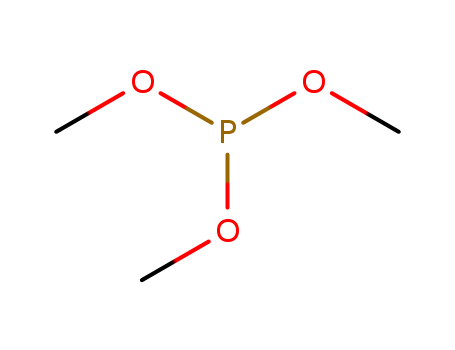
Trimethyl phosphite

Base Information
  • Chemical Name:Trimethyl phosphite
  • CAS No.:121-45-9
  • Molecular Formula:C3H9O3P
  • Molecular Weight:124.076
  • Hs Code.:HOSPHITE PRODUCT IDENTIFICATION
  • European Community (EC) Number:204-471-5
  • ICSC Number:1556
  • NSC Number:6513
  • UN Number:2329
  • UNII:26Q0321ZDG
  • DSSTox Substance ID:DTXSID4026979
  • Nikkaji Number:J2.486D
  • Wikipedia:Trimethyl_phosphite
  • Wikidata:Q153418
  • ChEMBL ID:CHEMBL3186364
  • Mol file:121-45-9.mol
Trimethyl phosphite

Synonyms:trimethyl phosphite

Suppliers and Price of Trimethyl phosphite
Supply Marketing:
Business phase:
The product has achieved commercial mass production*data from LookChem market partment
Manufacturers and distributors:
  • Manufacture/Brand
  • Chemicals and raw materials
  • Packaging
  • price
  • Usbiological
  • Trimethyl Phosphite
  • 5g
  • $ 319.00
  • Strem Chemicals
  • Trimethylphosphite, 97%
  • 250g
  • $ 54.00
  • Strem Chemicals
  • Trimethylphosphite, 99%
  • 50g
  • $ 46.00
  • Strem Chemicals
  • Trimethylphosphite, 99%
  • 250g
  • $ 182.00
  • Strem Chemicals
  • Trimethylphosphite, 97%
  • 1kg
  • $ 161.00
  • Sigma-Aldrich
  • Trimethyl phosphite for synthesis. CAS 121-45-9, molar mass 124.08 g/mol., for synthesis
  • 8005530500
  • $ 190.00
  • Sigma-Aldrich
  • Trimethyl phosphite for synthesis. CAS 121-45-9, molar mass 124.08 g/mol., for synthesis
  • 8005530100
  • $ 37.20
  • Sigma-Aldrich
  • Trimethyl phosphite 97%
  • 5g
  • $ 36.00
  • Sigma-Aldrich
  • Trimethyl phosphite ≥99%
  • 25g
  • $ 35.80
  • Sigma-Aldrich
  • Trimethyl phosphite for synthesis
  • 100 mL
  • $ 35.61
Total 20 raw suppliers
Chemical Property of Trimethyl phosphite
Chemical Property:
  • Appearance/Colour:clear colorless liquid 
  • Vapor Pressure:17 mm Hg ( 20 °C) 
  • Melting Point:-78 °C 
  • Refractive Index:n20/D 1.408(lit.)  
  • Boiling Point:110.2 °C at 760 mmHg 
  • Flash Point:27.8 °C 
  • PSA:41.28000 
  • Density:1.052g/mLat 25°C(lit.) 
  • LogP:1.15250 
  • Storage Temp.:2-8°C 
  • Sensitive.:Air & Moisture Sensitive 
  • Water Solubility.:Hydrolyzes with water. 
  • XLogP3:0.1
  • Hydrogen Bond Donor Count:0
  • Hydrogen Bond Acceptor Count:3
  • Rotatable Bond Count:3
  • Exact Mass:124.02893114
  • Heavy Atom Count:7
  • Complexity:31.7
  • Transport DOT Label:Flammable Liquid
Purity/Quality:

99.9% *data from raw suppliers

Trimethyl Phosphite *data from reagent suppliers

Safty Information:
  • Pictogram(s): HarmfulXn 
  • Hazard Codes:Xn,T,F,Xi 
  • Statements: 10-22-36/37/38-41-37/38-65-48/23/24/25-11-46-45-67-66-36 
  • Safety Statements: 26-39-62-45-16-53 
MSDS Files:

SDS file from LookChem

Total 1 MSDS from other Authors

Useful:
  • Chemical Classes:Other Classes -> Phosphite Compounds
  • Canonical SMILES:COP(OC)OC
  • Inhalation Risk:A harmful contamination of the air can be reached very quickly on evaporation of this substance at 20 °C.
  • Effects of Short Term Exposure:The substance is severely irritating to the eyes and skin.
  • Effects of Long Term Exposure:Animal tests show that this substance possibly causes toxicity to human reproduction or development.
  • Uses Trimethyl phosphite has been used primarily as an intermediate in the manufacture of pesticides and the synthesis of organophosphate insecticides. It is also used as a fire retardants in the production of textiles, as an intermediate in the production of flame-retardant polymers for polyurethane foams, and as a catalyst.
Technology Process of Trimethyl phosphite

There total 66 articles about Trimethyl phosphite which guide to synthetic route it. The literature collected by LookChem mainly comes from the sharing of users and the free literature resources found by Internet computing technology. We keep the original model of the professional version of literature to make it easier and faster for users to retrieve and use. At the same time, we analyze and calculate the most feasible synthesis route with the highest yield for your reference as below:

synthetic route:
Guidance literature:
In benzene; dropwise addn. of phosphine to Rh-compound in benzene (N2, Schlenk tube technique), stirring for 1h at room temp., filtn., washing with ether, drying in vac., dissolving in methanol, addn. of NH4PF6, stirring for 10 min; addn. of ether, filtn., washing with ether, recrystn. (acetone/ether);
Guidance literature:
With potassium phosphate; tetrahexylammonium chloride; phosphorus trichloride; In dichloromethane; at 20 ℃; for 3h;
DOI:10.1002/hc.20438
Refernces

New building block for C3 symmetry molecules: Synthesis of s-triazine-based redox active chromophores

10.1021/ol902203t

The research focuses on the synthesis of a novel C3 symmetric building block, a s-triazine-based molecule with three phosphonate groups, which can be easily synthesized in two steps starting from p-bromomethylbenzonitrile. This new building block readily undergoes olefination reactions to yield derivatives such as tris(tetrathiafulvalene)- and tris(ferrocene)-1,3,5-triazines. The experiments involved the preparation of intermediate building block 3 through reactions with triflic anhydride and trimethyl phosphite, followed by olefination reactions with formylferrocene and formylTTF to synthesize the final compounds 5 and 7. The reactants included p-bromomethylbenzonitrile, triflic anhydride, trimethyl phosphite, formylferrocene, and formylTTF. The analyses used to characterize the compounds were spectroscopic techniques (UV-vis, FT-IR, 1H and 13C NMR, HR-MS), cyclic voltammetry for electrochemical characterization, and solvatochromic studies to assess the charge-transfer properties of the synthesized molecules.

A mild and highly efficient protocol for the one-pot synthesis of primary α-amino phosphonates under solvent-free conditions

10.1016/j.tetlet.2004.10.092

The research aims to develop a novel, mild, and efficient method for synthesizing primary α-amino phosphonates using a one-pot, three-component reaction under solvent-free conditions. The key chemicals used in this study include benzaldehyde, hexamethyldisilazane (HMDS), trialkyl phosphites (such as trimethyl phosphite and triethyl phosphite), and solid lithium perchlorate (LiClO?). The researchers optimized the reaction conditions to achieve high yields and short reaction times, finding that the presence of LiClO? was crucial for the reaction to proceed. The study demonstrated that various aromatic aldehydes and trialkyl phosphites could be successfully converted into primary α-amino phosphonates under these conditions, with yields ranging from 80% to 92%. The mild reaction conditions allowed for the tolerance of sensitive functional groups like OMe and NO?. Additionally, the researchers explored the formation of 1-aryl-N,N'-bis(arylidene)methanediamines using benzaldehyde, HMDS, and LiClO?, obtaining these compounds in high yields with short reaction times. The study concludes that this solvent-free, one-pot synthesis method provides a green and efficient approach for preparing primary α-amino phosphonates, which have significant applications in pharmaceuticals and as enzyme inhibitors.


Post a RFQ

Enter 15 to 2000 letters.Word count: 0 letters

Attach files(File Format: Jpeg, Jpg, Gif, Png, PDF, PPT, Zip, Rar,Word or Excel Maximum File Size: 3MB)

1 Customer Service

What can I do for you?
Get Best Price

Get Best Price for 121-45-9