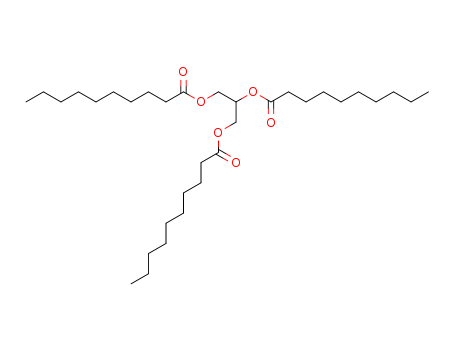
Chemical Property of Tricaprin
Chemical Property:
- Appearance/Colour:white or white crystaline powder
- Melting Point:31-32 °C
- Refractive Index:approximate 1.44
- Boiling Point:578.6 °C at 760 mmHg
- Flash Point:233.3 °C
- PSA:78.90000
- Density:0.949 g/cm3
- LogP:9.40670
- Storage Temp.:−20°C
- Solubility.:Chloroform (Sparingly), DMSO (Slightly, Sonicated)
- XLogP3:12.2
- Hydrogen Bond Donor Count:0
- Hydrogen Bond Acceptor Count:6
- Rotatable Bond Count:32
- Exact Mass:554.45463969
- Heavy Atom Count:39
- Complexity:543
- Purity/Quality:
-
98%, *data from raw suppliers
Tricaprin *data from reagent suppliers
Safty Information:
- Pictogram(s):
 F,
F, Xn
Xn
- Hazard Codes:F,Xn
- Statements:
11-20/21/22
- Safety Statements:
26-28
- MSDS Files:
-
SDS file from LookChem
Useful:
- Canonical SMILES:CCCCCCCCCC(=O)OCC(COC(=O)CCCCCCCCC)OC(=O)CCCCCCCCC
- Recent ClinicalTrials:Comparing the Ketogenic Effect of Coconut Oil and Different MCTs
-
Description
1,2,3-Tridecanoyl glycerol is a triacylglycerol that contains decanoic acid at the sn-1, sn-2, and sn-3 positions. It has been found in human breast milk. 1,2,3-Tridecanoyl glycerol has been used as a standard for the quantification of triacylglycerols in fish oils by RP-HPLC. Formulations containing 1,2,3-tridecanoyl glycerol have been used in cosmetic products as thickening and skin-conditioning agents.
-
Uses
Tricaprin is used to construct solid lipid nanoparticles (SLNs) as delivery system for bromocriptine (B682600, Mesylate salt). It is also used in cationic SLNs to enhance p53 tumor suppressor gene transfer to lung cancer cells.