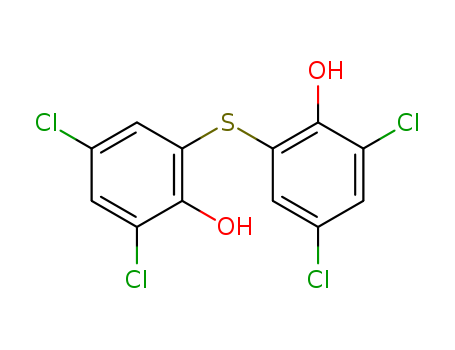
Chemical Property of Bithionol
Chemical Property:
- Appearance/Colour:off-white crystalline powder
- Melting Point:188°C
- Boiling Point:444.7 °C at 760 mmHg
- PKA:4.82, 10.50(at 25℃)
- Flash Point:222.8 °C
- PSA:65.76000
- Density:1.75 g/cm3
- LogP:5.86260
- Storage Temp.:0-6°C
- Solubility.:DMSO: soluble20mg/mL, clear
- Water Solubility.:<0.1 g/100 mL at 23 oC
- XLogP3:5.8
- Hydrogen Bond Donor Count:2
- Hydrogen Bond Acceptor Count:3
- Rotatable Bond Count:2
- Exact Mass:355.881311
- Heavy Atom Count:19
- Complexity:282
- Transport DOT Label:Poison
- Purity/Quality:
-
99%, *data from raw suppliers
Bithionol *data from reagent suppliers
Safty Information:
- Pictogram(s):
 T+,
T+, Xn
Xn
- Hazard Codes:T+,Xn
- Statements:
28-20/21/22
- Safety Statements:
28-36/37-45-36
- MSDS Files:
-
SDS file from LookChem
Useful:
- Chemical Classes:Other Uses -> Biocides/Disinfectants
- Canonical SMILES:C1=C(C=C(C(=C1SC2=C(C(=CC(=C2)Cl)Cl)O)O)Cl)Cl
-
Indications
Infections with Parogonimus westermani (lung fluke) and Fasciola hepatica (liver fluke).
Bithionol should only be used as a second-line drug in the treatment of paragonimiasis for those patients who fail to respond to full course therapy with praziquantel. Triclabendazole, which is a new drug still under clinical evaluation, will most probably become the drug of choice against fascioliasis in the near future. Bithionol (Actamer) is a phenolic derivative whose
mode of action is related to uncoupling of parasitespecific
fumarate reductase–mediated oxidative phosphorylation.
The drug is administered orally and is absorbed
from the intestinal tract. Peak blood levels are achieved in
4 to 8 hours. Excretion is mainly by the kidneys.
Bithionol is used in treatment of F. hepatica infections
and as an alternative to praziquantel in the treatment
of infestation by P. westermani. It is highly active
against the adult worm but exerts no action against the
migratory stages. A second course of treatment is required
for complete cure in 20 to 30% of patients.
Side effects are generally mild and transient; they
include nausea, vomiting, diarrhea, headache, dizziness,
urticaria, and other skin rashes in 50% of patients.
-
Description
Bithionol (97-18-7) is an antihelmintic drug with bacteriostatic and fungicidal properties. Bithionol has also been found to be an inhibitor of glutamate dehydrogenase1,2?(IC50?= 4.8 μM bovine GDH1).
-
Uses
bactericide; antihelmintic; algicide; proposed as agricultural fungicide; food additive in feed and drinking water for foodproducing
animals; permitted in food for human consumption; deodorant; in germicide pharmaceuticals, antibacterial agent in soaps,
cosmetics, veterinary antiseptic and antihelminthic products, industrial cleansers, etc. anthelmintic, antiseptic
-
Clinical Use
2,2’-Thiobis(4,6-dichlorophenol), or bis(2-hydroxy-3,5-dichlorophenyl)sulfide (Lorothidol, Bithin), a chlorinatedbisphenol, was formerly used in soaps and cosmetics for itsantimicrobial properties but was removed from the marketfor topical use because of reports of contact photodermatitis.Bithionol has useful anthelmintic properties and hasbeen used as a fasciolicide and taeniacide. It is still consideredthe agent of choice for the treatment of infestationscaused by the liver fluke Fasciola hepatica and the lungfluke Paragonimus westermani. Niclosamide is believed tobe superior to it for the treatment of tapeworm infestations.