Welcome to LookChem.com Sign In|Join Free
  • or

Encyclopedia

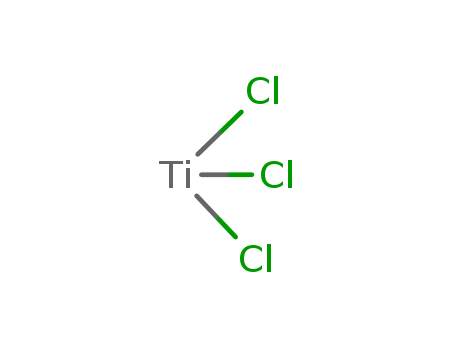
titanium(III) trichloride

Base Information
  • Chemical Name:titanium(III) trichloride
  • CAS No.:7705-07-9
  • Molecular Formula:Cl3Ti
  • Molecular Weight:154.239
  • Hs Code.:28273990
  • UNII:GVD566MM7K
  • Nikkaji Number:J95.274E
  • Mol file:7705-07-9.mol
titanium(III) trichloride

Synonyms:titanium trichoride;RivastigmineTartrate;titanium (III) chloride;titanium-(III)-chloride;titanium(III) trichloride;LYNX-900;TAC-121;TAS-101;TITANIUM TRICHLORIDE [MI];YONPGGFAJWQGJC-UHFFFAOYSA-K;AKOS015833128

Suppliers and Price of titanium(III) trichloride
Supply Marketing:
Business phase:
The product has achieved commercial mass production*data from LookChem market partment
Manufacturers and distributors:
  • Manufacture/Brand
  • Chemicals and raw materials
  • Packaging
  • price
  • Sigma-Aldrich
  • Titanium(III) chloride solution ≥12% TiCl3 basis
  • 1l-r
  • $ 189.00
  • Sigma-Aldrich
  • Titanium(III) chloride solution ≥12% TiCl3 basis
  • 250ml-r
  • $ 55.20
  • Sigma-Aldrich
  • Titanium(III) chloride solution ≥12% TiCl3 basis
  • 6x1l-r
  • $ 868.00
  • American Custom Chemicals Corporation
  • TITANIUM TRICHLORIDE 95.00%
  • 1G
  • $ 597.87
Total 19 raw suppliers
Chemical Property of titanium(III) trichloride
Chemical Property:
  • Appearance/Colour:purple crystalline solid 
  • Melting Point:-24 ºC 
  • Boiling Point:100 ºC 
  • PSA:0.00000 
  • Density:1.2 
  • LogP:2.06850 
  • Sensitive.:Air Sensitive 
  • Water Solubility.:Soluble 
  • Hydrogen Bond Donor Count:0
  • Hydrogen Bond Acceptor Count:3
  • Rotatable Bond Count:0
  • Exact Mass:152.854499
  • Heavy Atom Count:4
  • Complexity:0
Purity/Quality:

98% *data from raw suppliers

Titanium(III) chloride solution ≥12% TiCl3 basis *data from reagent suppliers

Safty Information:
  • Pictogram(s):  
  • Hazard Codes:C,F 
  • Statements: 34-37-35-17-14 
  • Safety Statements: 6-26-30-36/37/39-43-45 
MSDS Files:

SDS file from LookChem

Total 1 MSDS from other Authors

Useful:
  • Canonical SMILES:[Cl-].[Cl-].[Cl-].[Ti+3]
  • General Description Titanous chloride (TiCl3), also known as titanium(III) chloride or trichlorotitanium, is a lower-valent titanium halide with notable structural and electronic properties. It exists in α- and β- crystalline forms, exhibiting distinct optical behaviors, including interionic d-d transitions (2–4 eV) and higher-energy charge-transfer or band-to-band transitions (>4 eV). The interband gap between anion 3p and cation 4s states is approximately 7.5 eV in α-TiCl3 and 6.9 eV in β-TiCl3. In the gas phase, TiCl3 adopts a D3h-symmetric equilibrium structure, as confirmed by electron-diffraction studies, with calculated vibrational parameters and force constants supporting its harmonic behavior. Its reactivity and coordination flexibility are evident in complexes with ligands like TEMPO derivatives.
Technology Process of titanium(III) trichloride

There total 48 articles about titanium(III) trichloride which guide to synthetic route it. The literature collected by LookChem mainly comes from the sharing of users and the free literature resources found by Internet computing technology. We keep the original model of the professional version of literature to make it easier and faster for users to retrieve and use. At the same time, we analyze and calculate the most feasible synthesis route with the highest yield for your reference as below:

synthetic route:
Guidance literature:
In n-heptane; byproducts: CH3C6H5; under purified Ar atm.; soln. of TiCl4 in heptane added to soln. of Ti(η6-MeC6H5)2 in heptane; mixt. stirred for 18 h at room temp.; solid filtered; washed (heptane); dried (vac.); elem. anal.;
DOI:10.1016/j.jorganchem.2005.03.064
Guidance literature:
In not given; inert gas atm., Al(iso-C4H9)3/TiCl4 ratio greater than 1 (up to 2); centrifuging or filtration; liq. phase examined by ESR and 1H-NMR;
Guidance literature:
In neat (no solvent); Mg film exposing to TiCl4 at 1E-7 and 1E-6 Torr; monitoring by XPS;
DOI:10.1021/jp982017y
Refernces

Tetrabenzo[a,c,g,i]fluorenyltitanium(III) and -(IV) complexes: Syntheses, reactions, and catalytic application

10.1021/om7012293

The research focuses on the synthesis, characterization, and catalytic application of tetrabenzo[a,c,g,i]fluorenyltitanium(III) and -(IV) complexes. The study involves reacting tetrabenzo[a,c,g,i]fluorenyllithium with TiCl3 to form TbfTiCl2(THF), which is then converted to TbfTiCl3 through oxidative chlorination. Further reactions with lithium phenoxides yield a series of titanium complexes, TbfTiCl2(OAr). The complexes are characterized using IR, MS, NMR measurements, and X-ray crystallography. Additionally, the article describes the synthesis of titanium complexes with TEMPO and OtBu radicals. Ethylene polymerization experiments are conducted using d-MAO as a catalyst, with the activities of the compounds reported in terms of polymer production rates and molecular weights. The reactants used include various lithium phenoxides, TEMPO, and di-tert-butylperoxide, while analyses involve melting point determination, mass spectrometry, infrared spectroscopy, and elemental analysis.

Radical fluoroarylation in radiochemical synthesis

10.1016/j.tetlet.2007.12.128

The research focuses on the radical [18F]fluoroarylation of various olefins using 4-[18F]fluorobenzenediazonium ions, offering a novel approach to synthesize radiopharmaceuticals containing a deactivated, 4-[18F]fluoro substituted phenyl group. The study demonstrates the methodology's suitability for the synthesis of 18F-labeled stilbenes, with stilbene 7 being synthesized within 80 minutes with a 30–45% overall radiochemical yield starting from [18F]fluoride. The experiments involved reacting 4-fluorobenzenediazonium tetrafluoroborate with substrates such as arecoline, ecgonidine methylate, and styrenes under optimized conditions using titanium(III)-chloride in dilute hydrochloric acid as a reductant. The analyses included determining radiochemical yields through reverse-phase high-performance liquid chromatography (RP-HPLC) with gradient elution and UV detection at 214 nm, as well as assessing diastereoselectivity in the synthesized products.


Post a RFQ

Enter 15 to 2000 letters.Word count: 0 letters

Attach files(File Format: Jpeg, Jpg, Gif, Png, PDF, PPT, Zip, Rar,Word or Excel Maximum File Size: 3MB)

1 Customer Service

What can I do for you?
Get Best Price

Get Best Price for 7705-07-9