Welcome to LookChem.com Sign In|Join Free
  • or

Encyclopedia

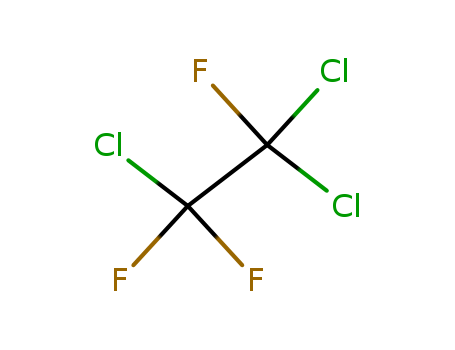
1,1,2-Trichlorotrifluoroethane

Base Information
  • Chemical Name:1,1,2-Trichlorotrifluoroethane
  • CAS No.:76-13-1
  • Deprecated CAS:39349-94-5,56996-61-3,57762-34-2,59948-56-0,56996-61-3,57762-34-2,59948-56-0
  • Molecular Formula:C2Cl3F3
  • Molecular Weight:187.376
  • Hs Code.:
  • European Community (EC) Number:200-936-1
  • ICSC Number:0050
  • UN Number:3082
  • UNII:0739N04X3A
  • DSSTox Substance ID:DTXSID6021377
  • Nikkaji Number:J1.947J
  • Wikipedia:1,1,2-Trichloro-1,2,2-trifluoroethane
  • Wikidata:Q161276
  • NCI Thesaurus Code:C96191
  • ChEMBL ID:CHEMBL478511
  • Mol file:76-13-1.mol
1,1,2-Trichlorotrifluoroethane

Synonyms:1,1,2-trichloro-1,2,2-trifluoroethane;CFC 113;Freon 113;Frigen 113 TR

Suppliers and Price of 1,1,2-Trichlorotrifluoroethane
Supply Marketing:
Business phase:
The product has achieved commercial mass production*data from LookChem market partment
Manufacturers and distributors:
  • Manufacture/Brand
  • Chemicals and raw materials
  • Packaging
  • price
Total 15 raw suppliers
Chemical Property of 1,1,2-Trichlorotrifluoroethane
Chemical Property:
  • Appearance/Colour:Colorless liquid with a sweet, ether-like odor 
  • Melting Point:-35 °C(lit.) 
  • Refractive Index:n20/D 1.358(lit.)  
  • Boiling Point:50.9 °C at 760 mmHg 
  • Flash Point:195°C 
  • PSA:0.00000 
  • Density:1.67 g/cm3 
  • LogP:2.91890 
  • Water Solubility.:0.02 g/100 mL. Slightly soluble 
  • XLogP3:3.2
  • Hydrogen Bond Donor Count:0
  • Hydrogen Bond Acceptor Count:3
  • Rotatable Bond Count:1
  • Exact Mass:185.901768
  • Heavy Atom Count:8
  • Complexity:90.5
  • Transport DOT Label:Class 9
Purity/Quality:

98% *data from raw suppliers

Safty Information:
  • Pictogram(s): DangerousN,IrritantXi,Toxic
  • Hazard Codes: N:Dangerous for the enviro 
  • Statements: R52/53:; R59:; 
  • Safety Statements: S59:; S61:; 
MSDS Files:

SDS file from LookChem

Total 1 MSDS from other Authors

Useful:
  • Chemical Classes:Solvents -> Chlorofluorocarbons
  • Canonical SMILES:C(C(F)(Cl)Cl)(F)(F)Cl
  • Inhalation Risk:On loss of containment this substance can cause suffocation by lowering the oxygen content of the air in confined areas.
  • Effects of Short Term Exposure:The substance is irritating to the eyes. The substance may cause effects on the cardiovascular system and central nervous system. This may result in cardiac disorders and central nervous system depression. Exposure could cause lowering of consciousness.
  • Effects of Long Term Exposure:Repeated or prolonged contact with skin may cause dermatitis.
Technology Process of 1,1,2-Trichlorotrifluoroethane

There total 81 articles about 1,1,2-Trichlorotrifluoroethane which guide to synthetic route it. The literature collected by LookChem mainly comes from the sharing of users and the free literature resources found by Internet computing technology. We keep the original model of the professional version of literature to make it easier and faster for users to retrieve and use. At the same time, we analyze and calculate the most feasible synthesis route with the highest yield for your reference as below:

synthetic route:
Guidance literature:
With hydrogen fluoride; 20% CrCl3 on carbon; at 53 - 400 ℃; for 4.5h; Product distribution / selectivity;
Refernces

Molecular structure of perfluoroadamantane from gas-phase electron diffraction

10.1016/S0022-2860(97)00412-2

The research aimed to determine the molecular structure of perfluoroadamantane using gas-phase electron diffraction. The study sought to examine the structural consequences of hydrogen/fluorine substitution in adamantane, a carbon-cage molecule with high symmetry, by comparing the bond lengths and angles of perfluoroadamantane to those of adamantane. The researchers found that perfluorination expanded the adamantane cage, with a significant lengthening of the C-C bonds by 0.02 ?, attributed to the electron-withdrawing ability of fluorine ligands. The chemicals used in the process included adamantane, sodium fluoride, anhydrous hydrogen fluoride, and Freon-113 for extraction, as well as helium for agitation during the electrochemical fluorination process. The final product, perfluoroadamantane, was obtained with a yield of 31.1% based on the sample fed and a purity of 99.3% as confirmed by gas chromatography.

Post a RFQ

Enter 15 to 2000 letters.Word count: 0 letters

Attach files(File Format: Jpeg, Jpg, Gif, Png, PDF, PPT, Zip, Rar,Word or Excel Maximum File Size: 3MB)

1 Customer Service

What can I do for you?
Get Best Price

Get Best Price for 76-13-1