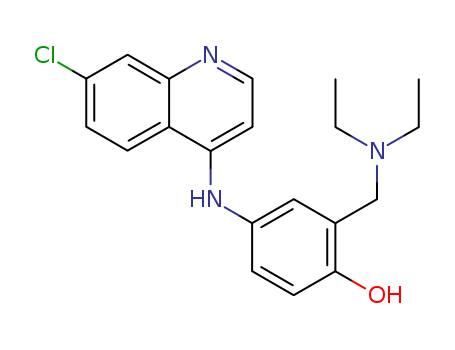
Chemical Property of 4-[(7-Chloroquinolin-4-yl)amino]-2-[(diethylammonio)methyl]phenolate
Chemical Property:
- Appearance/Colour:cyrstalline solid
- Melting Point:208 °C
- Boiling Point:478 °C at 760 mmHg
- PKA:9.43±0.50(Predicted)
- Flash Point:242.9 °C
- PSA:48.39000
- Density:1.258 g/cm3
- LogP:5.25220
- Storage Temp.:-20°C Freezer
- Solubility.:DMSO (Slightly, Sonicated), Methanol (Slightly)
- XLogP3:3.8
- Hydrogen Bond Donor Count:2
- Hydrogen Bond Acceptor Count:3
- Rotatable Bond Count:6
- Exact Mass:355.1451400
- Heavy Atom Count:25
- Complexity:406
- Purity/Quality:
-
99%, *data from raw suppliers
Amodiaquine *data from reagent suppliers
Safty Information:
- Pictogram(s):
- Hazard Codes:
- MSDS Files:
-
SDS file from LookChem
Useful:
- Canonical SMILES:CC[NH+](CC)CC1=C(C=CC(=C1)NC2=C3C=CC(=CC3=NC=C2)Cl)[O-]
-
Description
Amodiaquine is a prodrug form of the antimalarial compound N-desethyl amodiaquine . It is active against several strains of P. falciparum in vitro (EC50s = 0.23-0.52 nM) and exhibits a synergistic effect when used in combination with N-desethyl amodiaquine. Amodiaquine dose-dependently inhibits development of parasitemia in a mouse model of P. berghei infection.
-
Uses
An antimalarial
-
Indications
Amodiaquine (Camoquin) is another 4-aminoquinoline
derivative whose antimalarial spectrum and adverse reactions
are similar to those of chloroquine, although
chloroquine-resistant parasites may not be amodiaquine-
resistant to the same degree. Prolonged treatment
with amodiaquine may result in pigmentation of
the palate, nail beds, and skin. There is a 1:2000 risk of
agranulocytosis and hepatocellular dysfunction when
the drug is used prophylactically.
-
Clinical Use
Treatment of falciparum malaria Mechanistically, it is very similar to chloroquine and does nothave any advantages over the other 4-aminoquinoline drugs.When used for prophylaxis of malaria, it had a higher incidenceof hepatitis and agranulocytosis than that was chloroquine.There is evidence that the hydroquinone (phenol)amine system readily oxidizes to a quinone imine either autoxidatively and/or metabolically, and this productmay contribute to amodiaquine’s toxicity.