Welcome to LookChem.com Sign In|Join Free
  • or

Encyclopedia

Aluminium fluoride

Base Information
  • Chemical Name:Aluminium fluoride
  • CAS No.:7784-18-1
  • Deprecated CAS:1328946-66-2,856859-79-5
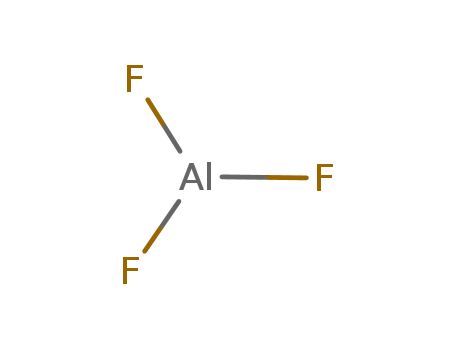
  • Molecular Formula:AlF3
  • Molecular Weight:83.9767
  • Hs Code.:2826121000
  • UNII:Z77H3IKW94
  • DSSTox Substance ID:DTXSID8030712
  • Nikkaji Number:J43.601A
  • Mol file:7784-18-1.mol
Aluminium fluoride

Synonyms:Aluminium fluoride;aluminum;trifluoride;17949-86-9;fluorure d'aluminium;ALF (CHRIS Code);Al-F3;Aluminium Fluoride Powder;aluminium fluoride (aif3);Aluminium fluoride (AlF3);Aluminium fluoride (AlF3);Fluoruro de aluminio (alf3);ALUMINUM(III) FLUORIDE;ALUMINUM FLUORIDE [MI];ALUMINUM FLUORIDE [HSDB];ALUMINUM FLUORIDE [INCI];Aluminium(III) fluoride, anhydrous;AMY37021;Aluminum fluoride, anhydrous, 99+%;PC1008;AKOS024438230;AKOS025310871;Aluminum, di-.mu.-fluorotetrafluorodi-;Zinc Telluride (ZnTe) Sputtering Targets;A839240

Suppliers and Price of Aluminium fluoride
Supply Marketing:
Business phase:
The product has achieved commercial mass production*data from LookChem market partment
Manufacturers and distributors:
  • Manufacture/Brand
  • Chemicals and raw materials
  • Packaging
  • price
Total 193 raw suppliers
Chemical Property of Aluminium fluoride
Chemical Property:
  • Appearance/Colour:white crystalline powder, odorless 
  • Melting Point:250 °C 
  • Boiling Point:19.5 °C at 760 mmHg 
  • Flash Point:1250 °C 
  • PSA:0.00000 
  • Density:3.1 g/mL at 25 °C(lit.) 
  • LogP:-8.65050 
  • Water Solubility.:SLIGHTLY SOLUBLE 
  • Hydrogen Bond Donor Count:0
  • Hydrogen Bond Acceptor Count:3
  • Rotatable Bond Count:0
  • Exact Mass:83.9767479
  • Heavy Atom Count:4
  • Complexity:0
Purity/Quality:

99% *data from raw suppliers

Safty Information:
  • Pictogram(s): IrritantXi 
  • Hazard Codes: T:toxic;
     
  • Statements: R36/37/38:; 
  • Safety Statements: S26:; S37/39:; 
MSDS Files:

SDS file from LookChem

Total 1 MSDS from other Authors

Useful:
  • Canonical SMILES:[F-].[F-].[F-].[Al+3]
  • General Description Aluminum fluoride (AlF3) is a versatile compound with applications in materials science and electrochemistry. It exhibits complex crystallization behavior under electron-beam irradiation, forming Al, AlF3, and Al2O3, with moisture significantly influencing the process. As a coating for lithium-ion battery cathodes, AlF3 enhances electrochemical performance by suppressing transition metal dissolution and reducing charge-transfer resistance, leading to improved capacity, retention, and thermal stability. Additionally, AlF3 is involved in phase transitions in materials like Pb5Al3F19, affecting ionic conductivity and fluoride ion diffusion. Its reactivity with hydrogen halides and role in fluoro-topaz synthesis further highlight its utility in chemical and thermal processes.
Technology Process of Aluminium fluoride

There total 167 articles about Aluminium fluoride which guide to synthetic route it. The literature collected by LookChem mainly comes from the sharing of users and the free literature resources found by Internet computing technology. We keep the original model of the professional version of literature to make it easier and faster for users to retrieve and use. At the same time, we analyze and calculate the most feasible synthesis route with the highest yield for your reference as below:

synthetic route:
Guidance literature:
In neat (no solvent); plasma react. in inductively coupled tubular reactor, temp. of reactor exterior <=180°C, 200 mg of powdered precursor in alumina boat, power of 150-200 W, chamber pressure of 250 mTorr, NF3 flow rate of 10 sccm, reaction time of 10-20 min; X-ray diffraction anal.; EDX anal.; chem. anal.;
DOI:10.1021/ja015645t
Guidance literature:
In further solvent(s); soln. NaBH4 in triglyme was added slowly for 2-3 h at room temp. to BF3-triglyme, AlCl3 in triglyme; B2H6 was absorbed with THF;
DOI:10.1021/ic0000911
Guidance literature:
In further solvent(s); soln. NaBH4 in triglyme was added slowly for 2-3 h at room temp. to BF3-tetraglyme, AlCl3 in triglyme; B2H6 was absorbed with THF;
DOI:10.1021/ic0000911
Refernces

EFFECT OF LEWIS ACIDS ON ACID CHLORIDES OF α-NITROALKANECARBOXYLIC ACIDS

10.1007/BF00953106

The research aimed to investigate the effect of Lewis acids on the decarboxylation of α-nitroalkanecarboxylic acid chlorides. The study found that aluminum chloride (AlCl?) and aluminum fluoride (AlF?) readily induce decarboxylation of these acid chlorides, with AlCl? being more effective than AlF?. The reaction, when conducted in the absence of a solvent, results in a complex mixture from which pure products cannot be isolated. However, a nitroso compound can be obtained in approximately 50% yield when the reaction is carried out in hexane. The researchers also noted that the acid chlorides do not decarboxylate in the presence of AlCl? in either absolute benzene or toluene, instead forming aromatic acids upon hydrolysis.

Post a RFQ

Enter 15 to 2000 letters.Word count: 0 letters

Attach files(File Format: Jpeg, Jpg, Gif, Png, PDF, PPT, Zip, Rar,Word or Excel Maximum File Size: 3MB)

1 Customer Service

What can I do for you?
Get Best Price

Get Best Price for 7784-18-1