Welcome to LookChem.com Sign In|Join Free
  • or

Encyclopedia

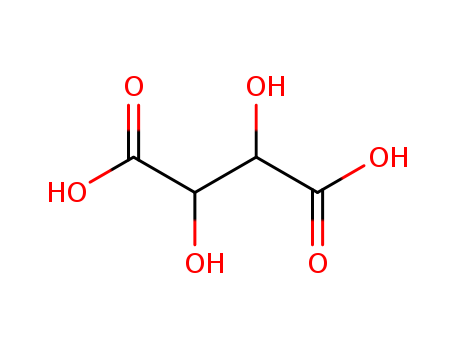
L-Tartaric acid

Base Information
  • Chemical Name:L-Tartaric acid
  • CAS No.:526-83-0
  • Deprecated CAS:1336-18-1,8014-54-8,8059-77-6,1039646-76-8,1334703-49-9,1488329-53-8,2088032-42-0,2411406-12-5,138508-61-9,1039646-76-8,1334703-49-9,8014-54-8,8059-77-6
  • Molecular Formula:C4H6O6
  • Molecular Weight:150.088
  • Hs Code.:29181200
  • European Community (EC) Number:201-766-0
  • ICSC Number:0772
  • NSC Number:759609
  • UNII:4J4Z8788N8,W4888I119H
  • DSSTox Substance ID:DTXSID8023632
  • Nikkaji Number:J31.839F
  • Wikipedia:Tartaric acid,Tartaric_acid
  • Wikidata:Q18226455
  • NCI Thesaurus Code:C47744
  • RXCUI:37578
  • Metabolomics Workbench ID:37519
  • ChEMBL ID:CHEMBL1236315
  • Mol file:526-83-0.mol
L-Tartaric acid

Synonyms:(R*,R*)-(+-)-2,3-dihydroxybutanedioic acid, monoammonium monosodium salt;aluminum tartrate;ammonium tartrate;calcium tartrate;calcium tartrate tetrahydrate;Mn(III) tartrate;potassium tartrate;seignette salt;sodium ammonium tartrate;sodium potassium tartrate;sodium tartrate;stannous tartrate;tartaric acid;tartaric acid, ((R*,R*)-(+-))-isomer;tartaric acid, (R*,S*)-isomer;tartaric acid, (R-(R*,R*))-isomer;tartaric acid, (S-(R*,R*))-isomer;tartaric acid, ammonium sodium salt, (1:1:1) salt, (R*,R*)-(+-)-isomer;tartaric acid, calcium salt, (R-R*,R*)-isomer;tartaric acid, monoammonium salt, (R-(R*,R*))-isomer;tartrate

Suppliers and Price of L-Tartaric acid
Supply Marketing:
Business phase:
The product has achieved commercial mass production*data from LookChem market partment
Manufacturers and distributors:
  • Manufacture/Brand
  • Chemicals and raw materials
  • Packaging
  • price
  • Sigma-Aldrich
  • D-(?)-Tartaric acid ReagentPlus?, 99%
  • 25 g
  • $ 38.80
  • Sigma-Aldrich
  • D-(?)-Tartaric acid puriss., unnatural form, ≥99.0% (T)
  • 10 g
  • $ 32.70
  • Sigma-Aldrich
  • D-(?)-Tartaric acid ReagentPlus?, 99%
  • 100 g
  • $ 109.00
  • Sigma-Aldrich
  • D-(?)-Tartaric acid puriss., unnatural form, ≥99.0% (T)
  • 50 g
  • $ 108.00
  • Sigma-Aldrich
  • D-(?)-Tartaric acid 99%
  • 100 g
  • $ 115.00
  • Sigma-Aldrich
  • D-(?)-Tartaric acid puriss., unnatural form, ≥99.0% (T)
  • 250 g
  • $ 416.00
  • DC Chemicals
  • D-(?)-Tartaric acid >98%,StandardReferencesGrade
  • 20 mg
  • $ 280.00
  • Crysdot
  • 2,3-Dihydroxysuccinicacid 95+%
  • 100g
  • $ 90.00
  • Ambeed
  • 2,3-Dihydroxysuccinicacid 95%
  • 1kg
  • $ 114.00
  • Ambeed
  • 2,3-Dihydroxysuccinicacid 95%
  • 500g
  • $ 63.00
Total 160 raw suppliers
Chemical Property of L-Tartaric acid
Chemical Property:
  • Appearance/Colour:white crystalline diprotic organic acid 
  • Boiling Point:399.3 °C at 760 mmHg 
  • PKA:3.07±0.34(Predicted) 
  • Flash Point:209.4 °C 
  • PSA:115.06000 
  • Density:1.886 g/cm3 
  • LogP:-2.12260 
  • Storage Temp.:Sealed in dry,Room Temperature 
  • Solubility.:DMSO (Slightly, Heated), Methanol (Slightly), Water (Sparingly, Sonicated) 
  • XLogP3:-1.9
  • Hydrogen Bond Donor Count:4
  • Hydrogen Bond Acceptor Count:6
  • Rotatable Bond Count:3
  • Exact Mass:150.01643791
  • Heavy Atom Count:10
  • Complexity:134
Purity/Quality:

≥98% *data from raw suppliers

D-(?)-Tartaric acid ReagentPlus?, 99% *data from reagent suppliers

Safty Information:
  • Pictogram(s):  
  • Hazard Codes: 
MSDS Files:

SDS file from LookChem

Useful:
  • Chemical Classes:Other Classes -> Organic Acids
  • Canonical SMILES:C(C(C(=O)O)O)(C(=O)O)O
  • Isomeric SMILES:[C@@H]([C@H](C(=O)O)O)(C(=O)O)O
  • Recent NIPH Clinical Trials:Unraveling of neural basis of voluntary cough and cough reflex
  • Inhalation Risk:Evaporation at 20 °C is negligible; a harmful concentration of airborne particles can, however, be reached quickly when dispersed.
  • Effects of Short Term Exposure:Corrosive. The substance is corrosive to the eyes, skin and respiratory tract. Corrosive on ingestion. Inhalation of the aerosol may cause lung oedema. The effects may be delayed. Medical observation is indicated.
  • Description Tartaric acid is a white crystalline diprotic aldaric acid. It occurs naturally in many plants, particularly grapes, bananas, and tamarinds, is commonly combined with baking soda to function as a leavening agent in recipes, and is one of the main acids found in wine. It is added to other foods to give a sour taste, and is used as an antioxidant. Salts of tartaric acid are known as tartrates. It is a dihydroxyl derivative of succinic acid. Tartaric acid was first isolated from potassium tartrate, known to the ancients as tartar, circa 800 AD, by the alchemist Jabir ibn Hayyan The modern process was developed in 1769 by the Swedish chemist Carl Wilhelm Scheele. Tartaric acid played an important role in the discovery of chemical chirality. This property of tartaric acid was first observed in 1832 by Jean Baptiste Biot, who observed its ability to rotate polarized light. Louis Pasteur continued this research in 1847 by investigating the shapes of ammonium sodium tartrate crystals, which he found to be chiral. By manually sorting the differently shaped crystals under magnification, Pasteur was the first to produce a pure sample of levotartaric acid.
  • Uses Pharmaceutic aid (buffering agent).
Technology Process of L-Tartaric acid

There total 2 articles about L-Tartaric acid which guide to synthetic route it. The literature collected by LookChem mainly comes from the sharing of users and the free literature resources found by Internet computing technology. We keep the original model of the professional version of literature to make it easier and faster for users to retrieve and use. At the same time, we analyze and calculate the most feasible synthesis route with the highest yield for your reference as below:

synthetic route:
Guidance literature:
With (+)-enantiomer of phosphoric triamide deposited on Fe3O4/silica nanoparticle; In methanol; water; for 1h; Resolution of racemate;
DOI:10.1039/c9ra03260f
Refernces

Enantiospecific synthesis of functionalized polyols from tartaric acid using Ley's dithiaketalization: Application to the total synthesis of achaetolide

10.1016/j.tet.2016.11.035

The research focuses on the enantiospecific synthesis of functionalized polyols derived from tartaric acid, utilizing Ley's dithiaketalization method. The study demonstrates the application of this strategy in the total synthesis of achaetolide, a decanolactone natural product. The experiments involved the synthesis of chiral tetrols and 1,2,4-triols with varied substitutions, with a key reaction being the Ley’s dithianylation of an alkynyl ketone derived from tartaric acid. The synthesis strategy was executed in several steps, starting from the addition of alkynyl Grignard reagents to tartaric acid amides, followed by stereoselective reduction, and elaboration to polyol systems. The research employed various reactants, including tartaric acid, alkynyl Grignard reagents, 1,3-propanedithiol, and NaBH4, among others. Analytical techniques used throughout the experiments included column chromatography, TLC, NMR spectroscopy, and HRMS for compound characterization and yield determination. The study resulted in the total synthesis of achaetolide in 14 steps from the bis-Weinreb amide of tartaric acid, with an overall yield of 9.5%.

Enantioselective hydrogenation of β-aryl-β-ketoester over α-hydroxy acid-modified Raney nickel catalysts: competitive hydrogenation with methyl acetoacetate

10.1016/j.tetasy.2016.05.006

The research investigates the enantioselective hydrogenation of aromatic β-ketoesters, specifically methyl 3-phenyl-3-oxopropanoate (1) and its p-methoxy-analogue (2), over α-hydroxy acid-modified Raney nickel catalysts, comparing their behavior with that of the aliphatic substrate methyl acetoacetate. The study employs a competitive hydrogenation approach to elucidate the catalytic behaviors and enantioselectivity of these reactions. Key chemicals involved include tartaric acid and malic acid, which are used to modify the Raney nickel catalysts, thereby influencing the hydrogenation outcomes. The enantioselectivity is found to be significantly affected by the interaction modes between the surface modifier, the Ni metal surface, and the substrate, as well as the keto/enol ratio of the substrate. The presence of a p-methoxy group in compound 2 is shown to enhance enantioselectivity by suppressing unfavorable phenyl-Ni metal surface interactions. The study also highlights the importance of suitable interactions between the surface chiral modifier and the prochiral substrate for achieving high enantioselectivity in the hydrogenation of β-ketoesters.

Stereoselective Alkylierung an C(α) von Serin, Gycerinsaeure, Thereonin und Weinsaeure ueber heterocyclische Enolate mit exocyclischer Doppelbindung

10.1002/hlca.19870700426

The study, titled "Stereoselective Alkylation at C(α) of Serine, Glyceric Acid, Threonine, and Tartaric Acid Involving Heterocyclic Enolates with Exocyclic Double Bonds," investigates the stereoselective alkylation of various chiral, non-racemic α-amino acids and their derivatives using heterocyclic enolates with exocyclic double bonds. The researchers converted these acids into methyl dioxolane, oxazoline, and oxazolidine carboxylates. These compounds were then deprotonated to form lithium enolates, which were stable enough to undergo alkylation with or without cosolvents like HMPA or DMPU. The products were obtained in good to excellent yields and with high diastereoselectivities, except for the tartrate-derived acetonide. The study demonstrated that the configuration of the products could be determined through NOE-NMR measurements and chemical correlation, revealing that the dioxolane-derived enolates were alkylated preferentially from the face already substituted, while the dihydrooxazol- and oxazolidine-derived enolates were alkylated from the opposite face. This work provides a method for constructing quaternary stereogenic centers without racemization, using readily available enantiomerically pure precursors like hydroxy- and amino-acids.

Post a RFQ

Enter 15 to 2000 letters.Word count: 0 letters

Attach files(File Format: Jpeg, Jpg, Gif, Png, PDF, PPT, Zip, Rar,Word or Excel Maximum File Size: 3MB)

1 Customer Service

What can I do for you?
Get Best Price

Get Best Price for 526-83-0