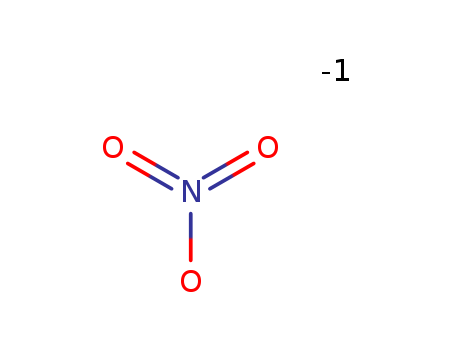
Chemical Property of Nitrate
Chemical Property:
- Vapor Pressure:49.8mmHg at 25°C
- Boiling Point:83°Cat760mmHg
- Flash Point:°C
- PSA:68.88000
- Density:g/cm3
- LogP:0.28410
- Storage Temp.:2-8°C
- Water Solubility.:Miscible with water.
- XLogP3:-1.4
- Hydrogen Bond Donor Count:0
- Hydrogen Bond Acceptor Count:3
- Rotatable Bond Count:0
- Exact Mass:61.987817862
- Heavy Atom Count:4
- Complexity:18.8
- Purity/Quality:
-
99% HPLC *data from raw suppliers
NITRATE 95.00% *data from reagent suppliers
Safty Information:
- Pictogram(s):
- Hazard Codes:
- MSDS Files:
-
SDS file from LookChem
Useful:
- Canonical SMILES:[N+](=O)([O-])[O-]
- Recent ClinicalTrials:Dietary Inorganic Nitrate and the Enteral Microbiome
-
Description
Nitrate is commonly found in drinking water sources especially
in agricultural areas where nitrogen fertilizer is used, and where
unregulated shallow private wells are more at the risk of
contamination. The World Health Organization (WHO)
guideline of 50 ppm and the US maximum contaminant level
(MCL) of 45 ppm for nitrate in drinking water have been
established for protecting infants from methemoglobinemia,
commonly known as blue baby syndrome. The health protective
value continues to be a subject of public health interest for
many years, with varying opinion on whether it is too high or
too low. Evaluation of nitrate will need to include consideration
of nitrite because both are closely related in the nitrogen
cycle in the environment and the body, and nitrite plays
a major role in inducing toxicity after its formation from
nitrate. More recently, reports of nitrate in drinking water,
especially at levels higher than 50 ppm, have been associated
with other health effects other than methemoglobinemia. This
toxicological review provides an update on the health effects of
nitrate with a focus on methemoglobinemia, reproductive and
developmental effects, potential carcinogenicity, and especially
endocrine/thyroid effects.
-
Uses
Nitrate is the salt of nitric acid. it is used in meat curing to develop
and stabilize the pink color associated with cured meat. by itself, it
is not effective in producing the curing reaction until it is chemi-
cally reduced to nitrite. it has an effect on flavor and also functions
as an antioxidant. it is available as sodium and potassium nitrate,
with the sodium form being more common. In the treatment of angina pectoris; in the manufacture of inorganic and organic nitrates and nitro
compounds for fertilizers, dye intermediates, explosives, and many different organic chemicals. Nitrate is used in fertilizers; in the manufacture of nitrites,
nitrous oxide, explosives, pyrotechnics, matches, freezing
mixtures, and special cements; as a coloring agent and
preserving additive in food; for coagulation of latexes; in the
nuclear industry; and for odor (sulfide) and corrosion control
in aqueous systems.