Welcome to LookChem.com Sign In|Join Free
  • or

Encyclopedia

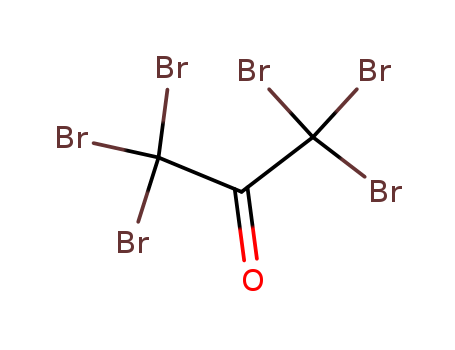
1,1,1,3,3,3-Hexabromoacetone

Base Information
  • Chemical Name:1,1,1,3,3,3-Hexabromoacetone
  • CAS No.:23162-64-3
  • Molecular Formula:C3Br6 O
  • Molecular Weight:531.456
  • Hs Code.:
  • European Community (EC) Number:627-645-6
  • DSSTox Substance ID:DTXSID00549348
  • Nikkaji Number:J2.557.869D
  • Wikidata:Q82428372
  • Mol file:23162-64-3.mol
1,1,1,3,3,3-Hexabromoacetone

Synonyms:1,1,1,3,3,3-HEXABROMOACETONE;23162-64-3;1,1,1,3,3,3-hexabromopropan-2-one;2-Propanone, 1,1,1,3,3,3-hexabromo-;hexabromoacetone;Brom Pentabromaceton;Hexabromopropan-2-one;SCHEMBL985463;DTXSID00549348;1,1,1,3,3,3-Hexabromoacetone, 97%;1, 1, 1, 3, 3, 3-hexabromopropan-2-one;J-015017

Suppliers and Price of 1,1,1,3,3,3-Hexabromoacetone
Supply Marketing:
Business phase:
The product has achieved commercial mass production*data from LookChem market partment
Manufacturers and distributors:
  • Manufacture/Brand
  • Chemicals and raw materials
  • Packaging
  • price
  • Sigma-Aldrich
  • 1,1,1,3,3,3-Hexabromoacetone 97%
  • 25g
  • $ 334.00
  • Sigma-Aldrich
  • 1,1,1,3,3,3-Hexabromoacetone 97%
  • 5g
  • $ 133.00
  • American Custom Chemicals Corporation
  • 1,1,1,3,3,3-HEXABROMOACETONE 95.00%
  • 25G
  • $ 1373.44
  • American Custom Chemicals Corporation
  • 1,1,1,3,3,3-HEXABROMOACETONE 95.00%
  • 5G
  • $ 872.81
  • AK Scientific
  • 1,1,1,3,3,3-Hexabromoacetone
  • 25g
  • $ 462.00
Total 5 raw suppliers
Chemical Property of 1,1,1,3,3,3-Hexabromoacetone
Chemical Property:
  • Melting Point:108-111 °C 
  • Boiling Point:359.8±37.0 °C(Predicted) 
  • PSA:17.07000 
  • Density:3.442±0.06 g/cm3(Predicted) 
  • LogP:4.23250 
  • XLogP3:4.7
  • Hydrogen Bond Donor Count:0
  • Hydrogen Bond Acceptor Count:1
  • Rotatable Bond Count:0
  • Exact Mass:531.49879
  • Heavy Atom Count:10
  • Complexity:124
Purity/Quality:

99% *data from raw suppliers

1,1,1,3,3,3-Hexabromoacetone 97% *data from reagent suppliers

Safty Information:
  • Pictogram(s):  
  • Hazard Codes:Xn,N 
  • Statements: 22-51/53 
  • Safety Statements: 24/25-61 
MSDS Files:

SDS file from LookChem

Useful:
  • Canonical SMILES:C(=O)(C(Br)(Br)Br)C(Br)(Br)Br
  • General Description 1,1,1,3,3,3-Hexabromoacetone (HBA) is a versatile brominating reagent used in organic synthesis, particularly for the conversion of benzyl alcohols to benzyl bromides under mild, neutral conditions. It serves as a less corrosive alternative to traditional reagents like thionyl chloride, offering broad substrate compatibility, including electron-rich, electron-deficient, and heterocyclic benzyl alcohols. HBA, in combination with triphenylphosphine, facilitates efficient bromination via an SN2 mechanism, with steric effects influencing reaction efficiency. Its utility is demonstrated in synthesizing drug intermediates, such as the precursor to omeprazole, highlighting its relevance in pharmaceutical applications. Optimal performance is achieved in acetonitrile with controlled reagent equivalents, ensuring high reproducibility and yields.
Technology Process of 1,1,1,3,3,3-Hexabromoacetone

There total 1 articles about 1,1,1,3,3,3-Hexabromoacetone which guide to synthetic route it. The literature collected by LookChem mainly comes from the sharing of users and the free literature resources found by Internet computing technology. We keep the original model of the professional version of literature to make it easier and faster for users to retrieve and use. At the same time, we analyze and calculate the most feasible synthesis route with the highest yield for your reference as below:

synthetic route:
Guidance literature:
With N,N-dimethyl-formamide; at 60 ℃; for 10h;
DOI:10.1016/j.tetlet.2009.03.093
Guidance literature:
With N,N-dimethyl-formamide; at 60 ℃; for 10h;
DOI:10.1016/j.tetlet.2009.03.093
Refernces

Synthesis of benzyl bromides with hexabromoacetone: An alternative path to drug intermediates

10.1016/j.tetlet.2010.10.133

The study explores an efficient method for preparing benzyl bromides from corresponding alcohols using hexabromoacetone (HBA) and triphenylphosphine (PPh3) under neutral conditions at low temperatures. This method serves as a milder alternative to traditional harsh and corrosive chlorinating agents like SOCl2. The researchers found that the protocol is applicable to a wide range of benzyl alcohols, including those with electron-withdrawing and electron-releasing groups, as well as heterocyclic analogues. The study also successfully synthesized the precursor of the antiulcer drug omeprazole, demonstrating the method's potential for preparing drug intermediates. The reaction mechanism involves the formation of an intermediate with PPh3 and HBA, followed by an SN2 displacement to yield the bromide. The study highlights the importance of steric factors influencing the reaction rates and yields, with para-substituted compounds generally converting more efficiently than ortho-substituted ones at room temperature. The use of acetonitrile as a solvent and the optimization of HBA equivalents were key to achieving high reproducibility and yields.

Post a RFQ

Enter 15 to 2000 letters.Word count: 0 letters

Attach files(File Format: Jpeg, Jpg, Gif, Png, PDF, PPT, Zip, Rar,Word or Excel Maximum File Size: 3MB)

1 Customer Service

What can I do for you?
Get Best Price

Get Best Price for 23162-64-3