
Journal of Molecular Structure (2021)
Update date:2022-08-11
Topics:
 Albuquerque, Magaly Gir?o
Gon?alves, Raoni Schroeder B.
Lima, Camilo Henrique da Silva
Machado, Sérgio de Paula
Maia, Fernanda Lima de Azevedo
Oliveira, Laudicéa do Nascimento
Wardell, James L.
Wardell, Solange M. S. V.
da Silva, Talis Uelisson
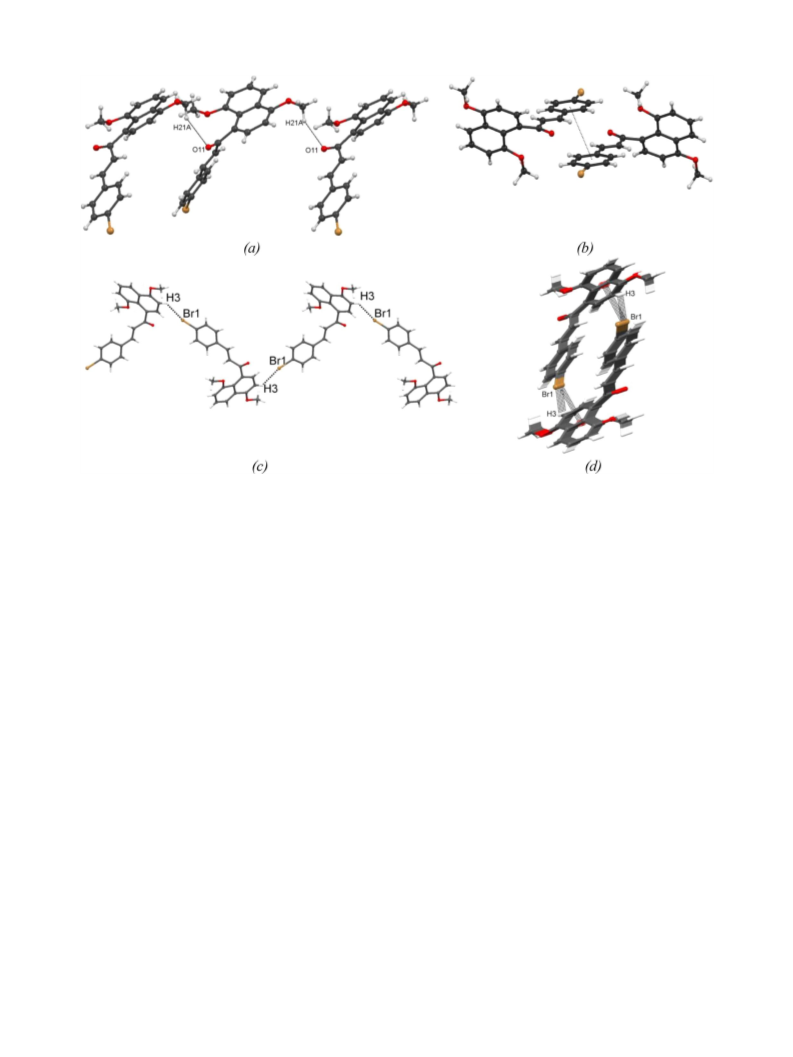
A combined structural and computational study has been conducted on two chalcone compounds, namely (E)-3-(4-bromophenyl)-1-(4,8-dimethoxynaphthalen-1-yl)prop-2-en-1-one (1), and (E)-3-(3,4-dichlorophenyl)-1-(4,8-dimethoxynaphthalen-1-yl)prop-2-en-1-one (2). These compounds are members of a series of compounds identified from a molecular modelling study as potentially active Mycobacterium tuberculosis Enoyl ACP reductase (InhA) inhibitors. In addition, the computational study indicated that the compounds have potential as optical materials. The combined study revealed that both molecules in the solid state displayed similar overall molecular conformations between a ‘‘T’’ and a ‘‘Y’’ shape, but with different arrangements in the bridging prop-2-en-1-one unit: an anti-periplanar in 1 and a syn-periplanar in 2. The experimental and calculated bond lengths and angles for anti-periplanar 1 and syn-periplanar 2 were generally in good agreement.Theoretical calculations at the B3LYP/DGTZVP level in the gas phase, DMSO and water media indicated that for both compounds, the syn-periplanar form was the energy local minimum while the anti-periplanar form was the energy global minimum. However, the energy differences are very small, with slight variations when using the different basis sets (0.80 and 0.84 kcal/mol using the B3LYP/DGTVP theory level in gas phase, 0.28 and 0.32 in DMSO and 0.27 and 0.31 kcal/mol in water). The differences in the solid state arrangements within the bridging prop-2-en-1-one unit in 1 and 2 arise from variations in the intermolecular interactions, with halogen bonds being considered to be an important factor in stabilizing a syn-periplanar arrangement in compound 2. PLATON and Hirshfeld surface analyses confirmed the important intermolecular interactions in 1 and 2. Calculations were also carried out on the electronic and vibrational spectra, dipole moments and charge distributions of 1 and 2. The HOMO was located in the dimethoxynaphthalenyl region of the molecule with mild donor character, while the LUMO was located in the propenyl and phenyl regions of each molecule. The energy gaps between these orbitals are 3.35 eV for 1 3.25 eV for 2. The delocalization present in compounds 1 and 2 facilitates the HOMO-LUMO charge transfer process. The total electronic molecular dipolar moments (μTotal) were calculated to be 4.1511 and 5.9316 D for 1 and 2, respectively. The values of μTotal found for 1 and 2 are both larger than reported values for similar compounds, indicating that the compounds studied here should exhibit a good non-linear optical response.




Shanghai Send Pharmaceutical Technology Co., Ltd.
website:http://www.shsendpharma.com
Contact:021-58088081, +8613585868794
Address::Room A601, Building 1,NO. 800 Qingdai Road Pudong District Shanghai,China
Jiangxi Hito Chemical Co., Ltd.
Contact:+86-792-3170318
Address:No. 6, Tianhong Ave., Xinghuo Industry Park, Yongxiu, Jiujiang, Jiangxi, China
Hangzhou JINLAN Pharm-Drugs Technology Co., Ltd
website:http://www.jlpharms.com
Contact:86-571-86982636
Address:Rm A606, Fuyi Center, jianqiao street
Synchem Pharma Co.,Ltd(expird)
Contact:+0086-21-61984905-1
Address:Building 60,Zimian Park, LongYang industrial Area, 1515Nong,Yuandong Road Fengxian District, Shanghai ,China
Contact:+86-21-61318535
Address:Building 29,No.2139 Xizha Road, Fengxian District, Shanghai
Doi:10.1039/c39950002321
(1995)Doi:10.1016/j.jorganchem.2012.11.008
(2013)Doi:10.1016/S0957-4166(00)00019-7
(2000)Doi:10.1016/j.saa.2019.117175
(2019)Doi:10.1002/asia.201800330
(2018)Doi:10.1002/hlca.19550380745
(1955)
