4264
J. G. Zeevaart et al. / Tetrahedron Letters 45(2004) 4261–4264
3. (a) Okuro, K.; Furuune, M.; Miura, M.; Nomura, M.
J. Org. Chem. 1993, 58, 7606; (b) Konopelski, J. P.;
It seems that not only the strength of the base but also
its availability must be tempered to match the rate of
enolate formation with the rate of the arylation reaction.
The same observation has been made by Buchwald in
the amidation of aryl halides.12c Both K3PO4 and
K2CO3 are thought to be thermodynamically strong
bases in aprotic solvents but their low solubility in tol-
uene ensures a slow formation of enolate. From the fact
that no arylation of ethyl phenylacetate was observed
using K3PO4 as the base while the use of sodium tert-
butoxide under identical reaction conditions, did yield
ethyl diphenylacetate 9 (58%), it is concluded that
K3PO4 is not strong enough to deprotonate a phenyl
acetate ester.
ꢀ
Hottenroth, J. M.; Oltra, H. M.; Veliz, E. A.; Yang, Z.-C.
Synlett 1996, 609; (c) Hang, H. C.; Drotleff, E.; Elliott, G.
I.; Ritsema, T. A.; Konopelski, J. P. Synthesis 1999, 398.
4. (a) Kawatsura, M.; Hartwig, J. F. J. Am. Chem. Soc. 1999,
121, 1473; (b) Fox, J. M.; Huang, X.; Chieffi, A.;
Buchwald, S. L. J. Am. Chem. Soc. 2000, 122, 1360; (c)
Beare, N. A.; Hartwig, J. F. J. Org. Chem. 2002, 67, 541;
(d) Hennessy, E. J.; Buchwald, S. L. Org. Lett. 2002, 4,
269.
5. (a) Moradi, W. A.; Buchwald, S. L. J. Am. Chem. Soc.
2001, 123, 7996; (b) Lee, S.; Beare, N. A.; Hartwig, J. F. J.
Am. Chem. Soc. 2001, 123, 8410; (c) Gooßen, L. J. Chem.
Commun. 2001, 669; (d) Jørgensen, M.; Lee, S.; Liu, X.;
Wolkowski, J. P.; Hartwig, J. F. J. Am. Chem. Soc. 2002,
124, 12557; (e) Hama, T.; Liu, X.; Culkin, D. A.; Hartwig,
J. F. J. Am. Chem. Soc. 2003, 125, 11176.
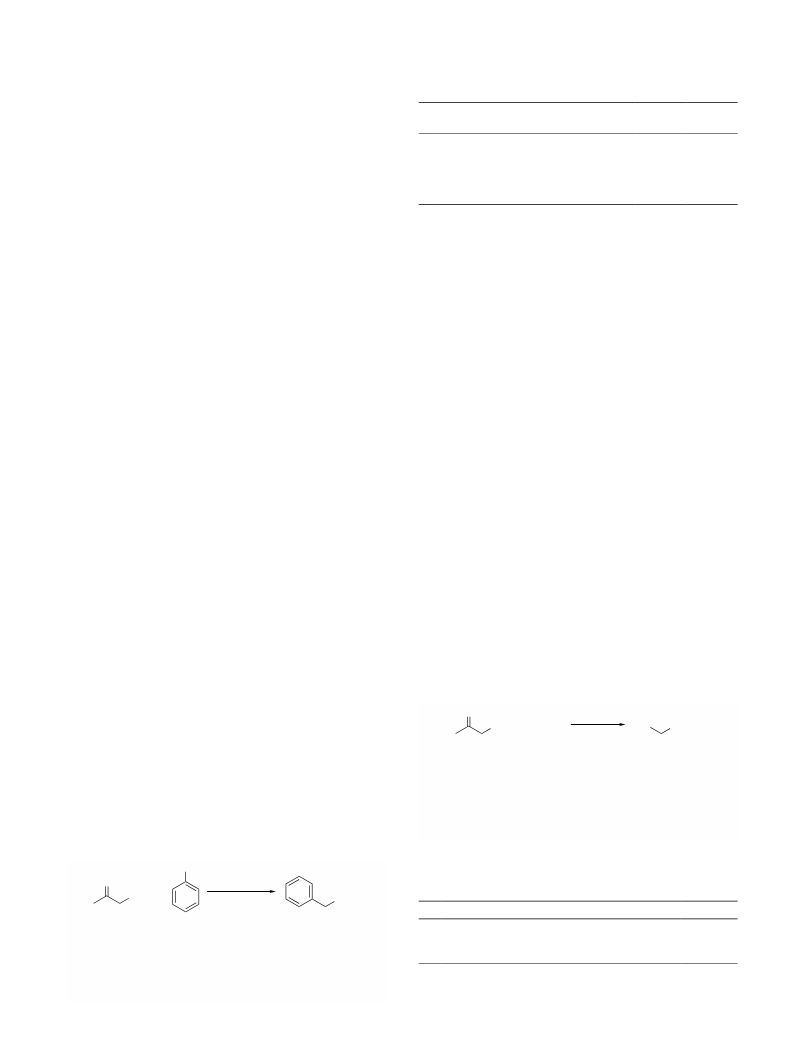
In conclusion, this work constitutes the first example of
a palladium-catalysed intermolecular arylation of an
acetoacetate ester. We have demonstrated the formation
of the arylated acetoacetate ester (e.g., 8) and its in situ
base catalysed de-acylation to an arylacetate ester (e.g.,
3b). A variety of mono-arylated acetate esters can be
prepared in this manner and the reaction is applicable to
both aryl bromides and chlorides.
6. Ugo, R.; Nardi, P.; Psaro, R.; Roberto, D. Gazz. Chim.
Ital. 1992, 122, 511.
7. Culkin, D. A.; Hartwig, J. F. Acc. Chem. Res. 2003, 36,
234.
8. Hurtley, W. R. H. J. Chem. Soc. 1929, 1870.
9. (a) Bruggink, A.; McKillop, A. Tetrahedron 1975, 31,
2607; (b) McKillop, A.; Rao, D. P. Synthesis 1977, 759.
10. Pinhey, J. T.; Rowe, B. A. Aust. J. Chem. 1980, 33, 113.
11. Acetoacetate esters are known to be de-acylated under
strong alkaline conditions: Adams, R.; Blomstrom, D. C.
J. Am. Chem. Soc. 1953, 75, 3403, and; Kaupp, G.;
Freytler, B.; Behmann, B. Synthesis 1985, 5, 555.
12. (a) Shaughnessy, K. H.; Hamann, B. C.; Hartwig, J. F. J.
Org. Chem. 1998, 63, 6546; (b) Gaertzen, O.; Buchwald, S.
L. J. Org. Chem. 2002, 67, 465; (c) Klapars, A.; Huang, X.;
Buchwald, S. L. J. Am. Chem. Soc. 2002, 124, 7421.
References and notes
1. Lednicer, D.; Mitscher, L. A. In The Organic Chemistry of
Drug Synthesis; John Wiley: New York, 1980; Vol. 2, p 62.
2. Pinhey, J. T.; Rowe, B. A. Tetrahedron Lett. 1980, 21, 965.